
Last updated: October 2026
Here is the short version most applicants take years to learn: the University of Oxford awards more than 200 new fully funded Clarendon Scholarships every year, and there is no separate application for any of them. Apply to your chosen Master's or DPhil course by its December 2026 or January 2027 deadline, and you are automatically considered. The award covers all course fees for every recipient regardless of nationality, plus an annual living grant. If Oxford is on your list for 2027 entry, the Clarendon is the single largest pool of full funding you can enter without filling in a single extra form.
What the Clarendon Scholarship actually covers
The Clarendon Fund, Oxford's flagship graduate scholarship scheme, publishes its offer in unusually plain terms. Here is the full breakdown:
| Funding component | What you get |
|---|---|
| Course fees | 100% covered for the full length of your course — for Home and Overseas fee status students alike |
| Living grant | Annual stipend of at least the UKRI minimum doctoral rate — at least £18,622 in 2023–24, rising with the national rate |
| Duration | Your full period of fee liability — typically 2 years for a research Master's, 3–4 years for a DPhil |
| Eligibility | No restrictions on nationality, country of residence, or field of study |
| Courses included | Every full-time and part-time Master's and DPhil course that leads to a degree |
Two details are worth dwelling on. First, the fees element is not a discount or a partial waiver — overseas fees at Oxford for taught Master's courses commonly run between £30,000 and £50,000 per year depending on the programme, and the Clarendon removes that entire line from your budget. Second, the living grant is pegged to the UKRI minimum doctoral stipend, which is reviewed upward most years; the £18,622 figure is the official example for 2023–24, and the fund's page for applicants carries the current number at the time you apply (linked in our sources below).
The scheme celebrated its 25th intake in 2025–26, which makes the 2027–28 cohort roughly the 27th in its history — a track record that matters for a practical reason: the process is mature, well-documented, and free of the surprises younger scholarship programmes suffer from.
Source: Wikimedia Commons — photo by Diliff, CC BY-SA 3.0

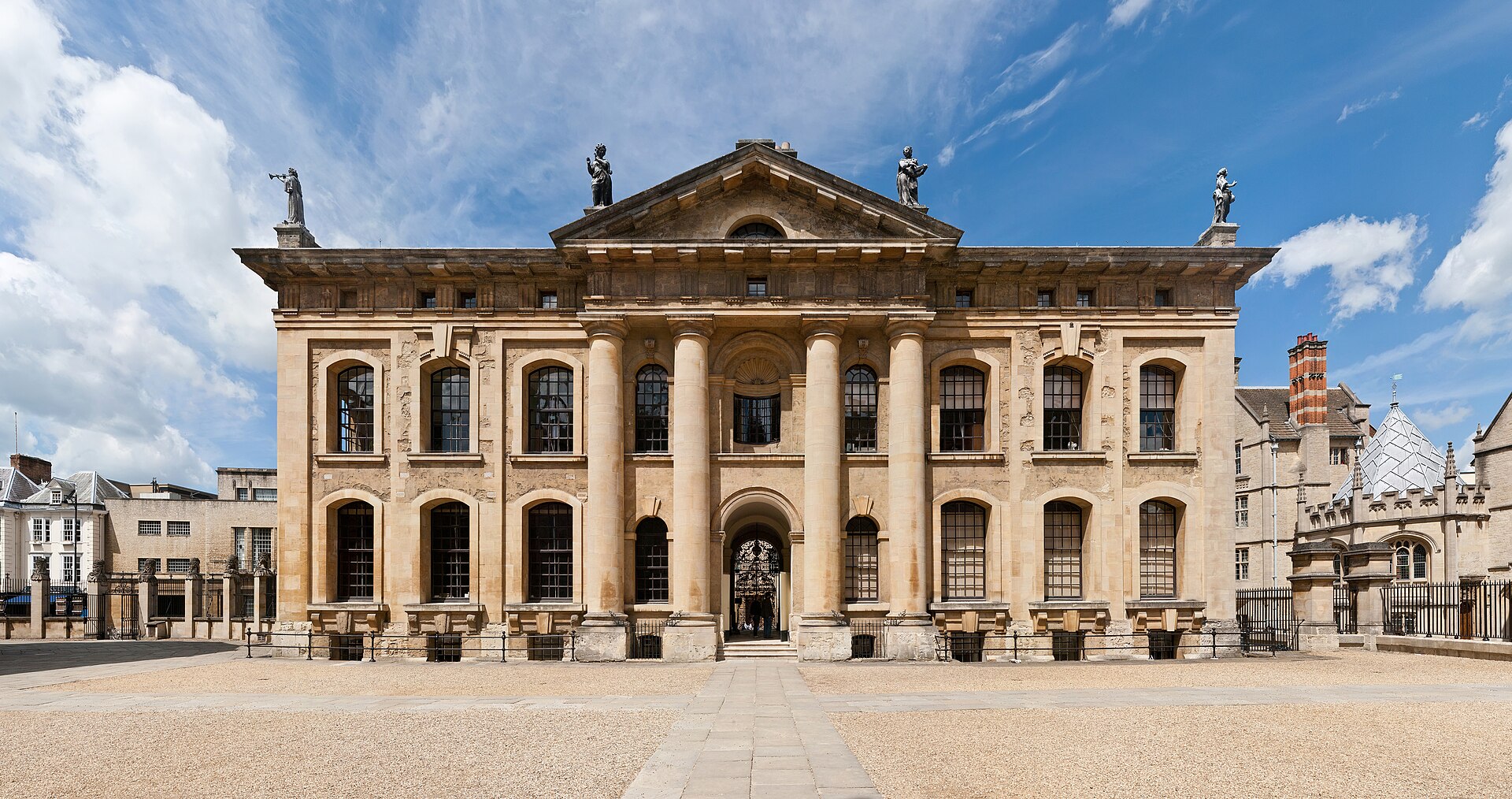
The name itself is a piece of university history worth knowing before an interview. The fund is closely tied to Oxford University Press and honours the Earl of Clarendon, Edward Hyde — Oxford's Chancellor from 1660 to 1667 — who bequeathed the royalties of his history of the English Civil War to the University. Those royalties paid for the construction of the Clarendon Building between 1711 and 1715, designed by Nicholas Hawksmoor. The building still stands on Broad Street as one of Oxford's landmarks, and the scholarship fund that carries the same name now finances graduate researchers instead of brickwork.
The one rule that decides everything: the December or January deadline
Clarendon consideration is attached to your course application, not to a scholarship portal. The official instruction reads: apply to your course by the December or January deadline, whichever is relevant to your course. Every Oxford course page lists its own standard deadline in the graduate course guide, and courses genuinely differ — some close in early December, most research programmes in early or mid-January.
That single rule has three practical consequences:
- Spring deadlines are too late for funding. If a course stays open into spring, applications submitted after the December/January gathering-field lose automatic Clarendon consideration. Check the deadline before you fall in love with a course, not after.
- There is nothing extra to submit. No scholarship essay, no separate form, no additional references. Your course application — personal statement, transcripts, three references, and a research proposal for doctoral courses — is the entire Clarendon file.
- Start six weeks before the deadline at minimum. A competitive Oxford graduate file takes longer to assemble than most applicants expect, particularly the research proposal and reference letters.
If you are comparing Oxford's funding routes, our analysis of the Rhodes Scholarship at Oxford 2027 — funding, eligibility and choosing your route explains how a constituency-based award differs from a course-linked one, and our detailed Rhodes application walkthrough shows the preparation rhythm that works for both.
Who gets nominated, and who decides
Selection is entirely academic and happens in two stages. First, the department you applied to assesses your application for admission and, in parallel, its academics identify the strongest candidates to nominate for a Clarendon under the fund's published criteria. Second, nominations go up to the academic division — Sciences, Humanities, Social Sciences, or Mathematical, Physical and Life Sciences — where specialists in your own field make the final calls.
The two published criteria are academic excellence and academic potential. Not leadership portfolios, not community service hours, not a hardship narrative — the Clarendon is decided by academics judging academic trajectory: the strength of your transcript, the quality and feasibility of your research proposal, any scholarly output you already have, and your referees' specific evidence that you can thrive in a demanding programme.
This is why your academic file deserves most of your preparation hours. Sense-check where you stand using a free GPA calculator across the US, UK and German grading systems, and benchmark the institutions you are targeting against the global university rankings before committing application fees anywhere.
The full timeline from application to answer
The fund publishes a clear annual cycle. For 2027–28 entry, expect it to run as follows:
| Stage | Timing | What happens |
|---|---|---|
| Applications open | Early September 2026 | Course applications for 2027–28 entry go live on Oxford's portal |
| Funding deadline | December 2026 or January 2027 | The course deadline that secures automatic Clarendon consideration |
| Department decisions | February – March 2027 | Academic admission decisions and Clarendon nominations proceed in parallel |
| Initial offers | By end of April 2027 | Most successful candidates receive an initial offer (known as a CB1) |
| Funding packages | May – summer 2027 | Final packages are assembled, including matching Partnership Awards |
| Cut-off point | Mid-June 2027 | No email by then means the application was unsuccessful this cycle |
The fund is explicit that it does not send individual rejection letters, given the volume of eligible applicants. Silence after mid-June is the answer — which sounds harsh, but also means you can plan alternatives without waiting indefinitely. A strong strategy is to run two or three funding applications in parallel: the Clarendon costs you nothing extra, while dedicated programmes require separate files. Two good companions to track are our updated list of fully funded scholarships open now for fall 2026, sorted by deadline and the October–November 2026 closing deadlines list, headed by Gates Cambridge's 14 October round.
Source: Wikimedia Commons — photo by Julian Herzog, CC BY 4.0

What this means for international applicants
For students from Nigeria, India, Pakistan, Indonesia, Vietnam, Brazil, Egypt or anywhere outside the UK and EU, three features of the Clarendon matter disproportionately. First, the absence of nationality or residence restrictions puts every applicant in the same academic competition — the division's specialists judge the file, not the passport. Second, full overseas fee coverage removes the single largest barrier to British postgraduate study, since international fees are the line item that makes UK study impossible for most self-funded students from emerging markets. Third, the award is renewable for the full fee liability period, so a DPhil offer effectively means four funded years without reapplying.
Beyond money, the Clarendon is deliberately built as a community. Scholars join the Clarendon Scholars' Association, elect a Scholars' Council, meet at the fund's annual reception in the Weston Library, and appear in the publicly published class lists. For early-career researchers, that network — hundreds of active graduate scholars across every discipline — is often worth as much as the stipend itself: it is where collaborations, second supervisors' introductions and postdoc references come from.
Source: Graduate Study at Oxford on YouTube
Frequently asked questions about the Clarendon Scholarship
Do I need a separate Clarendon application?
No. Every applicant to a degree-bearing Master's or DPhil course who applies by their course's December or January deadline is automatically considered. There is no scholarship form, no extra essay and no additional documents — your course application is your Clarendon application.
What is the exact deadline for 2027–28 Clarendon consideration?
There is no single scholarship deadline. Each course sets its own December 2026 or January 2027 closing date, published at the top of its page in Oxford's official graduate course guide. Find your course first, then read its deadline — that date is your Clarendon deadline.
Who is eligible for the Clarendon Scholarship?
Any applicant to a new Master's or DPhil course at Oxford, of any nationality, from any country of residence, in any field of study, studying full-time or part-time. There are no age limits or regional quotas, and funding terms are identical for Home and Overseas fee status students.
How many Clarendon Scholarships are awarded each year?
More than 200 new fully funded scholarships are awarded annually. Each covers all course fees for the duration of the course plus an annual living grant of at least the UKRI minimum doctoral stipend rate — officially at least £18,622 in the 2023–24 academic year, adjusted upward as the national rate rises.
When will I hear the result?
Most initial offers go out by the end of April in your application year, and full funding packages are confirmed through the summer. The fund does not send individual rejections, so if nothing arrives by mid-June, treat the cycle as closed and plan your next application — many scholars succeed on a second attempt with a stronger proposal.
How do I maximise my chances?
Focus on what the selectors actually score: academic excellence and research potential. That means a transcript that shows trajectory, a research proposal that reads like the first pages of a real project, a personal statement with academic specificity rather than generic ambition, and referees who can cite your work in detail. Give yourself at least six weeks before the deadline — a coherent file beats a rushed one even when the rushed one has better grades.
Your next step this week
Choose one or two Oxford courses that genuinely fit your research interests, confirm their December or January deadlines in the course guide, and build a six-week plan backwards from the earlier date: proposal and statement in the first two weeks, reference requests immediately after, and a full week for final review. To weigh Oxford against every other funded option you could pursue this season, browse the Truescho opportunities platform with its smart filters, or hand your file to the Apply-For-Me service for expert review at every step.
Sources
- Official Clarendon Scholarships page — University of Oxford — scheme overview, annual numbers and funding facts
- Clarendon information for full-time applicants — award value and automatic-consideration rule
- Official Clarendon application timeline — offer seasons and the mid-June cut-off
- History of the Clarendon Fund — the Earl of Clarendon and the Clarendon Building
- Video: Clarendon Scholarships — Graduate Study at Oxford — the official explainer