
ChatGPT Sponsored Agents: How OpenAI's New Ads Work (2026 Guide)
Last updated: September 2026
On September 16, 2026, OpenAI moved ChatGPT advertising from static placements into full conversations. The company announced Sponsored Agents — clearly labeled, business-funded chat agents a user can start after clicking an ad inside ChatGPT — alongside natural-language campaign creation in ChatGPT Work, an AI creative assistant inside Ads Manager, and first-ever integrations with HubSpot and Shopify. The Shopify app goes international on September 23, 2026, making this the closest thing to a global launch date the platform has offered so far. This guide breaks down exactly what shipped, what it means for users and advertisers worldwide, and where the honest limits still are.
A merchant in Lagos, a marketer in Manila, and an agency owner in São Paulo have all been watching this story unfold. Our earlier coverage tracked how ChatGPT ads crossed $1 billion in run rate in under 200 days and then reached 31 European markets. The question has now changed shape: this is no longer "should I care about ads inside a chatbot?" but "how fast can my product catalog be ready for a channel where the ad itself answers questions?" Here is everything the official announcement actually says — and the parts between the lines that matter for anyone outside the US.
What OpenAI actually announced
The official post, titled "Reimagining advertising with AI," bundles four separate launches rather than one feature:
- Sponsored Agents — being tested with select advertisers in the United States right now.
- AI-powered ad creation — campaigns built and analyzed through natural-language prompts in ChatGPT Work via the Ads Manager plugin, plus suggested copy and imagery inside Ads Manager itself.
- Opt-in AI text customization — headlines and descriptions adapted to the context of a conversation, with automatic translation into the user's preferred language.
- HubSpot and Shopify integrations — the first CRM partner and the first ecommerce partner, respectively.
OpenAI also repeated its advertising principles verbatim, stating that "protecting the trust people place in ChatGPT remains our North Star." That sentence is doing real work: the company knows that a single quarter of feeling misled would damage the core product far more than any ad revenue is worth.

Source: OpenAI's official blog
How Sponsored Agents work, step by step
The mechanics are worth spelling out precisely, because they will reach international markets within months:
- You see a relevant ad inside ChatGPT — say, a dining table, a SaaS subscription, or a course.
- You get the option to start a conversation with a business-sponsored agent, clearly labeled as funded by that company rather than presented as ChatGPT's own judgment.
- You ask what actually matters to you: does the table fit a 3-meter room? How many people does it seat? How do you care for the finish without scratching it?
- The agent answers with deep, product-specific knowledge and handles unlimited follow-up questions.
- When you're ready, you follow a direct link to the business's website to complete the purchase.
One structural detail OpenAI emphasized: the sponsored conversation is completely separate from ChatGPT's independent answers and from the original conversation you were having. Your earlier question about a cake recipe will not suddenly mix with a pitch for baking equipment. This strict separation is the platform's first line of defense — and understanding it tells you how OpenAI plans to scale ads without hollowing out trust.
What this means for you: three situations
If you're an everyday ChatGPT user
Short term, nothing changes and nothing should worry you. Sponsored Agents are in testing with select US advertisers only, and your market is not in the announced expansion yet. When it arrives, the shift you'll notice is that an ad is no longer a banner that interrupts you but an optional counterpart that answers questions. The key fact to remember: entering a sponsored conversation is your choice — it begins only when you decide to click.
If you run an online store outside the US
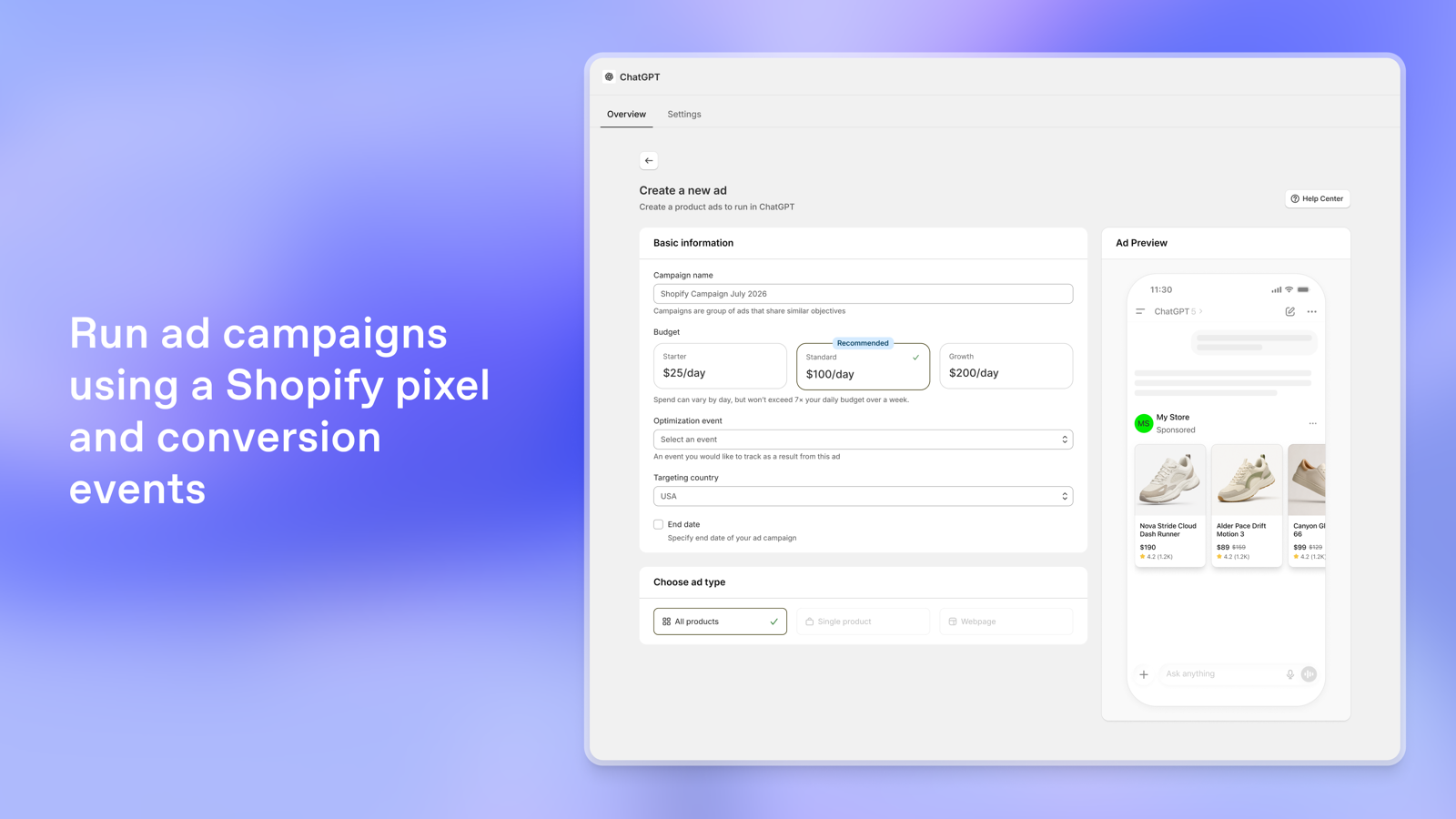
This is the single most important line in the whole announcement for you: the ChatGPT Ads app on Shopify is live for US merchants now, and becomes available internationally in every market where ChatGPT Ads operate, starting September 23, 2026. Products sync automatically through Shopify Catalog, so campaign setup becomes a matter of minutes rather than a data project. A merchant in Nigeria, Pakistan, or Vietnam selling globally can treat September 23 as the realistic entry point — and start enriching product pages with dimensions, specifications, and FAQs today, because that is exactly the material a Sponsored Agent will draw on when customers start asking.
Source: ChatGPT Ads on the Shopify App Store
If you manage customer relationships in HubSpot
The new connection lets a business link a ChatGPT Ads account to HubSpot, then create ads, track performance, and follow up on leads inside HubSpot with its own contextual data. For marketing teams, the significance is operational: the new ad channel came to the tools they already live in, rather than demanding another dashboard to babysit.
The new advertiser toolset: writing ads becomes a dialogue
Beyond the headline feature, three quieter tools may matter more to daily marketing work:
- The Ads Manager plugin in ChatGPT Work: type "turn my product pages into a back-to-school campaign" in plain language, and the system creates the campaign, updates it, and analyzes performance conversationally.
- The creative assistant inside Ads Manager: it proposes copy and imagery based on your landing page and campaign objective — and the advertiser reviews, edits, and approves before anything goes live.
- AI text customization (opt-in): adapts your existing headlines and descriptions to the context of each conversation, and automatically translates your ad copy into the user's preferred language. For anyone selling across multilingual markets, this alone replaces a translation workflow.
For a small business owner in emerging markets, these tools collapse creative production costs to a fraction of agency pricing — while keeping a human decision gate at every step, which is exactly where it belongs.
Quick comparison: ChatGPT ads before and after September 16
| Aspect | Before the announcement | After the announcement |
|---|---|---|
| Ad format | Text/visual placements inside chat | Placement + optional conversation with a sponsored agent |
| Campaign creation | Traditional Ads Manager flows | Natural-language prompts in ChatGPT Work + creative assistant |
| Ad copy | Fixed for all users | Optional contextual adaptation + automatic translation |
| Tooling integrations | None | HubSpot (CRM) and Shopify (ecommerce) |
| Markets | US + 31 announced European markets | Same + Shopify app international rollout from September 23 |
The timeline: how we got here in one year
Reading the announcement in isolation makes it look like a sudden leap. The trajectory was visible for months, and it explains the timing:
- Initial US testing, when limited in-chat placements first measured whether users tolerate advertising at all.
- Crossing $1 billion in ad run rate in under 200 days — the number that proved audience tolerance at scale.
- Expansion to 31 European markets, the sternest regulatory test imaginable for ad acceptance — and its success logically unlocked whatever came next.
- September 16, 2026: the conversational layer — Sponsored Agents, dialogue-based creative tools, and the HubSpot/Shopify integrations.
- September 23, 2026: the announced date for the Shopify app's international availability in all live markets.
Read between the lines and a single question drove every step: "do users still trust the product?" Each time the answer held, OpenAI added a deeper commercial layer. Sponsored Agents are the boldest layer yet — the first time a sales conversation enters the product itself.
Why conversation ads matter more than banner ads
The difference between a placement and a conversation ad is the difference between interruption and intent. A banner intercepts someone who was doing something else; a conversation ad appears for someone who was already asking purchase-shaped questions. When a user asks ChatGPT for "the best dining table for six people," they are closer to a buying decision than almost any social media scroller, and a Sponsored Agent answering follow-up questions enters at precisely that peak-intent moment.
This is why the next essential marketing skill is answering detailed product questions well. Your ad is no longer what you claim about yourself — it is how completely your agent answers a stranger's questions. The merchant with richer structured product data (dimensions, materials, warranties, FAQs) will field a smarter agent than a competitor with triple the budget and thinner data.
Honest limitations to know before getting excited
- Sponsored Agents are in testing with select US advertisers only — no European or emerging markets are included in this specific feature yet.
- A sponsored agent conversation is not neutral advice: the agent represents its sponsor by design, however clear the labeling. Big purchases still deserve independent research afterward.
- The dialogue-based campaign tools are tied to ChatGPT Work, the professional tier — not the free consumer plan.
- Full per-market pricing details have not been published for the new formats; prudent advertisers start with small test budgets rather than betting a quarter on an unproven channel.
- Human review of AI-suggested copy and imagery remains effectively mandatory — skipping it risks your brand voice drifting into generic machine prose.
A practical 4-step preparation plan
- Audit your product pages: rich specifications, dimensions, and FAQ sections are the raw material a Sponsored Agent learns from — improve them now, before the channel reaches your market.
- Prepare ad copy in at least two languages: automatic translation is strong, but a well-written original per market still outperforms a translated one.
- Get comfortable in ChatGPT Work if you already subscribe: building campaigns conversationally today shortens your learning curve dramatically for tomorrow.
- Circle September 23 on your calendar: the Shopify app's international date is the most realistic entry point for merchants outside the US — and we will cover the rollout details as they land.
And if you're building the broader skill set this shift rewards — marketing, ecommerce, and AI fluency together — Truescho's opportunities platform curates scholarships and programs that support exactly that career path, while our GPT-6 Astra launch guide explains the model underneath this entire advertising ecosystem.
FAQ about ChatGPT's new ads
What are Sponsored Agents in ChatGPT?
Sponsored Agents are a feature in testing that lets a user start a clearly labeled conversation with a business-funded agent after clicking an ad in ChatGPT. The agent answers detailed product questions and links to the sponsor's website. The conversation is separate from ChatGPT's independent answers and from your original chat.
Are ChatGPT ads available outside the US?
ChatGPT ads run in the United States and were announced for 31 European markets, while Sponsored Agents specifically are being tested with select US advertisers only. No regional launch dates beyond these have been announced, and the Shopify ads app becomes available internationally in live markets starting September 23, 2026.
How do I avoid ads in ChatGPT?
Entering a sponsored conversation is optional and begins only with your click on an ad, so simply not engaging keeps your experience ad-conversation-free. Placements themselves follow your account's market and the platform's policies, and OpenAI continues expanding user controls as availability grows.
How much does advertising on ChatGPT cost?
OpenAI has not published unified public pricing for the new formats, and live markets use an auction model where costs depend on your targeting and competitor bids. The practical approach experienced marketers recommend is a small test budget, careful measurement, and scaling only after unit economics prove out.
How is a Sponsored Agent answer different from a normal ChatGPT answer?
A normal ChatGPT answer is independent and drawn from general knowledge without commercial bias, while a sponsored agent represents its sponsoring company with detailed product knowledge and clear labeling. Use the first for neutral guidance and the second for deep questions about a product you're genuinely considering.
Your next move
Mark two dates: September 23 for the Shopify app's international rollout, and the current quarter's end as a reasonable window for Sponsored Agents to expand beyond US testing. Between them, spend two focused hours a week on one task — making your product pages answer questions better than your competitors' pages do. The coming competition is over the quality of answers before the size of budgets. Follow our coverage for the rollout details, and let Truescho support the skills side: one platform for scholarships, study tools, and career resources as this shift lands.
Sources
- OpenAI's official announcement: Reimagining advertising with AI — the complete launch post
- ChatGPT Ads app on the Shopify App Store — official listing and international availability date
- Our previous coverage: ChatGPT ads cross $1B run rate — the financial context
- ChatGPT ads reaching 31 European markets — the prior expansion map