

Article 2 ===
ChatGPT Now Connects to Epic Health Records: What OpenAI's New EHR Integration Actually Does
Last updated: September 2, 2026.
Picture a clinician starting a morning clinic: thirty patients on the schedule, each with a chart holding years of notes, lab results, medications adjusted by different specialists, and referral letters. Until September 1, 2026, pulling that context together before every visit meant dozens of clicks inside the electronic health record. On that day OpenAI announced an integration that brings authorized patient context from Epic — the largest EHR provider in the United States — directly into ChatGPT for Healthcare, alongside a new plugin connecting nine official public healthcare databases. Whether you work in a hospital, run digital transformation for a health system, or simply follow medical AI, here is exactly what launched, straight from the official announcement.
What OpenAI announced, precisely
The official post, titled "Healthcare organizations can now connect EHR and additional industry data to ChatGPT," has two main components. First, an EHR integration that brings authorized patient context from Epic environments into ChatGPT for Healthcare. Second, the Healthcare Public Data plugin, providing direct, structured access to official datasets including PubMed, DailyMed, CMS Coverage, RxNorm, and ClinicalTrials.gov — nine official sources in total.
The stated goal: instead of searching across appointment notes, laboratory results, medications, and specialist documentation separately, clinical teams ask questions in natural language, and ChatGPT assembles relevant information from the authorized record, summarizes important developments, and points back to the supporting chart information.
How the integration works inside ChatGPT
The announcement describes two complementary experiences. "EHR context in ChatGPT" brings authorized patient information from a supported EHR into the chat to review patient history, identify changes, and prepare for appointments. "ChatGPT in the EHR workflow" goes the other way: in supported deployments, ChatGPT can be embedded directly into the EHR layout so AI-assisted work happens without leaving the patient chart.
OpenAI listed four example questions verbatim: What has changed since this patient's last visit? Which recent lab results should I review before today's appointment? Have there been medication changes or new specialist recommendations? And what follow-ups, referrals, or unresolved issues should I be aware of?
Notably, TechCrunch's launch coverage clarified that the integration provides read-only access to health records — the model assembles and analyzes but does not write into the chart, a crucial distinction for health-data governance.
Nine official data sources in one plugin
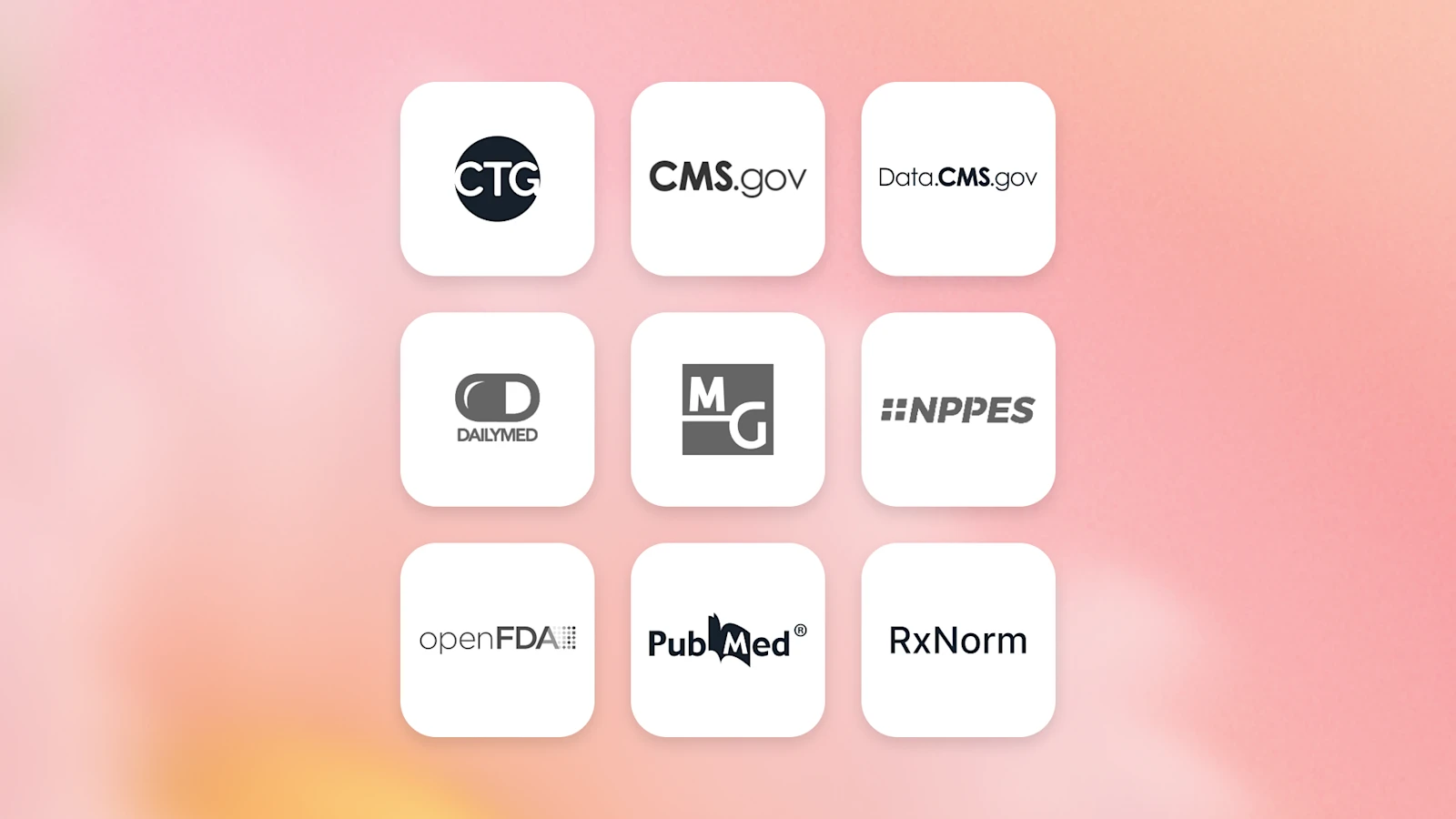
Source: OpenAI's official announcement
The plugin is more than a web search. Each of the nine sources has a dedicated connector, letting teams work with specific records, fields, identifiers, and versions. OpenAI's own examples: a research team could use ClinicalTrials.gov to identify actively recruiting trials and compare eligibility criteria; a pharmacy team could confirm the latest label and warnings for a medication through DailyMed; a population-health team could pull research, active trials, and Medicare coverage information into one source-backed view.
What the physician evaluations say
The announcement includes concrete evaluation numbers. OpenAI partners with hundreds of physicians across 60 countries, 49 languages, and 26 medical specialties; together they have reviewed more than 700,000 model responses. Specifically for connected EHR context, physicians evaluated responses across 27 clinical use cases — including pre-visit review, clinical timelines, medication review, and handoff summaries. Across 4,363 ratings, 99.1% of responses were rated safe across all use cases. In a separate two-round evaluation on nuanced clinical questions built from large US healthcare datasets, more than 93% of responses were rated "good" or better in accuracy for each of the five connected sources tested.
These are internal human evaluations, not peer-reviewed clinical trials — but they are exactly the kind of evidence compliance officers look for when assessing a medical AI tool.
Who can use it today
Precision matters here because access is tiered. ChatGPT for Healthcare customers ask their workspace administrator to enable the EHR integration and the Healthcare Public Data plugin. ChatGPT Enterprise customers contact their OpenAI account team to confirm eligibility and the right configuration for a Regulated Workspace. Individual clinicians: only eligible US users of ChatGPT for Clinicians can install the Healthcare Public Data plugin, and the EHR integration is explicitly not available for individual accounts.
The launch partner list reads like a who's-who of American medicine: AdventHealth, Baylor Scott & White Health, Boston Children's Hospital, Cedars-Sinai, HCA Healthcare, Memorial Sloan Kettering Cancer Center, and UCSF.
Source: OpenAI's official announcement
Governance and privacy: why this is different from pasting a chart into a chatbot
This is the first question any compliance officer asks, and the announcement answers it specifically. Data lives inside a governed workspace with enterprise controls: role-based access, single sign-on, and audit logs. With an applicable Business Associate Agreement in place, customers can use ChatGPT Work, Codex, apps, and plugins in the same workspace to support HIPAA-compliant workflows. The essential difference from consumer usage: clinical context stays inside a defined regulatory frame instead of an open environment.
Why this matters beyond the United States
Even if the integration is not available in your country's hospitals today, the story deserves attention for three reasons. First, Epic sets patterns that international EHR ecosystems follow, so what is being built now will arrive in other markets through future update cycles. Second, the design lesson is immediately transferable: separating "read" from "write" access to the record, and tying every summary back to its chart source, is a governance model any digital-health team can adopt in vendor discussions. Third, if you evaluate AI tools for a health organization, the evaluation pattern published here — safety rates across named use cases, accuracy per data source — is precisely what you should demand from any supplier.
For wider context on OpenAI's commercial trajectory, this announcement landed on a busy day for the company; we also covered ChatGPT ads passing a billion-dollar annual run rate and the strategic debate analyzed in OpenAI's stated vision for the intelligence age.
Quick comparison: before and after the integration
| Task | Traditional EHR workflow | With the Epic integration |
|---|---|---|
| Pre-visit preparation | Dozens of screens opened manually | One question summarizes changes since the last visit |
| Medication review | Manual comparison across visits | Automatic extraction with pointers to chart sources |
| Checking an official drug label | Searches across separate sites | DailyMed connector inside the conversation |
| Trial eligibility criteria | Reading long documents | Structured comparison via ClinicalTrials.gov |
| Feedback and measurement | No standardized measure | 27 use cases and 4,363 published ratings |
| Writing to the chart | Fully manual | Not available — the integration is read-only |
Honest limitations you should not ignore
The integration is read-only and does not write to medical records — which is a governance decision, not a missing feature. The announcement does not claim that ChatGPT diagnoses or treats; its stated role is assembling context, summarizing, and preparing work for human review. Access is institutional: individual clinicians outside the United States cannot enable the public-data plugin, and the EHR integration is unavailable to individual accounts entirely. The evaluation figures, while substantial, are internal numbers from OpenAI and its physician partners rather than independent peer review. And the announcement publishes no pricing for ChatGPT for Healthcare licensing; cost is handled through the sales team.
Frequently asked questions
Can ChatGPT now edit a patient's medical record?
No. The announced integration is read-only: it gathers authorized information, summarizes it, and cites the chart source, while writing stays with the clinical staff.
Is the integration available to hospitals outside the United States?
The announcement describes institutional paths for ChatGPT for Healthcare and Enterprise customers without publishing a country list, while eligible individual clinicians are US-only for the plugin.
Is patient data protected under HIPAA?
Yes, per the announcement: inside the governed workspace and with an applicable BAA, alongside role-based access, SSO, and audit logs.
Which official medical sources are connected?
Nine sources through the Healthcare Public Data plugin, including PubMed, DailyMed, RxNorm, ClinicalTrials.gov, and CMS Coverage.
Should clinicians outside the US follow this at all?
Yes — the read/write separation and source-cited summaries define a governance pattern that international health systems will likely demand from their own AI vendors, and eligibility may expand as the rollout proceeds.