
Best US Business Bank Account for Non-Residents in 2026: The Honest Round-Up
The best US business bank account for non-residents in 2026 is not a bank at all — it is a fintech platform paired with a chartered partner bank, opened remotely with your passport, your LLC formation documents, and your EIN letter. That sentence upsets people who want a single winner, but the honest answer is that the right choice depends on one filter most round-ups skip: which provider will actually approve a founder who lives in your country. This guide compares the platforms that openly serve non-US-resident owners — Mercury, Airwallex, Wise, Relay, and Payoneer — using only their official published terms.
The question behind dozens of search phrasings — can a non-US citizen open a business bank account, easiest bank for a business account, which bank accepts non-residents without SSN — has the same root answer: yes, through a US entity plus an EIN, and the differences between providers are in fees, address rules, and country restrictions. Here is the full comparison.
The 2026 Comparison Table
| Provider | Accepts non-resident owners? | Monthly fee | EIN required? | US address required? | Official highlight |
|---|---|---|---|---|---|
| Mercury | Yes — "U.S. companies founded by people across the globe" | $0, no minimums | Yes, plus formation docs and ID for 25%+ owners | No — US or international business address; registered agent / PO box / UPS addresses rejected | Partner banks Choice Financial Group and Column N.A.; FDIC pass-through up to $5M via sweep |
| Airwallex | Yes, for companies registered in its supported jurisdictions | $0 (Explore plan); $12/user (Grow) | For US entities, standard KYC on registration documents | No published US-address requirement | Multi-currency Global Accounts; interbank FX; free batch transfers to 120+ countries |
| Wise Business | Yes — built for cross-border businesses | $0, no subscriptions | For US-entity account details, yes | Not published as a hard requirement | Wires from $1.13; receive in 22 currencies; domestic wire receive $6.11 |
| Relay | Focuses on US businesses; non-resident owner eligibility not published | $0 hidden fees; tiered plans | Yes for US entities | Not published | Up to 20 checking accounts; Thread Bank; FDIC sweep to $3M |
| Payoneer | Yes — designed for international sellers | Varies by plan | Receiving accounts do not require a US entity | No | USD receiving accounts for marketplace and client payments |
Read the table with one rule in mind: eligibility text changes quietly. Providers update restricted-country lists and address rules without announcements. Before applying, open the provider's own help center and read the current eligibility page — the rows above link each claim to its official source in the Sources section.
Mercury: The Default Starting Point
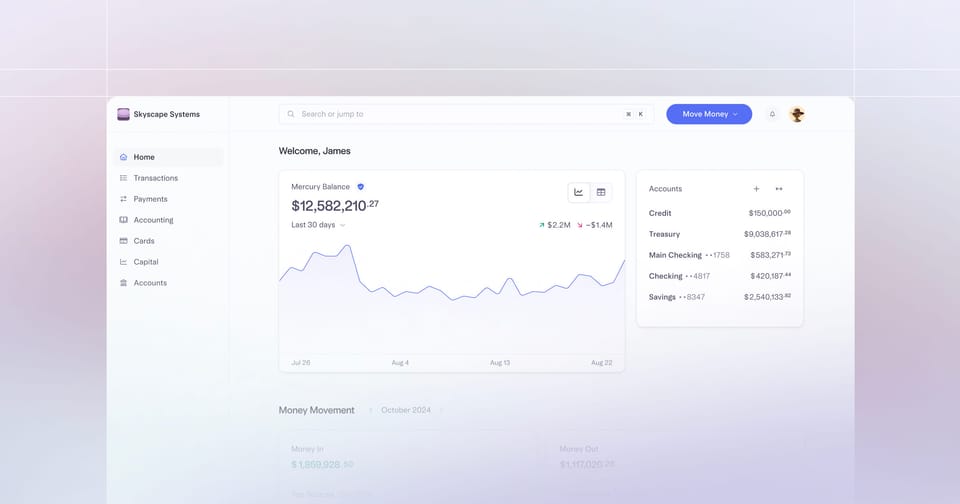
Mercury has become the first attempt for most non-resident founders, and its official eligibility page is unusually direct about who it serves: companies formed and registered in the United States, with existing or planned US operations — and founders who can live anywhere outside its restricted-countries list. The documentation set is fixed: official formation documents, the IRS-issued EIN document, and government ID for every person with operating control and every owner holding 25% or more.
The address rule is where good applications die. Mercury requires a principal place of business that is a US or international address, and explicitly not a registered agent address, PO box, or UPS box. Founders who used their agent's address everywhere during formation often paste it into the banking application too — that mismatch is a common, avoidable rejection.
Pricing is the easy part: $0 per month, free checking and savings accounts, zero minimums. Mercury is a fintech, not a bank; deposit insurance comes through partner banks Choice Financial Group and Column N.A., with access to up to $5M FDIC coverage through sweep networks. Mercury also markets cards and credit products to eligible customers — treat any borrowing feature carefully and read terms yourself; this guide covers payment infrastructure, not financing.
The official walkthrough below shows the real application flow, published on Mercury's own channel:
Source: Build with Mercury — official channel
For a single-product deep dive on Mercury — including the account-review triggers that close accounts — see our Mercury for non-US founders review.
Airwallex: The Multi-Currency Operator
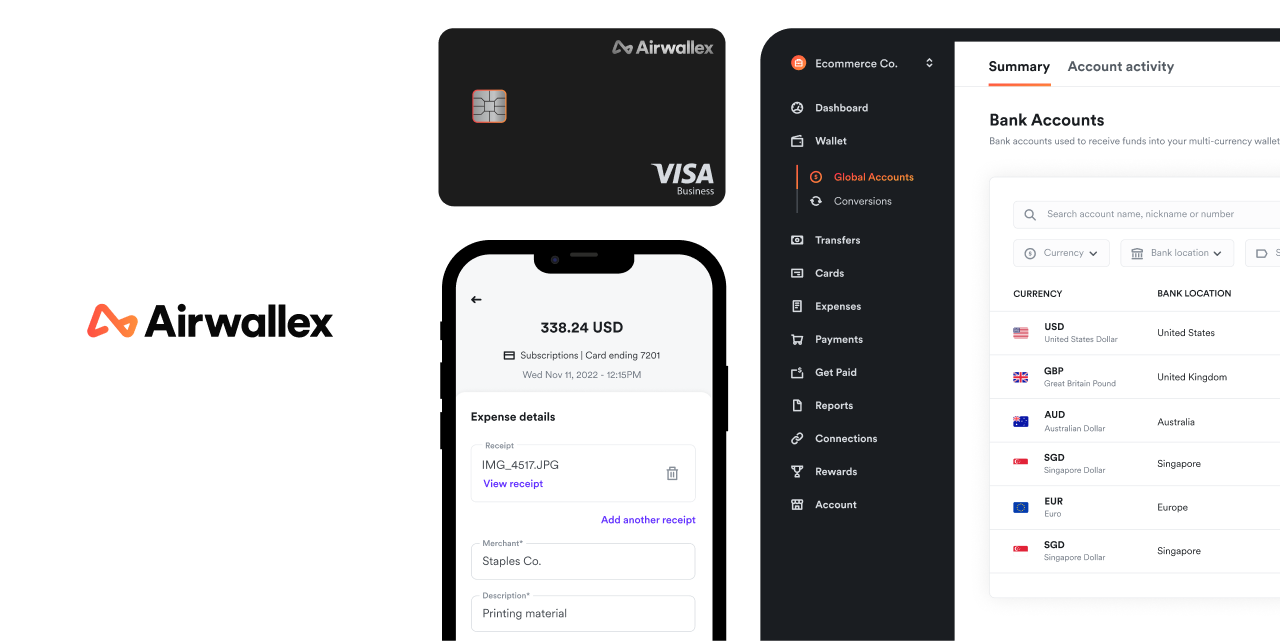
If your business earns and spends across several currencies rather than purely in USD, Airwallex deserves the first look. Its official pricing page lists the Explore plan at $0 per user per month including up to 10 Spend users, Grow at $12 per user per month, and custom-priced Accelerate for larger teams. Explore includes interbank FX rates and free batch transfers to 120+ countries, with cards carrying zero international fees.
The core product is the Global Account: local receiving details in multiple currencies under one login, so a US LLC can hold USD while also receiving EUR or GBP without converting on arrival. Airwallex is a payments platform rather than a chartered bank; eligibility runs through business registration in its supported jurisdictions with standard document verification. We use it ourselves for multi-currency flows, and you can open an Airwallex account here.
Source: Airwallex official site
For head-to-head cost comparisons against Payoneer and Wise, read Airwallex vs Wise vs Payoneer and Payoneer vs Airwallex.
💬 Disclosure: Some links in this article are affiliate links. We may earn a small commission when you complete a purchase at no extra cost to you. This helps us keep our content free, and it does not affect the integrity of our recommendations.
Wise Business: The Transfer Specialist
Wise is the cleanest answer when your priority is sending money out of the US cheaply rather than holding a full operating account. Official US terms: registration is free, with no subscriptions or monthly fees; international wires start from $1.13, versus $25+ at traditional banks; receiving a domestic wire costs a fixed $6.11; and you can receive payments in 22 currencies. Wise reports 96% of payments arriving within 24 hours as of Q3 2025, and volume discounts kick in above the equivalent of £20,000 in monthly volume.
The structural caveat matters: Wise US Inc. is a Money Service Business registered with FinCEN, not an FDIC-insured bank, with pass-through FDIC coverage of up to $250,000 on eligible funds through program banks. For many non-resident founders, Wise works best as the outbound-transfer layer beside a primary operating account elsewhere.
Relay: For US-Centered Teams
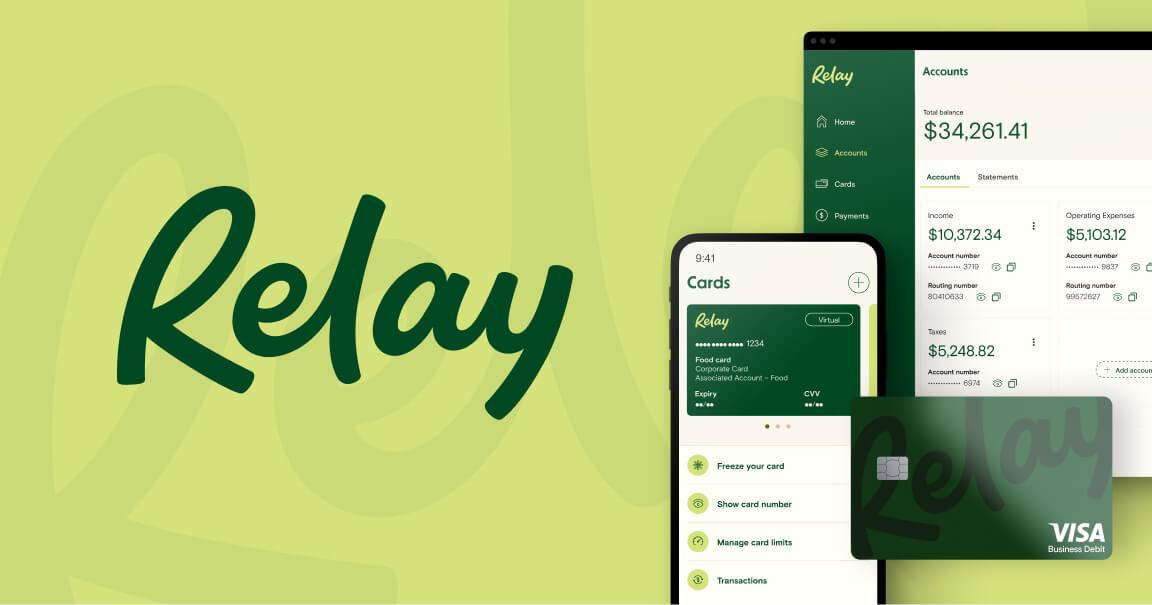
Relay's official pages emphasize $0 hidden fees, tiered plans (Starter, Grow, Scale), savings yields of 1.11% / 1.75% / 3.00% APY by tier as of May 2026, up to 20 business checking accounts, and banking through Thread Bank, Member FDIC, with deposit sweep coverage up to $3M. Applications are typically reviewed within 1–2 business days.
What Relay does not publish is clear non-resident-owner eligibility — its product is built around US businesses. If your ownership and operations are genuinely US-centered, it belongs on your shortlist; if you are a fully remote non-resident founder, treat it as a maybe and confirm before investing time in an application.
Source: Relay official site
Payoneer: The Marketplace Receiver
Payoneer occupies a different niche: receiving accounts that let international sellers collect USD from marketplaces and clients without a US entity at all. Its help center frames registration around receiving-account approval, with fees that vary by plan and payment flow. For Amazon-, Upwork-, and Fiverr-style revenue, Payoneer is often the simplest on-ramp; for a real operating account with routing numbers under your own US LLC, the platforms above fit better. Our Payoneer vs Airwallex comparison details the trade-offs.
Before Any Application: The EIN Bottleneck
Every US-entity account in the table sits behind one prerequisite: the EIN, obtained from the IRS via Form SS-4 — and for founders without an SSN, that means fax or mail rather than the online wizard. This is usually the slowest step in the whole US launch, and it is worth sequencing around: form the LLC, apply for the EIN immediately, and only then begin the banking application, because providers ask for the IRS-issued EIN document itself, not just the number. The formation guide's EIN section covers the SS-4 mechanics for owners without a US social security number.
While the EIN is in flight, use the time to prepare what the banks will actually scrutinize: a consistent business description, a real operating address, and clean formation documents that match your ID everywhere.
Red Flags That Get Non-Resident Applications Declined
Applications rarely fail on eligibility; they fail on consistency. Four patterns do most of the damage:
- Registered-agent addresses pasted into the address field. Mercury's rule is explicit — a US or international business address is fine, a registered agent, PO box, or UPS box is not. Founders who used the agent's address on their formation documents often reuse it automatically, and the mismatch reads as a shell company.
- Vague activity descriptions. "Consulting" with no website, no clients, and no explanation invites manual review. One honest paragraph about what the company sells and to whom prevents a week of back-and-forth.
- Undeclared co-owners. Every person holding 25% or more needs ID on file. Splitting ownership informally between friends and declaring only one owner is a compliance problem the platform will eventually discover.
- Residence in a restricted country. The lists are short but real, and they check residence, not citizenship. Check before applying rather than after.
Keeping the Account Alive After Approval
Approval is not the end of the story. Fintech business accounts run periodic KYC refreshes, react to sudden changes in transaction pattern, and quietly review whether the entity is still in good standing with its state. Three habits keep a non-resident-owned account healthy for years: file the state paperwork on time (a Delaware LLC that loses good standing over its $300 tax eventually surfaces in banking reviews), answer document requests within days, not weeks, and keep the money pattern explainable — a business that suddenly moves sums unrelated to its stated activity will trigger a review no matter where its owner lives.
The underlying theme connects back to the account's foundation: these platforms bank the entity, so the entity's health — franchise tax, Form 5472, registered agent — is part of your banking relationship, not separate from it. That is also why we treat the Delaware LLC recurring-cost guide and this article as one continuous topic.
How to Choose: Three Filters
Filter 1 — Can a non-US citizen open a business bank account? Yes — with a US entity and an EIN for US-account providers, or without a US entity for receiving-account providers like Payoneer. Your citizenship is not the blocker; your residence country can be, via each provider's restricted list. Mercury publishes its list in its help center; check yours before applying.
Filter 2 — What does an EIN actually unlock? The EIN is the tax ID your LLC obtains from the IRS (Form SS-4, no SSN required), and every US-entity account above asks for the IRS-issued EIN document during onboarding. Our US LLC formation guide covers obtaining it remotely.
Filter 3 — Where does the money actually flow? Pure USD in and out: Mercury. Multi-currency earning: Airwallex. Heavy international transfers out: Wise. Marketplace revenue first: Payoneer. Most non-resident founders end up with two providers, not one — an operating account plus a transfer layer — and that pairing usually beats forcing a single provider into both roles. One tactical note from hard experience: open the second account while the first one is still healthy, because applying from a frozen or closed account is dramatically harder than applying from an active one.
Choosing the entity before the bank? The decision matters as much as the provider: our US LLC vs UK Ltd comparison prices both structures over a full year, and the Delaware LLC cost guide covers the filing obligations that keep the account alive. The Truescho team maintains both alongside its business and residency resources.
A Note on Cards and Financing Features
Several platforms above market corporate cards alongside the account, and some advertise credit products — borrowing facilities, deferred payment options, and similar financing. This guide deliberately covers payment infrastructure only: moving, holding, and receiving money you already earned. If a provider offers you credit, that is a separate decision with a separate risk profile — interest costs, personal guarantees, and repayment obligations that payment rails never carry. Non-resident founders should read those terms in full before touching them, and nothing in this round-up is a recommendation of any financing feature on any platform. The same neutrality applies to savings yields quoted by some providers: attractive, but secondary to whether the account serves your actual cash flow.
The practical takeaway for choosing: rank providers on eligibility fit, transfer costs, and operational reliability first. Everything else is a feature you can add later — or decline.
FAQ
Can a non-US citizen open a business bank account?
Yes. With a US-registered entity and an IRS-issued EIN, platforms like Mercury officially support founders living outside the US, using your passport and formation documents. Without a US entity, providers like Payoneer offer USD receiving accounts for marketplace and client payments.
Do I need an EIN for a US business bank account?
Yes for US-entity accounts. Mercury's official requirements list the IRS-issued EIN document alongside formation documents; fintech accounts are opened in the entity's name, and the EIN is how the entity proves it exists to the US tax system.
Which bank is easiest for a business account as a non-resident?
Mercury is the most commonly approved starting point: $0 monthly fee, no minimums, and official support for US companies founded globally. Airwallex is the fastest alternative when you need multi-currency receiving from day one.
Can I open a US business account without visiting the US?
Yes — the entire 2026 stack is remote: form the LLC online, obtain the EIN by fax or mail, and apply to Mercury, Airwallex, or Wise with digital documents. The one physical-world rule to respect: a real business address, never a registered agent or PO box.
Is my money FDIC-insured on these platforms?
Through partner banks, partially. Mercury reports up to $5M FDIC coverage via Choice Financial Group, Column N.A., and sweep networks; Relay reports up to $3M via Thread Bank's sweep; Wise provides pass-through FDIC coverage up to $250,000 on eligible funds. The fintechs themselves are not banks.
Sources
- Mercury — business banking and eligibility
- Airwallex — official pricing
- Wise — US business account terms
- Relay — official site and plans
- Payoneer — help center
- IRS — EIN and Form SS-4
Get Started with Truescho
Whether you are forming a US company from abroad, choosing banking, or comparing jurisdictions end-to-end, Truescho brings the tools, data, and services together in one place.
Get Started →