
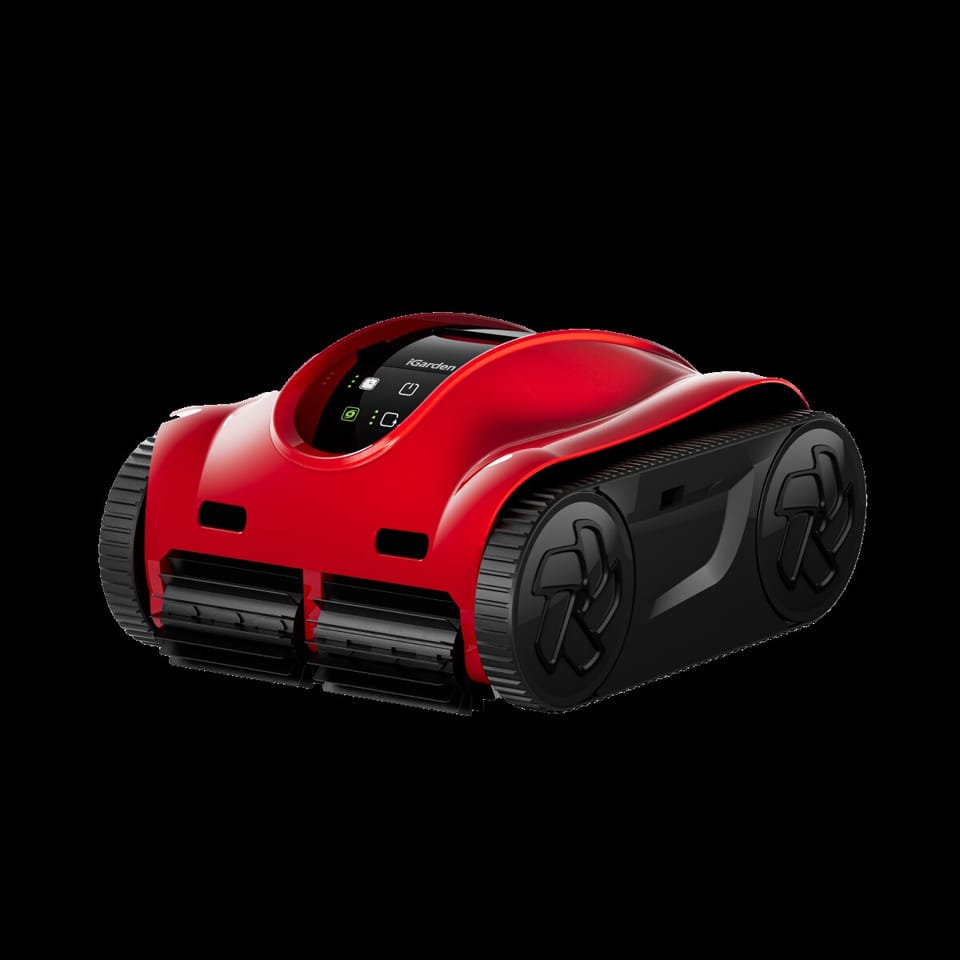
Best Robotic Pool Cleaner 2026: Is iGarden M1-AI Worth It?
Updated: May 2026
If you are searching for the best robotic pool cleaner 2026, the honest answer is that no single machine is best for every pool. The right choice depends on whether you value cordless convenience, long runtime, fine filtration, strong wall cleaning, or the confidence that comes from years of independent testing. The iGarden M1-AI is one of the most interesting new cordless options this year because it is built around dual-camera vision, dual-layer filtration, and navigation for pools with steps, curves, and awkward geometry.
💬 Disclosure: Some links in this article are affiliate links. We may earn a small commission when you complete a purchase at no extra cost to you. This helps us keep our content free, and it does not affect the integrity of our recommendations.
The short verdict is measured rather than absolute: the iGarden M1-AI looks like a strong 2026 choice for owners of complex pools who want finer debris capture than many long-runtime cordless models offer. It is harder to call it the best overall pool robot today because the current store lineup is still new, the public product pages are not perfectly aligned, and there is less long-term outside testing on the exact versions now sold than there is for established rivals.
What should the best robotic pool cleaner in 2026 actually do?
The best robotic pool cleaner 2026 should solve your pool's real maintenance problem, not simply win a specification contest. A large rectangular pool with heavy leaf fall needs different strengths from a compact freeform pool with stairs, tanning ledges, and fine dust. Runtime matters, but so do filtration, navigation, retrieval, basket cleaning, support, and whether the cleaner spends its battery on useful passes instead of repeating easy areas.
A useful buying standard has five parts:
- Cleaning coverage. A serious pool robot should handle the floor, walls, and waterline if your pool requires all three.
- Navigation quality. Random wandering is less acceptable at premium prices. Better robots map or at least follow repeatable paths.
- Debris handling. Large leaves and fine sand are different jobs. A robot that catches one may struggle with the other.
- Ownership effort. Charging, retrieval, app setup, basket rinsing, and storage determine whether you enjoy using the machine after week three.
- Evidence. Official claims are useful, but independent testing, buyer reviews, and stable specifications reduce purchase risk.
That framework matters because the iGarden M1-AI is not trying to be the longest-running cordless cleaner on the shelf. Its clearest promise is smarter cleaning in more difficult pool shapes, backed by dual vision, dual-flow suction, and a dual-layer filter. If that is your actual pain point, it becomes much more relevant than a simpler machine with a bigger battery.
Why the M1-AI stands out this year
The M1-AI is interesting because it targets the hard part of cordless pool cleaning: seeing the pool accurately enough to spend less time missing corners, steps, and debris patches. The current official store page lists dual-force flow, dual-layer filtration, dual-grip traction, smart pathing, waterline return, and models built for complex pools. The brand's broader product page also emphasizes dual-camera vision and 3D awareness.
The practical strengths are easy to understand:
- Dual-layer filtration: The current research materials describe a 150 micron plus 60 micron setup, which is more attractive for fine particles than the standard 180 micron filter listed for the K Pro line.
- Complex-pool focus: The official comparison page recommends M1-AI variants for pools with steps and curves, which is exactly where simpler cleaners often lose efficiency.
- Floor-to-waterline coverage: A premium cleaner should not require one tool for the floor and another for visible scum at the waterline.
- Cordless convenience: No power cable means easier deployment and a cleaner pool deck.
- Three-year main-component warranty: The official warranty policy gives the M Series three years on core components and six months on consumables.
These are meaningful advantages. They are also not the same as proof that the model is already the universal winner. A product can be promising, well specified, and still deserve a cautious recommendation while the exact retail lineup matures.
The specification issue buyers need to understand before ordering
The biggest reason to read carefully before buying is that public M1-AI materials do not currently tell one perfectly consistent story. The global brand page promotes a higher headline runtime for the broader M1-AI family, while the current United States store page sells M1-AI 55, M1-AI 70, and M1-AI 90 models with floor-only runtimes shown as 5.5, 7, and 9 hours. The store page currently presents M1-AI 90 as the top option in that listing.
That distinction matters. A buyer comparing products should not place a generic family claim next to a specific retail model and treat them as equivalent. If you are shopping today, use the numbers attached to the exact model in your cart, then confirm them again before checkout. Product naming has already shifted around this line during 2026, and Christopher Null's March review for WIRED noted a correction after earlier correspondence misidentified a model number and availability.
The safest way to read the lineup is:
| Current store model | Current listed price | Current listed floor-only runtime | Best fit |
|---|---|---|---|
| M1-AI 55 | $999 | 5.5 hours | Smaller or less demanding pools where the M1-AI feature set matters more than maximum runtime |
| M1-AI 70 | $1,199 | 7 hours | Buyers wanting a middle ground between price and cleaning window |
| M1-AI 90 | $1,399 | 9 hours | Buyers who want the strongest currently listed store version of this series |
The store page also shows "No reviews" at the time of writing. That does not mean the product is bad. It means buyers should weigh official specifications more cautiously than they would for a model with years of verified owner feedback.
How it compares with strong alternatives
The best robotic pool cleaner 2026 conversation should include more than one brand. If an article names one winner without explaining tradeoffs, it is doing shopping advice badly. The M1-AI has a clear case, but several alternatives remain better for particular households.
| Cleaner | Strongest reason to choose it | Main tradeoff |
|---|---|---|
| iGarden M1-AI | Fine filtration and navigation aimed at complex pools | Newer retail lineup with less outside evidence on the exact current versions |
| K Pro 150 | Very long cordless runtime and stronger current external testing | Higher price, coarser standard filtration, and more bulk |
| Polaris Freedom Plus | PCWorld's current cordless favorite for broad usability | Less appealing if your main problem is fine debris in complex geometry |
| Fanttik Aero X | PCWorld highlights it for larger pools | A large-pool choice is not automatically the best fit for stairs and curved shapes |
| Polaris VRX iQ+ | PCWorld calls it the best-performing corded robot it has tested | Cord management reduces the cordless convenience many buyers want |
The direct sibling comparison is especially useful. K Pro 150 is easier to recommend when the job is "run for a very long time in a large pool," because the current store page lists up to 15 hours floor-only runtime and PCWorld has published actual testing. The M1-AI is easier to justify when the job is "navigate a more complicated pool and catch finer debris." For a deeper head-to-head, see our M1-AI vs K Pro comparison and the dedicated K Pro review.
What independent testing says, and what it does not say yet
Independent testing is useful here, but it must be read with precision. WIRED reviewed an M1-100 in March 2026, not the exact 55, 70, or 90 naming set now shown on the current store page. Reviewer Christopher Null rated that tested unit 8/10, reported about 95 percent debris removal after two hours and complete collection after a third hour in his test pool, and confirmed the claimed 10-hour floor-only runtime for his unit. He also noted weaker points: a difficult-to-clean basket, pole retrieval, a confusing control panel, and a limited app.
That review is encouraging because it shows that the broader M1 family can clean effectively in real use. It is not a blank check for every current retail variant. A buyer should not assume the exact same runtime, battery, or ownership experience across every model name unless the seller confirms it.
The same logic applies to the K Pro line. PCWorld's review of K Pro 150 found 90 percent of synthetic leaves collected within 90 minutes and 98 percent within three hours, while also criticizing the interface, retrieval method, and charging-port design. That makes the comparison more credible than a pure spec-sheet contest: both lines appear capable, both have quirks, and neither is magically maintenance-free.
Who should seriously consider it
The M1-AI deserves a place near the top of your shortlist if your pool presents one or more of these conditions:
- You have steps, curves, slopes, or an irregular shape. The official lineup specifically positions the M1-AI for complex pools.
- Fine debris is a recurring problem. A dual-layer filtration system is more relevant if you fight sand, dust, or tiny particles rather than only leaves.
- You want cordless cleaning without stepping down to a basic random cleaner. The M1-AI is aimed at premium cordless buyers, not bargain hunters.
- You are comfortable buying a newer product after checking the exact model details. Some buyers accept a little early-product uncertainty in exchange for newer hardware.
- You care more about precision than the very longest runtime. A 9-hour current top-store model may be enough if the robot uses that time intelligently in a demanding pool.
If those conditions fit, the iGarden M1-AI is a sensible product to inspect closely before summer demand peaks. If you want a more product-specific decision article before buying, read our detailed M1-AI review.
Who should not buy it
This is the section many buying guides skip, but it is the one that saves readers the most money. The M1-AI is not the right choice for everyone.
- Do not buy it if you mainly want the longest cordless runtime available. K Pro 150 currently has the clearer long-runtime case.
- Do not buy it if your pool is simple and your budget is tight. A rectangular pool with light debris may not benefit enough from dual vision and finer filtration to justify premium pricing.
- Do not buy it if you need a product with a long public record on the exact current model names. The store lineup is still new and the public naming history has moved quickly.
- Do not buy it if retrieval convenience matters more than everything else. Independent testing on the wider M1 family still mentions pole retrieval.
- Do not buy it because of one headline number. Buy the specific variant whose current seller page, warranty, and return terms you have checked.
That buyer honesty matters more than dramatic claims. The best robotic pool cleaner 2026 is the one that fits the pool you own, the debris you actually fight, and the amount of product uncertainty you are willing to accept.
Pros and cons at a glance
| Pros | Cons |
|---|---|
| Dual-layer filtration is attractive for finer debris | Exact current retail lineup is newer and less independently documented |
| Officially positioned for pools with steps and curves | Public pages still show some specification and naming inconsistency |
| Cordless design keeps the deck cleaner | Current store page shows no customer reviews yet |
| Floor, wall, and waterline coverage | Not the strongest choice if maximum runtime is the only goal |
| Three-year main-component warranty | Premium pricing makes fit more important |
| Waterline return helps pickup after a cycle | Wider M1-family testing still reports less convenient basket cleaning and retrieval |
Warranty, returns, and the fine print
The buying decision does not end with runtime and filters. The official warranty policy gives M Series pool cleaners three years on the motor, battery pack, electronic control systems, charger, and main body, with six months on consumables such as baskets, wheels, brushes, and retrieval hooks. That is reassuring, but it is not the same as every part being covered for three years.
The official refund policy says direct-store buyers generally have 30 calendar days from the day after receipt to request a return, subject to conditions. Change-of-mind returns must be in like-new condition with original packaging, accessories, gifts, and manuals intact and unused. For non-defect returns, original shipping fees may not be refunded and the buyer is responsible for return shipping. Policies can change, so confirm the live terms before ordering.
This caveat matters because premium pool robots are awkward products to return once wet, opened, or missing packaging. Before you order any expensive cleaner, measure the pool, identify your most common debris, confirm the model number, and save the product page or receipt details.
A practical way to choose in five minutes
If you are stuck between the M1-AI and the broader field, use this short filter:
- Write down your main problem. Leaves, dust, stairs, waterline grime, or time away from home each point toward a different strength.
- Measure your pool and note its shape. Complex geometry makes the M1-AI more compelling.
- Choose your tolerance for uncertainty. Newer technology can be worth it, but mature reviews reduce risk.
- Check the exact model page. Do not buy "the M1-AI" in the abstract; buy the 55, 70, or 90 you actually understand.
- Compare against one realistic alternative. If the K Pro 150 or a Polaris model solves your specific problem better, say so before spending.
Owners who are also improving the rest of a backyard setup may want to read the related Swim Jet review, but pool-cleaner buyers should finish the robot decision first. Mixing upgrades too early makes it easier to spend on features you will not use.
Is it worth the money?
The M1-AI is worth serious consideration if you need its particular strengths. At current listed prices of $999 to $1,399, it is not a casual purchase. Yet a robot that handles fine debris and irregular pool geometry well can save repeated manual brushing, spot vacuuming, and frustration that cheaper cleaners leave behind.
The value case weakens when your pool is easy to clean or when you expect the machine to prove itself through long-established reviews before you buy. In those cases, spending less or choosing a more mature alternative is rational. The more irregular your pool and the more annoying your fine debris, the stronger the M1-AI case becomes.
If you decide that this feature set matches your pool, check the current configuration and seller terms directly through iGarden before ordering. Prices, model names, and promotional bundles can move during a launch year.
Frequently asked questions
Is the M1-AI the best robotic pool cleaner 2026?
It is one of the most interesting 2026 options for complex pools and finer debris, but "best" depends on the job. Buyers who want maximum runtime may prefer K Pro 150, while those who want the strongest tested corded cleaning may prefer Polaris VRX iQ+. The M1-AI is strongest when precision matters more than a single headline runtime number.
What is the difference between M1-AI 55, 70, and 90?
The current store page lists three variants with floor-only runtimes of 5.5, 7, and 9 hours and prices of $999, $1,199, and $1,399. Because public naming has changed during 2026, compare the exact model in your cart rather than relying on older search snippets or broader family claims.
Why do some pages mention a higher M1 runtime?
The broader global brand page promotes the M1-AI family with a higher headline claim, while the current store page shows the presently sold 55, 70, and 90 versions with lower model-specific figures. Treat the store page for your exact purchasable model as the safer buying reference and confirm details before checkout.
Is the M1-AI better than K Pro?
It may be better for complex pools and finer filtration, while K Pro is easier to defend for long runtime and current external evidence. The better choice depends on whether your main problem is geometry and fine debris or the need to run a cordless robot for many hours between charges.
Does the M1-AI clean walls and the waterline?
The current official materials describe coverage from the floor to the waterline and position the model for more complex pool shapes. As with any robotic cleaner, actual performance can vary with pool surface, shape, water conditions, and debris load, so treat coverage claims as the starting point rather than a guarantee of identical results in every pool.
What are the main downsides?
The main downsides are launch-year uncertainty, premium pricing, limited direct review volume on the exact current store variants, and some confusing public naming. Independent testing on the wider M1 family also found basket cleaning and controls less convenient than ideal, so the product is not friction-free even when it cleans well.
What is the warranty and return policy?
The official policy lists three years for the M Series main components and six months for consumables. Direct-store returns are generally available within 30 calendar days if policy conditions are met, but change-of-mind returns require like-new condition and may leave return shipping to the buyer. Always read the live terms before ordering.
Which related guide should I read next?
Start with the dedicated M1-AI review if you want a closer purchase analysis, then read M1-AI vs K Pro if you are choosing between the two lines. Buyers prioritizing long runtime should also read the K Pro review.
Final verdict
The iGarden M1-AI earns a serious place in the best robotic pool cleaner 2026 discussion because it addresses real pain points that simpler cordless robots often miss: fine debris, steps, curves, and more deliberate navigation. It is not yet the safest universal recommendation, because the present retail lineup is fresh and the public product story is still settling.
Buy it if your pool is complicated enough to benefit from its strengths and you are willing to verify the exact model details before paying. Choose a different robot if your top priority is the longest proven runtime, the oldest review history, or the lowest practical cost.
Sources
- Official M1-AI product page — current store models, listed pricing, runtime, and return/warranty badges.
- Official robotic pool cleaner comparison page — current product positioning for complex pools and comparison context.
- Official warranty policy — warranty periods for main parts and consumables.
- WIRED M1-100 review — named independent testing of the wider M1 family.
- PCWorld best robotic pool cleaners guide — current alternative recommendations and comparative context.