

Best International Health Insurance for Expats and Digital Nomads 2026: What the Numbers Actually Say
Last updated: September 2026
International health insurance for expats averaged about $3,020 per person per year in 2026 according to William Russell's published data — but that single number hides a range running from $500 basic policies to $28,000 plans with US coverage, an 8–10% annual medical inflation rate, and country averages that differ by a factor of four. This guide compares the major global providers on hard numbers: price by country, coverage limits, visa requirements, and where digital nomad plans genuinely fit.
We built this comparison the way an expat actually shops: not by collecting brand names, but by pulling the published 2025–2026 pricing data (William Russell, Pacific Prime's country cost index, SafetyWing's posted rates), the coverage limits each provider files publicly, and the visa minimums governments enforce — then organizing it around the decisions you have to make. Where a number is an average rather than a quote, we say so, because presenting averages as personal pricing is how comparison articles mislead.
The main comparison: seven providers, one honest table
Read this table by coverage limit and network first, price second — the price follows those two choices:
| Provider | Annual coverage limit | Network reach | Best fit |
|---|---|---|---|
| Cigna Global | $1M to unlimited | Tiered global networks | Families wanting modular customization |
| Allianz Care | Up to $5M | Strong in Europe and the Gulf | Expats splitting life between two continents |
| AXA Global Healthcare | Up to $5M | 192 countries | Frequent multi-country movers |
| Bupa Global | £1M–£2M | Premium private hospitals | Quality-of-network-first buyers |
| Now Health | $1M–$4.5M | Multi-budget plan tiers | Price/limit balance seekers |
| William Russell | Tiered Ace to Elite plans | Global, broker-distributed | Individuals wanting transparent average pricing |
| SafetyWing | $250k per period | Digital-first, travel-medical | Nomads on shorter horizons |

Source: AXA Global Healthcare
A million-dollar limit sounds abstract until you price one event: a complicated surgery plus ICU week in a private hospital can run $80,000–150,000 in Singapore or Hong Kong, and cancer treatment in a top US facility can consume the entire million. That is the real math behind "unlimited" tiers — they exist for the tail risk, not for show.
What expats pay by country: the Pacific Prime index
The clearest published data on geographic pricing differences comes from Pacific Prime's cost index, and the spread is the story:
| Country | Average individual premium (per year) |
|---|---|
| United States | $15,300 |
| Hong Kong | $8,300 |
| Singapore | $6,900 |
| Israel | $6,300 |
| China | $5,900 |
| UAE (Dubai) | $5,900 |
| United Kingdom | $5,800 |
| Poland | $3,900 |
Three readings matter for your wallet. First, your country of residence is the biggest single price driver — bigger than provider choice in most cases. Second, Dubai sits mid-table: not cheap, but far from the extremes, which keeps competition among providers healthy. Third, the US-to-Poland spread is nearly 4x, which explains why your colleague in Warsaw and your neighbour in Dubai can quote wildly different numbers for "the same" insurance.
Ages shift everything again: premiums typically jump 40–60% once you pass 60, which is why locking a good plan with stable renewal terms in your fifties matters more than squeezing a discount in your thirties.
The USA problem: one checkbox that quadruples the price
If your plan includes the United States as a coverage region, the same policy that costs $500–6,000 per year jumps to $10,000–28,000. Nothing else in international health insurance moves price like this checkbox.
The logic is brutal but simple: US hospital billing makes every other market look gentle, so insurers price the exposure accordingly. The practical decision tree:
- Never or rarely visiting the US? Exclude it from your international plan and cover short visits with standalone travel medical insurance — the savings fund decades of travel policies.
- American returning home regularly? You need the US region included, and your main lever becomes the deductible (next section).
- Non-American with occasional US trips? Most plans let you add emergency-only US coverage at a fraction of full-region pricing — ask specifically for this middle option rather than accepting full inclusion.
For US citizens abroad, one tax note sweetens the math: expat health insurance premiums can be deductible for the self-employed via Form 7206 (Schedule 1, line 17) — worth a conversation with your tax preparer before you assume the sticker price is your real cost.
Digital nomads: what SafetyWing's numbers tell you
The nomad market matured in 2026, and SafetyWing — which launched its expanded Complete plan — publishes rates that make the segment's value proposition explicit:
| Plan | Posted price | Period max | Medical evacuation |
|---|---|---|---|
| SafetyWing Essential | $62.72 per 4 weeks (ages 18–39) | $250,000 | Up to $100,000 |
| SafetyWing Complete | $177.50 per month | $250,000 | Up to $100,000 |
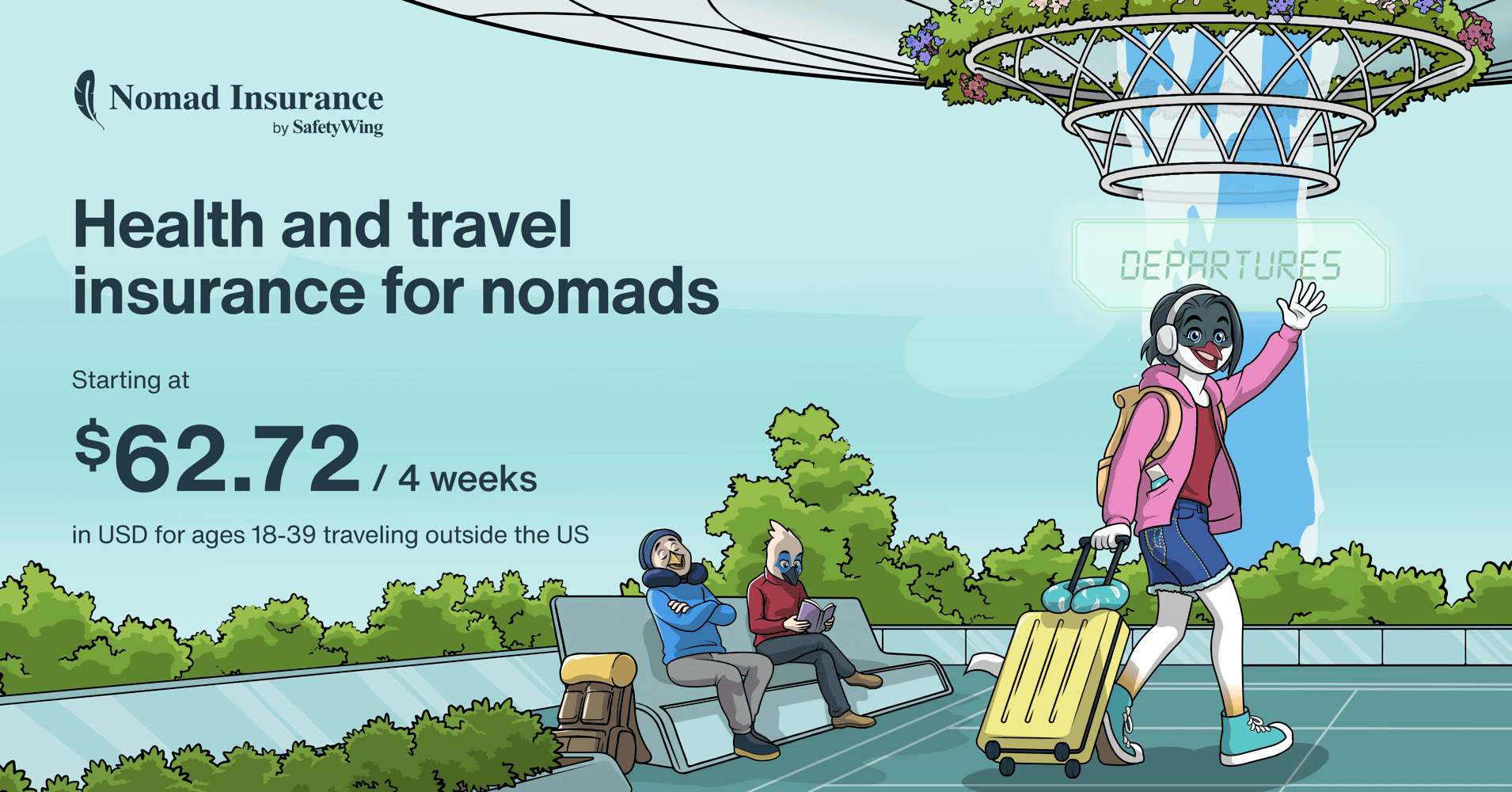
Source: SafetyWing Nomad Insurance
At roughly $753 per year, Essential is a quarter of the global PMI average — but read the exclusions before you celebrate: pre-existing conditions, maternity and cancer treatment are excluded from the Essential tier. This is travel-medical insurance with a nomad-friendly subscription model, not a full private medical insurance (PMI) policy.
The structure that works for most long-term nomads over 40 — or anyone with a family — is two layers: an international PMI policy anchored to your longest-stay country (worldwide-excluding-US keeps it affordable), plus a nomad subscription for the frequent-move lifestyle. One layer covers the tail risk; the other covers the friction.
Travel insurance vs international health insurance: the line that costs you
The most common expensive confusion among new expats: buying an annual multi-trip travel policy and assuming it is health insurance for a life abroad. The two products share vocabulary and nothing else:
| Feature | Travel medical | International PMI |
|---|---|---|
| Duration logic | Per trip / per period, capped total | Annual, renewable for decades |
| Covers emergencies | Yes | Yes |
| Covers chronic conditions | No | Yes (post-underwriting) |
| Covers planned surgery, maternity, oncology | No | Yes (per plan terms) |
| Covers routine check-ups | No | Often yes |
| Typical cost | $40–80 per 4 weeks | $500–28,000 per year |
The rule of thumb that never fails: visiting for weeks means travel insurance; living for months and years means international (or local mandatory) health cover. Anyone blending the two pays twice and gets served once.
Direct billing vs reimbursement: the difference you feel at the hospital
Two administrative models exist inside international insurance, and which one your plan uses shapes your worst day. Direct billing means the hospital invoices the insurer directly — you present a card, sign, and walk out. Reimbursement means you pay the full bill first, then file documents and wait weeks for repayment.
For a consultation the difference is annoyance; for a $40,000 surgical event the difference is a credit-limit crisis. Before choosing a plan, check whether its network in your actual city operates on direct billing — providers publish hospital networks, and a five-minute check of the hospitals you would actually use tells you more than any brochure. Expats in Singapore, Dubai and Hong Kong generally find mature direct-billing networks; those in smaller cities should verify hospital by hospital.
Pre-existing conditions: the clause that decides your real price
Every serious insurer handles disclosure the same way: you complete a medical declaration, an underwriter reviews it, and the outcome lands in one of three boxes — acceptance at standard rates, acceptance with a loading (typically +10–50%), or exclusion of the declared condition with everything else covered normally.
Four rules protect you here. Disclose fully: non-disclosure gives the insurer grounds to void coverage at claim time — the single worst outcome in insurance, years of premiums invalidated at the moment of need. Document stability: a hypertension or diabetes file showing years of good control earns better terms than an erratic one. Ask about moratorium underwriting: some providers offer a no-exam route with a longer waiting period instead of outright exclusion. And compare underwriting decisions across providers, not just prices: a 15% loading at one insurer versus 40% at another outweighs any headline premium difference.
Visa minimums: when the government picks your plan
Several residency routes make your insurance choice for you by setting a floor:
| Destination | Visa type | Minimum coverage required |
|---|---|---|
| Spain | Non-lucrative residence | €30,000 |
| Schengen area | Visitor visas | €30,000 travel medical |
| Thailand | Retirement O-A / O-X | $100,000 |
The expensive mistake runs in the surprising direction: buying a million-dollar international policy for a visa that requires €30,000. You are paying a PMI premium for a requirement a basic plan satisfies. The smart structure is the reverse: meet the visa floor with a compliant policy, then layer actual health protection sized to your medical reality, not to a bureaucrat's minimum. And always verify the current figure on the official visa page at application time — these thresholds get revised.
How to cut your premium without gutting your coverage
Five levers, ranked by realistic impact:
- Exclude the US region — the largest single saving available to most expats (see the section above)
- Raise your deductible — accepting the first $5,000 of annual costs yourself cuts premiums by 20–40%; rational for anyone with an emergency fund that size
- Pay annually — prepayment discounts of 5–10% are standard across the market
- Join a group scheme — professional associations and employer-adjacent groups access rates individuals cannot
- Re-shop at renewal after 50 — the market reprices you every year; loyalty is rarely rewarded in this industry
Each lever trades something real. The deductible trades cash-flow risk; regional exclusion trades access; annual prepayment trades flexibility. A "cheap" policy that excludes your actual medical needs is not cheap — it is a deferred invoice.
Halal and takaful options for Muslim expats
For expats who require Sharia-compliant structures, the market answer is takaful — cooperative insurance where contributions fund a shared pool and surpluses return to participants rather than shareholders. Several Gulf-based operators offer takaful products with cross-border coverage, and some global insurers maintain takaful-compliant windows in Gulf markets.
The practical checklist when a provider pitches you "Islamic insurance": is the certificate registered as takaful with the financial regulator? Who owns the participant fund and its surplus? What exactly is excluded, in writing? Vague reassurances about "approved Sharia principles" without documentation are a signal to keep shopping. Many expats adopt the position of preferring takaful where competitively available — and the pricing gap has narrowed enough that takaful certificates now compete directly in younger age bands.
Frequently asked questions
How much does international health insurance cost for expats in 2026?
The published global average is about $3,020 per person per year (William Russell data), ranging from roughly $500 for basic worldwide-ex-US plans to $28,000 for comprehensive US-inclusive cover. Country averages run from $3,900 (Poland) to $15,300 (US), and premiums rise 40–60% after age 60.
What's the difference between travel insurance and international health insurance?
Travel insurance is temporary and emergency-focused — accidents and sudden illness during trips. International health insurance is an annual, renewable policy covering full medical care: chronic conditions, planned treatment, maternity (after waiting periods) and prescriptions. Residents need the second; short visitors need the first.
Is SafetyWing real health insurance?
SafetyWing is regulated travel-medical insurance with a nomad-focused subscription model — not full PMI. Its Essential plan ($62.72 per 4 weeks) excludes pre-existing conditions, maternity and cancer, which matters enormously if it would be your only coverage. For healthy nomads on shorter horizons it is excellent value; as a sole lifetime layer it has structural gaps.
Can I use international health insurance in the USA?
Only if the US is included as a coverage region — and that inclusion moves the premium from $500–6,000 to $10,000–28,000 per year. Emergency-only US riders exist at intermediate cost. If you never visit, exclude the region and cover occasional trips with travel medical policies instead.
What's the minimum coverage for a Spain or Thailand visa?
Spain's non-lucrative visa and Schengen visitor visas require €30,000 in medical coverage; Thailand's retirement visas (O-A and O-X) require $100,000. These are floors, not targets — size your actual health coverage to your medical needs, and satisfy the visa floor with a compliant certificate.
Does expat insurance cover pre-existing conditions?
Sometimes. Full medical underwriting can accept, load (+10–50%) or exclude a declared condition. Moratorium options cover conditions that stay symptom-free for a waiting period. Budget travel-medical plans (including SafetyWing Essential) exclude them outright. Disclosure is mandatory either way — non-disclosure voids claims.
Is there halal international health insurance?
Yes — takaful operators offer cooperative, Sharia-structured certificates with cross-border coverage, and some global insurers run takaful windows in Gulf markets. Verify regulatory registration and surplus-sharing terms in writing before buying, since branding around "Islamic insurance" varies in rigor.
How does a deductible lower my premium?
By committing to pay the first slice of annual costs yourself, you convert the policy from paying-for-everything to paying-for-catastrophes — and insurers price that drop in claims frequency directly. A $5,000 deductible typically cuts premiums 20–40%, making it the cleanest lever for expats with healthy emergency funds.
What the next period of pricing looks like
Two forces will keep pressure on premiums through 2026–2027. Medical inflation running at 8–10% annually continues to feed directly into renewal pricing — a plan that costs $3,000 today is on trend to cost $3,240–3,300 at next renewal, all else equal. And the nomad segment's growth is pushing providers toward modular, region-flexible products, which is quietly good news: competition at the entry level constrains the big providers' pricing power at the mid-tier.
Our working advice for the year ahead: buy against your life structure (residence country, US exposure, family stage), verify underwriting outcomes across at least three providers from the main table, and put a renewal review in your calendar every year — because the market reprices you annually, whether you re-shop or not.
Protecting your income while abroad is the other half of this picture: our guide to the UAE's ILOE unemployment insurance explains the mandatory scheme that pays 60% of basic salary during involuntary job loss, and health insurance for UAE residents covers the local mandatory layer. For travelers comparing regional options, our Gulf travel insurance comparison separates travel cover from residence cover — and internationally mobile professionals can find curated opportunities and roles on Truescho to fund it all.
Sources
- William Russell — published 2026 average claim and premium data for expat PMI
- SafetyWing — posted Essential and Complete plan rates, limits and exclusions
- AXA Global Healthcare — coverage limits and 192-country network details
- Taxes for Expats — country cost analysis and US tax treatment of expat premiums
- European Commission — Schengen visa policy — minimum medical coverage requirements for Schengen visas