

AWS AI-Powered Cost Investigation: A FinOps Guide to Cloud Bill Spikes
An AWS AI-powered cost investigation can turn a Cost Anomaly Detection alert into a structured explanation of which service, account, region, and usage change probably drove the increase. Released on 8 June 2026, the capability uses Amazon Q Developer to connect billing evidence with operational events. It accelerates triage; it does not remove the need for a human to verify causation.
Last updated: June 2026
The feature distinguishes a usage-driven increase from a rate-driven change and, when evidence is available, correlates usage with AWS CloudTrail events, API calls, and IAM principals. It is available in AWS commercial regions without an additional feature fee. However, investigations that query CloudWatch Logs through Logs Insights can create normal scan-based charges. FinOps leaders should approve the data path, permissions, and investigation budget before enabling it widely.
Source: AWS Cloud Financial Management
What the investigation actually does
The investigation starts from an anomaly already detected by AWS Cost Anomaly Detection. Amazon Q examines cost dimensions and can explain whether the change appears to come from more usage or a changed effective rate. For usage changes, it can seek related operational activity, but the result remains an evidence-backed hypothesis rather than guaranteed proof.
This distinction is the foundation of a useful FinOps workflow. Billing data tells you what became more expensive. CloudTrail and related telemetry can help explain what action occurred. A deployment, scaling event, bulk object request, changed instance family, or new data path may line up with the cost increase. Correlation narrows the search, but an operator still confirms the business and technical context.
The June capability can identify contributing:
- AWS services;
- linked accounts in a multi-account environment;
- commercial regions;
- cost usage types and dimensions;
- usage-driven or rate-driven patterns;
- relevant API activity and IAM principals where logs support the link.
It does not magically reconstruct events that were never logged. If an S3 data event was not enabled, an application action used a path outside the available telemetry, or the relevant records have aged beyond the supported window, the investigation may stop at a service or usage dimension. “Insufficient evidence” is a valid outcome, not a product failure to be replaced with a confident guess.
The feature also differs from learning programmes such as AWS Educate, Azure for Students, and GitHub Student Pack. Those resources help people build cloud skills; this workflow is a production financial-operations control for teams already responsible for real AWS spend.
Cost Anomaly Detection, Cost Explorer, and FinOps Agent compared
These AWS capabilities overlap in cloud financial management but serve different moments. Cost Anomaly Detection monitors and alerts. Cost Explorer supports broad historical analysis and filtering. The anomaly investigation explains a selected event with Amazon Q. AWS FinOps Agent supports wider conversational FinOps work and can incorporate anomaly-related capabilities.
| Capability | Primary job | Starting point | Best question | Operational evidence | Main limitation |
|---|---|---|---|---|---|
| Cost Anomaly Detection | Detect unusual spend patterns and notify teams | Configured monitor and subscription | “Did spend deviate unexpectedly?” | Billing and anomaly model | Alert alone may not explain the operational event |
| AI-powered anomaly investigation | Investigate one detected anomaly | An anomaly detail in Cost Anomaly Detection | “Which dimensions changed, and what activity may explain it?” | Billing plus available CloudTrail and Logs data | Cannot establish facts absent from retained telemetry |
| Cost Explorer | Explore cost and usage over time | Filters, grouping, and date ranges | “How did spend change by service, tag, region, or account?” | Cost and usage records | Manual analysis is often needed to connect spend to a deployment |
| AWS FinOps Agent | Support broader conversational FinOps analysis | Agent workflow and configured access | “What should the FinOps team investigate or optimise?” | Available financial-management sources and tools | Broader scope requires governance and careful validation |
| CloudTrail | Record supported account and API activity | Trails and event history | “Which principal called this API, and when?” | Management and enabled data events | Data events may be disabled; retention depends on the setup |
| CloudWatch Logs Insights | Query relevant logs | A log group and query | “Which matching events occurred in this window?” | Scanned log data | Queries can incur charges based on data scanned |
| Human incident review | Validate cause and choose remediation | Investigation output plus system context | “Does this evidence prove the business cause, and what is safe to change?” | Change records, owners, metrics, tickets | Slower, but essential when automated evidence is incomplete |
Use the tools as a chain rather than substitutes. An alert can open an investigation; the investigation can suggest a likely driver; Cost Explorer can validate the financial pattern; logs can test the event sequence; and the service owner can confirm why the change occurred.
For organisations building model-based workflows across several services, the guide to AI orchestration for business systems offers useful architecture context. The same governance principle applies here: every automated explanation should have a defined source, permission boundary, and human decision owner.
Permissions and telemetry prerequisites
The user or role initiating the investigation needs access to Amazon Q Developer and the required Q actions. AWS identifies q:StartConversation, q:SendMessage, and q:PassRequest as relevant permissions. The surrounding Cost Management, CloudTrail, and log permissions must also match the data the workflow is expected to inspect.
Avoid attaching a broad administrative policy simply to make the first test succeed. Create a role for the investigation workflow, document the intended accounts and log groups, and validate the least-privilege boundary. In an organisation, separate the ability to inspect financial and operational evidence from the ability to change production resources.
A practical access checklist is:
| Control | Minimum decision | Owner | Verification evidence | Failure symptom |
|---|---|---|---|---|
| Amazon Q Developer access | Who may initiate and continue a conversation? | Identity team | Access assignment and successful test | Investigation cannot start or send prompts |
| Q API actions | Are the three required actions allowed? | IAM owner | Policy simulation and CloudTrail record | Access-denied message during investigation |
| Cost Management visibility | Which payer, linked accounts, and cost dimensions are visible? | FinOps | Account-scoped test anomaly | Result omits expected accounts or services |
| CloudTrail coverage | Are management and necessary data events recorded? | Security platform | Trail configuration and sampled event | Q identifies spend but not the triggering action |
| CloudWatch Logs delivery | Does the organisation trail reach the intended log groups? | Cloud operations | Ingestion timestamp and query test | Multi-account correlation is incomplete |
| Logs Insights budget | What scanned-data threshold is acceptable? | FinOps and observability | Query estimate, usage alert, and cost tag | Investigation creates unexpected logging cost |
| Retention | Will evidence remain available through the investigation window? | Security and compliance | Retention policy and archive test | Older anomaly has little operational context |
AWS recommends an organisation trail delivered to CloudWatch Logs for investigation across multiple accounts. This creates a central search path, but it is not a requirement to log every possible event indiscriminately. Security, privacy, cost, and regulatory requirements should shape which data events are enabled and how long records are retained.
Source: AWS Cloud Financial Management
A detailed runbook from alert to verified cause
The safest runbook treats the Amazon Q response as one stage in an incident process. The FinOps owner controls financial triage, the service owner validates technical context, and an authorised operator implements remediation. This prevents a plausible narrative from becoming an unreviewed production change.
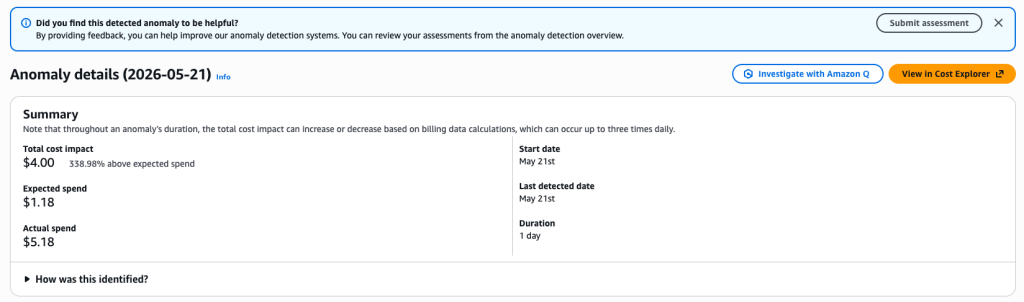
- Validate the anomaly window. Confirm the monitor, start date, expected spend, observed spend, impact, linked account, and service. Check whether delayed cost allocation or a known commercial adjustment could explain the alert before searching operations.
- Open the AI-powered investigation. From the anomaly detail, select the Amazon Q investigation option. Record the anomaly identifier and initial impact. Use the supported interface rather than pasting sensitive data into an unrelated assistant.
- Read the usage-versus-rate classification. A usage-driven increase points toward consumed units, requests, runtime, storage, or transfer. A rate-driven increase can reflect pricing, discount coverage, purchase-option changes, or another effective-rate factor. Do not force an operational API story onto a rate-driven event.
- Inspect dimensions before the narrative. Verify the service, account, region, usage type, and time window shown in the evidence. If the identified dimensions do not reconcile with Cost Explorer, pause and resolve the mismatch.
- Review CloudTrail correlation. For a usage-driven anomaly, inspect the related API calls and IAM principal where provided. Confirm the timestamp, resource, role session, source, and whether the event could realistically cause the billed usage. A nearby API call is not automatically the cause.
- Query logs with cost awareness. If the workflow uses CloudWatch Logs Insights, narrow the time range and log groups before running a broad query. Estimate or monitor scanned volume. The investigation feature has no additional feature fee, but Logs Insights usage can still be billable.
- Ask the service owner to verify. Match the evidence against deployment records, autoscaling policies, incident tickets, scheduled jobs, business campaigns, and service metrics. The owner may recognise an approved workload increase that financial data alone cannot explain.
- Choose a reversible response. Options can include stopping an unintended job, correcting a scaling policy, restoring a commitment or configuration, setting a budget control, or accepting a justified demand increase. Follow change-management rules; do not let an explanatory assistant execute an unsafe remedy by implication.
- Measure the result. Track usage and projected cost after remediation. Cost data can lag, so use operational metrics for immediate confirmation and financial data for later reconciliation.
- Close with an evidence record. Preserve the anomaly, investigation result, queries, human conclusion, change ticket, owner, and follow-up control. Mark whether the root cause was confirmed, probable, or unresolved.
Small online companies can connect this runbook to the infrastructure choices in the 90-day online business roadmap. A simple ownership map and cost alert established at launch is cheaper than reconstructing accountability after several teams share one payer account.
The feature has no added fee, but the data path may cost money
AWS states that the AI-powered investigation capability is available at no additional charge in commercial regions. That statement should not be shortened to “the whole investigation is free.” Existing services and supporting queries retain their normal pricing, including potential CloudWatch Logs Insights charges based on the amount of data scanned.
Consider a central organisation log group containing several terabytes. A broad query across 30 days may scan far more data than a tightly bounded query across two hours and one account. The Q feature can save engineering time while still producing an observability charge. Those two facts are compatible.
A FinOps policy should specify:
- default query windows for anomaly investigations;
- approved central log groups;
- when data-event searches are justified;
- a threshold for peer review of large scans;
- how observability charges are allocated;
- whether repeated queries should become saved, optimised runbooks.
This is similar to evaluating hosting bundles in Hostinger versus Bluehost for small business: a headline price never describes every usage-dependent component. In AWS, the feature fee, log ingestion, retention, and query scan are separate cost concepts.
Known limitations that change the answer
The investigation is strongest when the anomaly is recent and the organisation already has well-structured telemetry. AWS documents several limits that should appear in every operating procedure, because they explain why one incident receives a detailed principal-level narrative while another does not.
First, unlogged data events cannot be recovered by analysis. CloudTrail management events and data events are different. High-volume actions such as object-level operations may require explicit data-event configuration. If the action was never recorded, Amazon Q cannot identify the actor from a missing event.
Second, time reduces available context. Relevant CloudTrail information can age according to the organisation’s trail and retention setup. AWS also notes that resource-level data available to the feature covers 14 days, and anomalies are archived after 90 days. Investigate promptly rather than treating the anomaly list as a permanent forensic archive.
Third, cost allocation and operational identity are not always one-to-one. A role may be assumed by a deployment system, a shared service may incur charges for several teams, or a price change may affect usage without a corresponding API event. Tags, account design, and change records remain essential.
Fourth, the capability may identify a likely root cause without proving the counterfactual. A scaling API call can precede higher compute usage, but the business reason may be legitimate demand. A discount expiration can create a rate-driven increase even though workload volume is stable. Human reviewers must test the explanation against service metrics and commercial commitments.
Source: AWS Cloud Financial Management
Source: AWS Cost Anomaly Detection getting started page
Helix Commerce in Dublin: a practical composite scenario
This practical composite scenario is not a claim about a real company. Helix Commerce operates from Dublin in June 2026 with 12 AWS accounts, a monthly cloud run rate of USD 146,000, and an organisation trail delivered to a central CloudWatch log group.
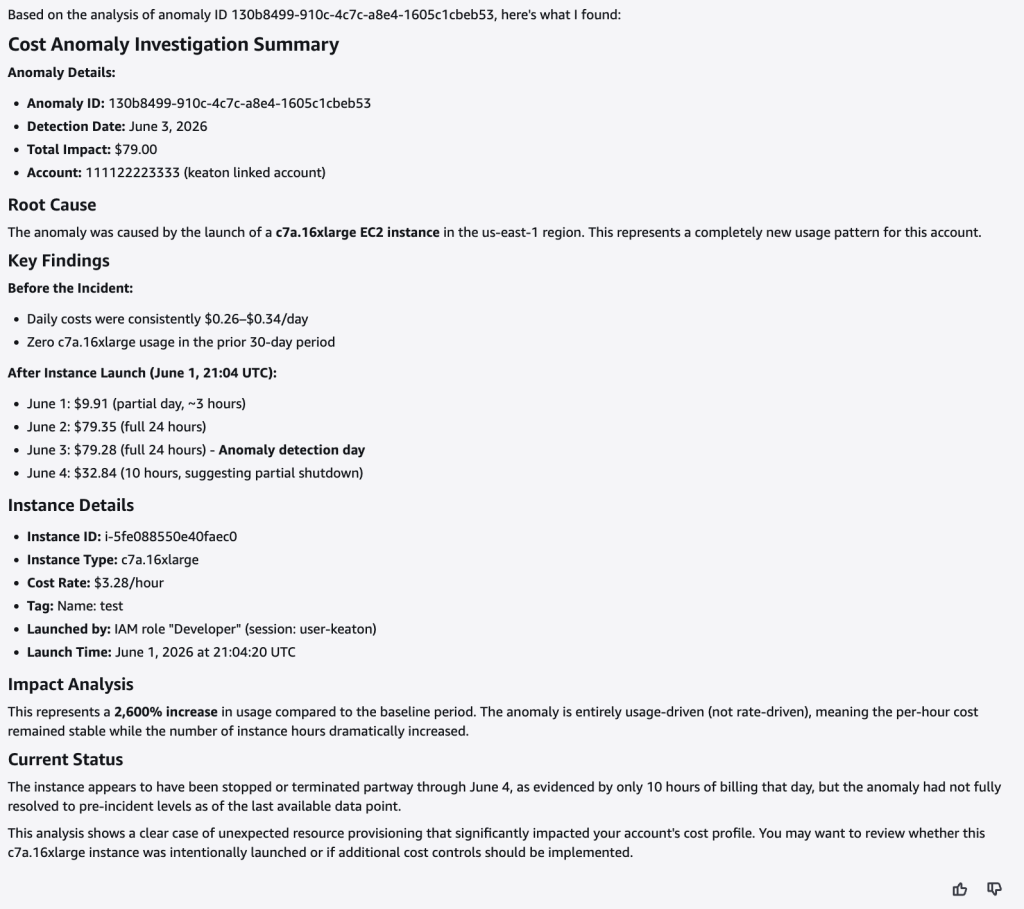
At 09:00 on a Monday, Cost Anomaly Detection reports a projected USD 18,700 impact in one linked account. The investigation classifies the increase as usage-driven, highlights a compute service in one region, and points to an API call made by a deployment role shortly before usage rose.
The FinOps analyst does not close the incident at that point. Cost Explorer confirms that the usage type and account match. The platform engineer checks the deployment record and finds that a scheduled load test used a production scaling policy instead of the test policy. Service metrics show capacity rising within minutes of the call.
The team narrows its Logs Insights query to a three-hour window, reverses the configuration through an approved ticket, and monitors capacity before relying on delayed billing data. The incident record labels the root cause “confirmed” because billing, API activity, deployment history, and metrics agree.
If the deployment role’s event had been absent, the correct conclusion would have been “probable workload increase; initiating actor unresolved.” The feature’s value is faster convergence on evidence, not permission to fill evidence gaps with certainty.
AWS’s official launch materials also present a walkthrough involving Maya. That example is useful for learning the interface, but a production team should apply the same scepticism to its own environment: verify dimensions and events before changing resources.
Governance for engineering and FinOps leaders
Assigning ownership before the first anomaly prevents alert ping-pong. FinOps should own cost impact and prioritisation. Cloud operations should own trail and log readiness. Service teams should validate workloads. Security should govern sensitive operational data and IAM. A change authority should approve remediation that affects availability.
Use three confidence levels in every closed investigation:
- Confirmed: independent billing, operational, and change evidence agree.
- Probable: the explanation fits the strongest available evidence, but one material link is missing.
- Unresolved: the data does not support a safe root-cause conclusion.
This vocabulary protects decision quality. It also gives platform teams a measurable backlog: repeated “probable” incidents caused by missing data events justify a telemetry decision, while repeated “unresolved” incidents caused by account sharing may justify architecture and tagging changes.
To track grants, conferences, internships, and professional programmes outside your AWS operations work, use Truescho’s opportunities hub; Truescho does not provide AWS or FinOps services.
Teams evaluating paid software can also use the cost-governance questions in Semrush One for startups: define the decision, owner, measurable value, and cancellation or rollback point before spend becomes routine.
Frequently asked questions
How does Amazon Q investigate an AWS cost anomaly?
Amazon Q starts with a detected anomaly, analyses the contributing cost dimensions, and classifies the change as usage-driven or rate-driven. For usage changes, it can correlate the window with available CloudTrail events, API calls, and IAM principals. A human should verify the proposed explanation against Cost Explorer, metrics, and change records.
Can the feature distinguish usage changes from rate changes?
Yes. The investigation can separate a rise in consumed resources from a change in effective rate. That distinction directs the next step: usage changes may justify operational-event review, while rate changes may require checking pricing, discount coverage, purchase options, or commercial adjustments rather than searching for a deployment API call.
Does it require an organisation CloudTrail?
An organisation trail is recommended for consistent multi-account investigation, particularly when delivered to CloudWatch Logs, but the precise result depends on the evidence available. A single-account setup can still provide useful data. Without suitable trail and event coverage, the investigation may identify the expensive service without identifying the actor or action.
What CloudWatch Logs Insights charges can occur?
AWS does not add a separate fee for the investigation feature, but CloudWatch Logs Insights can charge for data scanned by queries. Cost depends on normal service pricing and query scope. Limit time ranges and log groups, monitor scan volume, and do not interpret “no additional feature charge” as zero cost for every supporting service.
Can it identify the IAM role behind a bill spike?
It can surface an IAM principal associated with relevant CloudTrail activity when the event was recorded, retained, accessible, and credibly related to the usage change. It cannot identify a principal from an event that was never logged. Even when a role appears, the service owner should confirm that its action caused the billed usage.
What data limits affect older anomalies?
Older investigations can lose detail because operational records follow configured retention, resource-level data available to the feature covers 14 days, and anomalies are archived after 90 days. Investigate promptly, export the incident evidence your policy requires, and avoid assuming the anomaly interface is a permanent replacement for security or financial archives.
Does the investigation automatically fix the root cause?
No. Its job is to explain and accelerate analysis, not to authorise a production change. A FinOps analyst and service owner should validate the evidence, select a safe remediation, follow change control, and measure the outcome. Some increases are legitimate demand or rate changes and should not be “fixed” by reducing resources.
Conclusion: make faster investigations more reliable
An AWS AI-powered cost investigation is most valuable when it sits inside a disciplined runbook. Configure anomaly monitoring, grant narrow permissions, centralise appropriate CloudTrail evidence, control Logs Insights scan scope, and require human verification. Record the final cause as confirmed, probable, or unresolved instead of overstating what an automated correlation proves.
If your broader planning includes funded programmes or professional opportunities, check Truescho’s updated opportunities. For cloud architecture, billing, or security decisions, rely on your AWS account team and qualified specialists with access to the actual environment.
Official sources
- AWS launch announcement — release date, availability, and core capability.
- AWS Cloud Financial Management introduction — official walkthrough and screenshots.
- AWS Cost Management user guide — investigation procedure, permissions, and limits.
- AWS Cost Anomaly Detection FAQ — monitoring and service details.
- AWS FinOps Agent documentation — relationship with the agent workflow.
- AWS Cost Anomaly Detection getting started — official setup path and video source.