
At the October 8, 2026 close of SAR 25.74 on the Saudi Exchange, Saudi Aramco (ticker 2222) offered a forward dividend yield of about 5.3% — 5.27% on Yahoo Finance's quote checked the next day, a figure we recomputed from the same data: SAR 1.36 in expected annual dividends divided by SAR 25.74 equals 5.28%, within rounding of the published number. For income investors, that yield sits alongside a story that changed twice this year: the base dividend was raised 3.5% — the fourth consecutive annual increase — and the company announced the first share buyback in its history, up to $3.0 billion over 18 months, alongside full-year 2025 results on March 10, 2026. Add the February 2026 opening of the Saudi market to direct foreign investors, and Aramco has quietly become one of the most accessible mega-cap income stocks outside the S&P 500.
Disclaimer: this article is for informational purposes only and is not investment advice. It discusses listed equities and cash dividends only — it does not cover loans, margin, derivatives or any leveraged products. Markets move; do your own research and consider a licensed financial adviser before acting.
This guide calculates the yield transparently, lays out every dividend and results date that matters through 2027, dissects the buyback and the safety of the payout against free cash flow, and explains how international investors can actually buy Tadawul stocks after the February 2026 reform. Every figure carries its source and date, and where our arithmetic extends an official number, we say so.
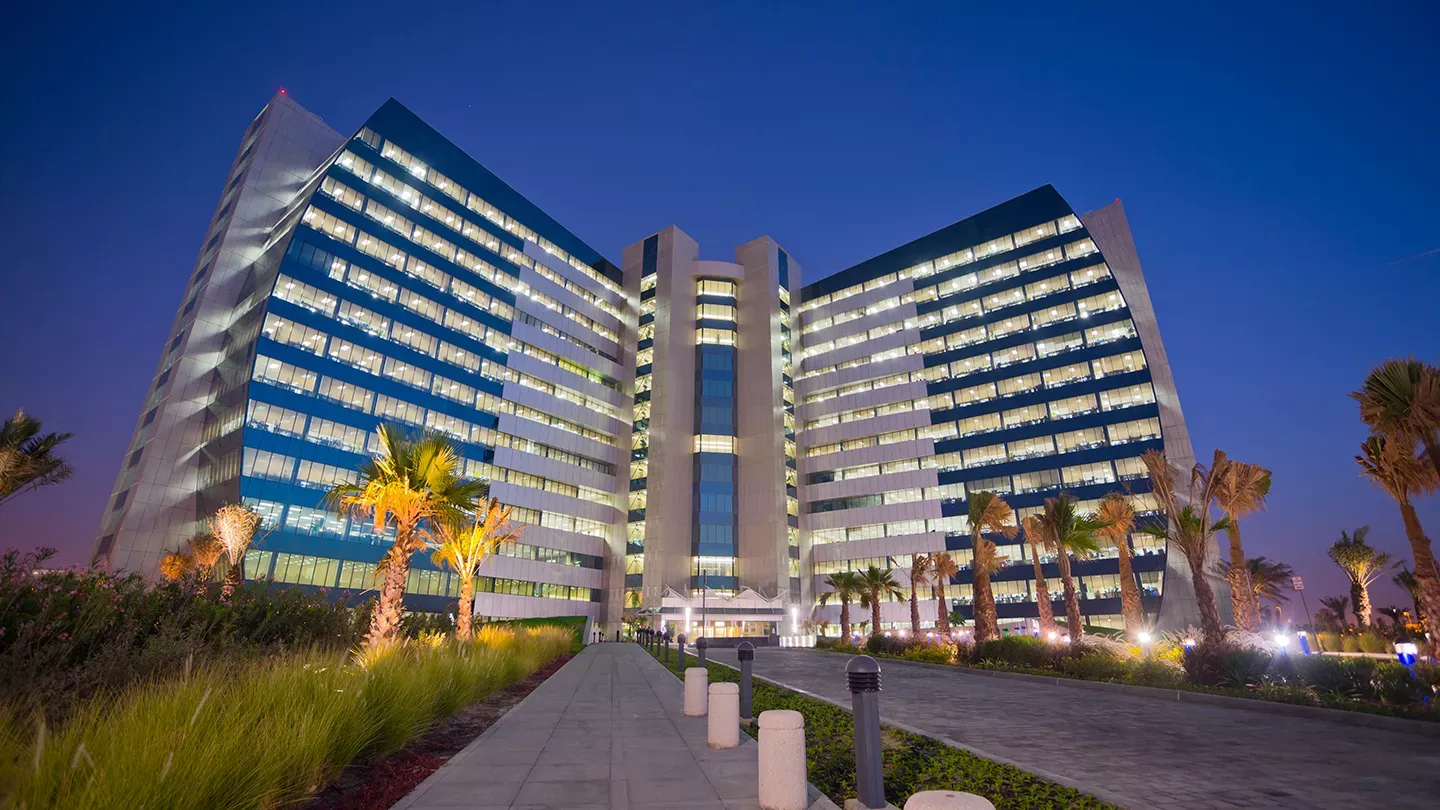
Source: Aramco
The 5.3% yield, calculated in the open
Income writers who round a yield to one decimal without showing the fractions are asking for trust this article would rather earn. The inputs, per Yahoo Finance checked October 9, 2026: closing price SAR 25.74 on October 8 (prior close SAR 25.84), forward dividend SAR 1.36 per share per year. Divide 1.36 by 25.74 and you get 5.28%; Yahoo's displayed 5.27% differs only by rounding conventions. The same quote page puts the 52-week range at SAR 23.29 to 27.96 and the market capitalization at SAR 6.227 trillion — which means the identical dividend has yielded between roughly 5.8% at the low (1.36 ÷ 23.29) and about 4.9% at the high (1.36 ÷ 27.96) over the past year. Entry price, not dividend policy, did most of that moving.
Two forward references frame the number. First, Al Jazira Capital forecast full-year 2026 dividends of SAR 1.37 per share, per Maal's report on July 21, 2026 — a broker estimate slightly above the SAR 1.36 forward figure, not company guidance. Second, the quarterly distributions behind these annual figures have been running at about SAR 0.33 per share (the Q1-2026 distribution was reported at roughly 33 halalas per share on May 10, 2026), which annualizes near the quoted forward rate. The stock, for orientation, traded at SAR 26.52 in the days after its Q2-2026 results, per Markets.com's August 17 snapshot — inside the 52-week band, and about 3% above the October 8 close.
Yield is also only half of an income investor's return arithmetic. The share's own 52-week band — SAR 23.29 to 27.96, a spread of roughly 20% — has contributed more price movement this year than the dividend rate changed, and reinvestment turns the two into one curve: a shareholder who reinvests a 5.28% yield at a constant price adds roughly 5.3% to their share count each year, so the income line compounds even when the payout itself stays flat. None of that protects the total-return case if the share de-rates — a yield this size always prices some risk — but it explains why income buyers watch the payout ratio more closely than the chart.
A single-quarter snapshot is where yield analysis starts, not ends: the durability of that 5.3% depends on the cash flowing underneath it, which is the subject of the safety section below.
How the payout got here: four consecutive raises
Aramco's dividend story is unusually mechanical, which income investors should like. The company operates a policy combining a resilient base dividend with performance-linked payouts, and the base line has now been raised four years running. The Q4-2025 base dividend of $21.89 billion, announced with full-year results on March 10, 2026, was 3.5% higher year on year — the fourth consecutive annual increase, per the company's press release — and was paid during the first quarter of 2026. Total dividends declared for 2025 came to $85.5 billion.
The quarterly cadence since then, from dated financial-press reporting: the Q3-2025 dividend was $21.37 billion (SAR 80.12 billion), announced November 4, 2025 alongside quarterly profit of $26.94 billion; the Q1-2026 distribution was declared at SAR 82.08 billion — approximately 33 halalas per share — with the base raised 3.5% to a SAR 82.1 billion quarterly run-rate, reported May 10, 2026; and the Q2-2026 dividend was $21.88 billion (SAR 82.06 billion), announced August 4, 2026 and paid during the third quarter. Run those quarterly numbers and roughly $21.9 billion has been flowing to shareholders every three months, on schedule, through a year in which the reported accounting profit actually fell.
The two-layer policy matters for planning. The base dividend — now running near $21.9 billion a quarter — is the layer management has raised four years running and the layer an income plan can sensibly be built on. Performance-linked payments ride on top and are, by design, variable, which is why the 2025 total of $85.5 billion and the base run-rate are different figures describing the same company. Whenever you read dividend commentary, check which layer the writer is annualizing: mixing the two is the most common error in dividend coverage, and it can inflate an expected payout by a wide margin.
There is an older payroll underneath this modern payout machine, and Aramco's own channel tells it well — how the company paid its people long before banks existed in the Eastern Province:
https://www.youtube.com/watch?v=hlfvxsMsxz0
The investor calendar for 2026 and 2027
Income investing is calendar-driven: you buy before the ex-dividend date, you hold through results, you get paid in the following quarter. Everything verified for the current cycle, in one table:
| Quarter (results event) | Results date | Declared dividend | Per-share detail | Payment and context |
|---|---|---|---|---|
| Q3-2025 | November 4, 2025 | $21.37bn / SAR 80.12bn | — | Quarterly profit $26.94bn (Asharq Al-Awsat, Al Arabiya) |
| Q4/FY-2025 | March 10, 2026 | $21.89bn base (+3.5% YoY) | — | Paid in Q1-2026; fourth consecutive annual raise; first-ever $3bn buyback announced the same day |
| Q1-2026 | May 10, 2026 | SAR 82.08bn (≈$21.9bn) | ~33 halalas/share | Base confirmed 3.5% higher, at a SAR 82.1bn quarterly run-rate (Mubasher, Okaz, Al Arabiya) |
| Q2-2026 | August 4, 2026 | $21.88bn / SAR 82.06bn | — | Paid in Q3-2026; most recent ex-dividend date August 20, 2026, per Yahoo Finance |
| Q3-2026 | Tuesday, November 3, 2026 | To be declared | — | Confirmed by Argaam and Maal (October 9, 2026), Al Arabiya (October 8) and Mubasher (October 5) |
| FY-2026 | Early 2027 (not yet scheduled) | Al Jazira Capital estimate: SAR 1.37/share for 2026 | — | Broker forecast, July 21, 2026 — not company guidance |
The November 3 date is the near-term catalyst: it settles both the Q3 dividend declaration and the next read on the buyback's progress. Anyone modeling income for 2027 should mark it, and should also note the pattern above — declarations land within days of results, payment follows in the next quarter, and the ex-dividend date for the August payout was August 20, 2026 (per Yahoo Finance's quote data). We will not guess future ex-dividend dates that have not been announced; the table updates when the company publishes them.
Use the calendar rather than chasing it. Because declaration, ex-dividend date and payment are separate events, an investor who wants a given payment must own the shares before that payment's ex-dividend date — the last confirmed one being August 20, 2026 for the Q2 distribution — and then wait for the following quarter's payment run. Buying the day before results to catch a declaration mostly just buys the event risk; the calendar rewards investors who settle their position sizing weeks earlier, while nothing is yet priced on a date that has not happened.
Inside the first $3 billion buyback
When Aramco reported full-year 2025 results on March 10, 2026, it also announced something no Aramco shareholder had ever seen: a share repurchase program, sized at up to $3.0 billion over 18 months — as reported by Reuters under the headline of a first-ever buyback, and by Bloomberg the same day. In May 2026, the CFO detailed the mechanics via the Saudi business daily Maal: up to 350 million shares repurchased over the same 18 months, covering employee stock plans.
Scale the numbers honestly. Spread evenly, $3.0 billion over 18 months is about $167 million a month — against a dividend stream running at roughly $21.9 billion per quarter. The entire 18-month program equals roughly 3.4% of a single year of dividends ($3.0 billion against about $87.6 billion of annualized quarterly payouts — our arithmetic from the documented quarterly figures). This is not a yield-support machine; it is a measured, symbolic first step. The symbolism matters: a company that paid out $85.5 billion in dividends for 2025 chose to add repurchases at all, and chose to keep them small enough to defend.
Two honest caveats. First, covering employee-plan dilution is a capital-management function, not the same thing as shrinking the share count for outsiders, so model any per-share accretion conservatively. Second, tying execution to specific share prices is speculation — the documented record gives size and duration, not a price limit, and we will not invent one. What the buyback does establish is direction: management's first response to a tight cash year was to protect the dividend and add a modest return channel, not to cut.
Dividend safety: $85.5 billion paid against $85.4 billion of free cash flow
The question every income investor should ask of a 5.3% yield is whether the cash covers it. Aramco makes this unusually checkable, reporting both measures in the same statements — all figures below from the company's official FY-2025 results release (March 10, 2026) and H1-2026 interim report (August 4, 2026):
| Metric | FY-2025 | H1-2026 |
|---|---|---|
| Adjusted net income | $104.7bn | $67.2bn (Q2: $33.4bn) |
| Reported net income | $92.81bn — down 11.6-12% YoY, per XTB and Arabic energy-press coverage | Not restated on this basis |
| Operating cash flow | $136.2bn | $56.2bn |
| Free cash flow | $85.4bn | $30.9bn (Q2: $12.3bn, after a $13.6bn working-capital build) |
| Capex | $52.2bn — about $1bn lower YoY | 2026 guidance: $50-55bn |
| Dividends declared | $85.5bn total for 2025 | Q1 SAR 82.08bn + Q2 $21.88bn (≈$21.9bn per quarter) |
| Gearing | 3.8% at December 31, 2025 (vs 4.5% end-2024) | 6.2% at June 30, 2026 |
Read the middle row twice: 2025 dividends of $85.5 billion were paid against free cash flow of $85.4 billion — a payout slightly above 100% of FCF. That single comparison explains both of this year's capital decisions: why the buyback was capped at a modest $3 billion, and why capex discipline is enforced ($52.2 billion spent in 2025, guidance set at $50-55 billion for 2026). It also explains the Q4-2025 detail that operating cash flow was a far sturdier $136.2 billion — working capital and investment timing sit between the two figures, which is why the H1-2026 line matters: the second quarter's free cash flow of $12.3 billion reflects a $13.6 billion working-capital build, a use of cash that reverses direction in normal operations rather than destroying value.
The balance-sheet cushion is real but moving: gearing rose from 3.8% at end-2025 to 6.2% at June 30, 2026 — still modest in absolute terms for a company of this cash generation, but a 2.4-point rise in six months is the kind of direction income investors track. Note too the gap between the two profit measures: 2025 reported net income of $92.81 billion against $104.7 billion adjusted — roughly $11.9 billion apart (our subtraction) — which is why we quote both and why headlines about profit "falling 11.6-12%" describe the accounting line, while the dividend was raised off the stronger adjusted base.
The verdict this data supports is neither cheerleading nor alarm: a covered-but-tight payout, deliberately small buyback, and management visibly choosing dividend reliability over expansion. Whether that trade suits you depends on what you want the income for — and for readers who pair equity income with hard assets, our halal gold investing guide covers a different store-of-value branch of the same portfolio question. Some investors even route part of their income into their own earning power: if upskilling budgets are part of your 2027 plan, our Coursera for Business pricing breakdown shows what corporate learning seats really cost. And if your cash-flow worry runs the other direction — software inflation eating the business that generates your investable income — our Salesforce and HubSpot AI pricing teardown documents the 2026 per-seat squeeze in detail.
Primary documents for your own review: the FY-2025 results press release (PDF), the H1-2026 interim report (PDF), and the 2025 Annual Report (PDF), all from Aramco's investor-relations library.
Buying Tadawul stocks as a foreign investor after February 2026
For most of Aramco's public life, international retail access was awkward — you reached the stock through regional funds, indexes or other indirect instruments rather than directly. That changed on February 1, 2026, when amended foreign-ownership rules took effect, opening the Saudi Exchange's Main Market to direct foreign investment, as covered by Dentons and Asharq Al-Awsat in English. The reform had been announced on January 7, 2026 by Arab News, Saudi Gazette and Gulf Business, and the early expectations were large: experts quoted by Arab News on January 9 projected inflows of around $10 billion.
The measured reality so far is more gradual. By February 3, 2026, the CEO of Derayah Financial reported roughly 500 foreign investors had applied for access through the firm, per Argaam; by July 20, 2026, waya.media put actual foreign inflows at $1.6 billion — the largest in the Gulf this year, but well short of the $10 billion headline. Regulators have signaled more to come: Arab News reported on February 3 an intent to raise the foreign-ownership cap in listed companies. For an income investor, the practical reading is that access now exists, liquidity is building, and the plumbing is still new — all reasons to size positions accordingly rather than reasons to stay away.
Mechanically, buying is straightforward and unexotic: you open an account with a licensed intermediary authorized under the amended rules, complete the account and settlement setup that broker requires, fund it, and trade 2222 in riyals during Saudi Exchange hours. Dividends are declared in both dollar and riyal terms — the Q2-2026 dividend of $21.88 billion/SAR 82.06 billion is the template — and your broker handles crediting and any withholding applicable to your jurisdiction. We deliberately do not recommend specific brokers; confirm licensing with the exchange or regulator before funding any account.
Investors comparing newly opened markets in the wider region — our piece on foreign investment into Syria covers another 2026 frontier — or weighing longer-term Gulf residency alongside a portfolio (see our Saudi premium residency investor guide and Oman's golden residency for investors) increasingly treat access reform as one connected story: capital borders in the Gulf are loosening at the same moment the region's flagship payer is raising its dividend.
FAQ: Aramco dividends and the buyback
What is Aramco's dividend yield in October 2026?
About 5.3%: SAR 1.36 in expected annual dividends against the October 8, 2026 close of SAR 25.74 — 5.28% by our calculation, 5.27% as displayed by Yahoo Finance (checked October 9, 2026). Over the past year the same dividend yielded roughly 4.9% to 5.8% as the share price moved between SAR 23.29 and 27.96.
When does Aramco report Q3-2026 results?
Tuesday, November 3, 2026 — confirmed by Argaam and Maal on October 9, Al Arabiya on October 8, and Mubasher on October 5. The Q3 dividend declaration comes with it.
How much was Aramco's H1-2026 dividend?
Two quarterly distributions of roughly $21.9 billion each: Q1-2026 at SAR 82.08 billion (about 33 halalas per share) and Q2-2026 at $21.88 billion/SAR 82.06 billion — together about $43.8 billion declared for the first half, paid across the second and third quarters.
What is Aramco's first-ever share buyback program?
Up to $3.0 billion of repurchases over 18 months, announced with FY-2025 results on March 10, 2026 (Reuters, Bloomberg). In May 2026 the CFO specified up to 350 million shares over the same period, covering employee stock plans — roughly 3.4% of one year's dividends in total size, a measured first step rather than a yield-support machine.
Can foreign investors buy Saudi Aramco directly after the February 2026 opening?
Yes. From February 1, 2026, amended rules allow direct foreign investment in the Main Market through licensed intermediaries. About 500 foreign applicants were reported via Derayah by February 3, and actual inflows reached $1.6 billion by July 20, 2026 — the Gulf's largest.
Is the 3.5% dividend increase sustainable alongside $3 billion of buybacks?
The honest answer is that 2025 dividends ($85.5 billion) slightly exceeded free cash flow ($85.4 billion), which is exactly why the buyback was kept small and capex guidance was trimmed to $50-55 billion. Gearing rose from 3.8% to 6.2% in H1-2026 — real, but modest. Sustainability currently rests on operating cash flow ($136.2 billion in 2025) rather than idle slack.
What was Aramco's 2025 net income, reported versus adjusted?
Reported net income was $92.81 billion — down 11.6-12% year on year, per XTB and Arabic energy-press coverage — while adjusted net income was $104.7 billion, roughly $11.9 billion higher (our subtraction). Aramco reports both; dividends were raised off the adjusted base.
How do international investors get exposure to Tadawul dividends?
Post-February 2026, the direct route is an account with a licensed intermediary under the amended ownership rules, buying riyal-denominated shares such as 2222 and receiving cash dividends through the broker. Foreign inflows of $1.6 billion by July 2026 show the route is being used — verify any broker's license before funding, and keep positions sized to the market's newness.
Sources
- Aramco FY-2025 results announcement (official page) — March 10, 2026
- Aramco H1-2026 results announcement (official, Arabic) — August 4, 2026
- Yahoo Finance — Saudi Aramco (2222.SR) quote — checked October 9, 2026 (October 8 close)
- Aramco media resources (official image source)
- Aramco official YouTube channel
- News reporting referenced with dates: Reuters and Bloomberg (first buyback, March 10, 2026); Argaam (November 3 results date, October 9, 2026; foreign access applications, February 3, 2026); Maal, the Saudi business daily (May 10, 2026; July 21, 2026; October 9, 2026); Al Arabiya (August 4, 2026; May 10, 2026; October 8, 2026); Mubasher (August 4, 2026; May 10, 2026; October 5, 2026); XTB and Arabic energy-press coverage (FY-2025 reported net income decline); Asharq Al-Awsat (November 4, 2025; February 2026 reform coverage); Dentons (ownership rules in force, February 1, 2026); Arab News (January 7, 9 and February 3, 2026); Saudi Gazette and Gulf Business (January 7, 2026); waya.media (foreign inflows, July 20, 2026); Markets.com (August 17, 2026).
DONE