
Last updated: September 2026
Apple has officially set Wednesday, September 9, 2026 as the date of its next major launch event, and the countdown clock is already running on the company's official newsroom page. The stream starts at 5 p.m. US Eastern Time and will be broadcast free and live on apple.com and Apple's official YouTube channel. The strongest supply-chain reports — from analysts Ming-Chi Kuo and Jeff Pu — point to a genuinely historic night: the first foldable iPhone at a price near $2,000, and an A20 Pro processor built on the world's first 2-nanometer chip production for a mass-market phone.
If you are asking "should I buy an iPhone right now?" — the direct answer is: wait two days. After the September 9 announcement, current iPhone 17 prices drop measurably across retailers, and the full picture of the next generation becomes clear before you spend a single dollar. That rule applies doubly for students working from a limited study budget on a phone meant to last four years or longer.
Why September 2026 is unlike every previous September event
For years, a September Apple event has meant one predictable thing: a new iPhone generation with incremental updates — a better camera, a faster chip, a fresh color. This time the story is different for two reasons that have never arrived together.
The first reason: a foldable iPhone for the first time in the company's history. Apple is the last major manufacturer to enter the foldable race, seven years after Samsung's first Galaxy Z Fold, and after Google, Xiaomi, Honor, and Huawei all shipped their own foldables. The delay was never absence from the market — it was waiting for what Apple considers technological maturity: hinges that do not wear out, and screens that do not show creasing after months of use.
The second reason: a real manufacturing leap, not a marketing one. Reports from analysts Jeff Pu and Ming-Chi Kuo — two of the most accurate Apple supply-chain sources over the past decade — agree that the upcoming iPhone 18 Pro models will run an A20 Pro processor manufactured on a 2-nanometer process at TSMC in Taiwan, the first wide-scale commercial use of that node in a phone. In plain terms: every drop in nanometers packs billions more transistors into the same space, which raises speed while cutting heat and battery drain at the same time.
Source: Apple — Official WWDC26 kickoff coverage
The foldable iPhone: the full numbers to expect
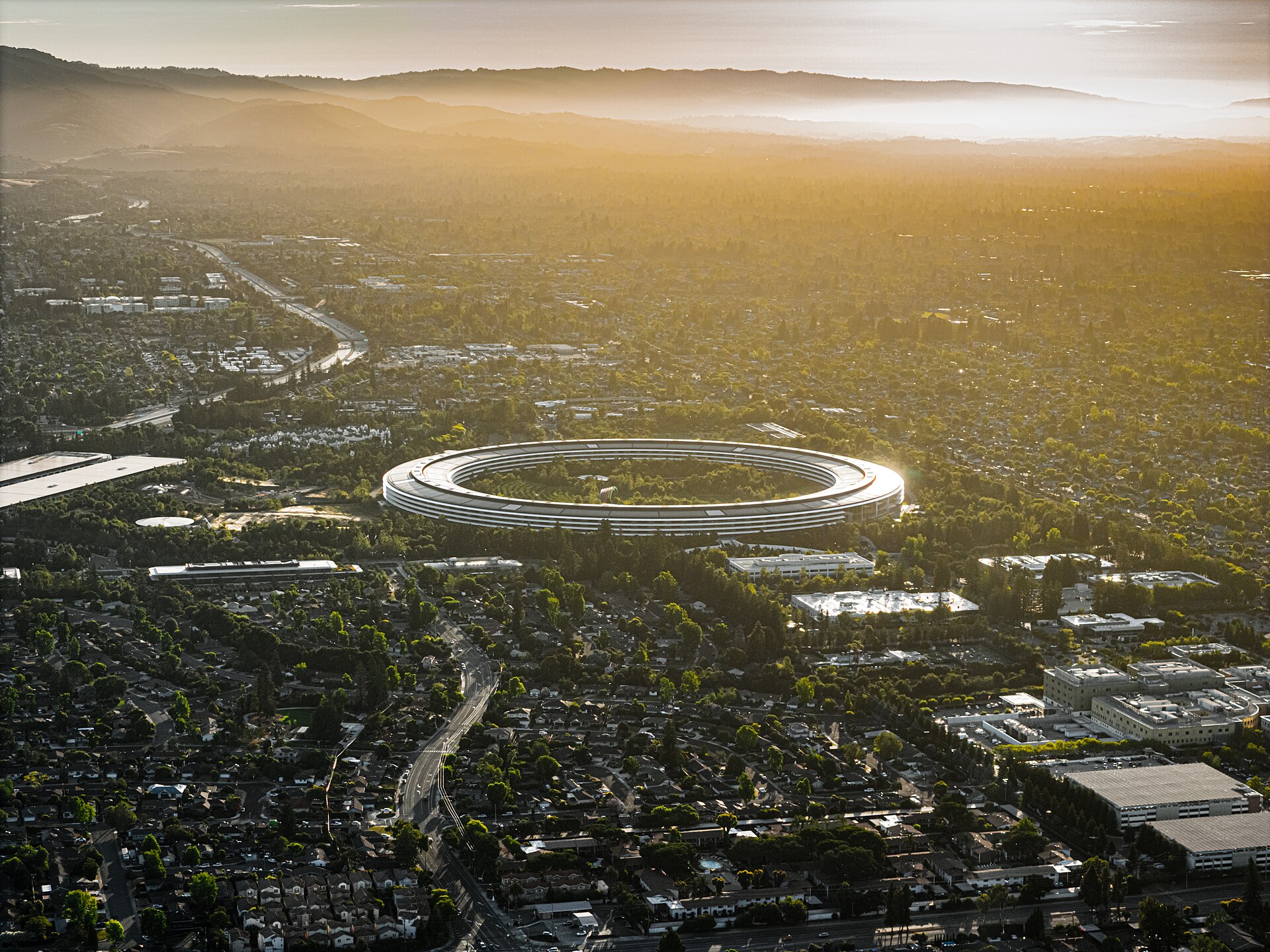
Source: Wikimedia Commons — Apple Park aerial view

The information circulating from supply-chain sources — led by analyst Ming-Chi Kuo and the well-known leaker Ice Universe — paints a nearly complete picture of the new device:
| Specification | Expected value for the foldable iPhone |
|---|---|
| Approximate price | Around $2,000 for the base version |
| Inner display | 7.8 inches when open |
| Outer display | 5.5 inches when closed |
| Thickness when open | Roughly 4.5 mm |
| Frame | Titanium with ceramic-glass layers |
| Biometric unlock | Touch ID built into the side button |
| Availability | May slip to December 2026 |
Two numbers deserve a pause. First, 4.5 mm when open — if it holds, that would make it the thinnest foldable on the market, ahead of Samsung's current best at around 5.5 mm. Second, $2,000 — roughly double the price of a standard iPhone, and this is exactly where the decision gets interesting for students and international buyers, as the budget section below breaks down.
Why so expensive? Because a foldable screen without a visible crease, a titanium hinge rated for hundreds of thousands of folds, and flexible ceramic glass add up to materials and assembly costs several times those of a conventional metal body. Apple is not pricing arbitrarily; it is reflecting the real cost of a first-generation category.
iPhone 18 Pro: the mainstream flagship gets 2nm silicon
While the foldable grabs the headlines, the iPhone 18 Pro and Pro Max remain the products that will affect millions of ordinary buyers, and these are the key documented expectations:
- A20 Pro on a 2-nanometer process: the first iPhone generation built on this node, according to matching reports from Kuo and Pu. The practical gain is not raw speed alone — it is power efficiency, which translates into genuinely extra hours of everyday battery life.
- Apple's own C2 modem: continuing the independence journey from Qualcomm chips that started with the C1 family. Full modem control typically improves network reception and lowers power draw during connectivity.
- Variable aperture main camera: a first for iPhone, per Jeff Pu's reports — the ability to change how much light enters the primary lens depending on the scene, a professional capability once reserved for DSLR cameras.
- A new deep red finish: the cosmetic touch that rounds out the Pro line refresh.
The other models — the standard iPhone 18, 18e, and the second-generation Air — are reported by Kuo to have slipped to spring 2027, an unprecedented move that separates them from their Pro siblings by a full half year. Apple simply does not want any budget phone stealing the spotlight from the first foldable in its history.
Source: Apple's official YouTube channel
The student decision table: buy now or wait?
This table condenses the decision into clear lines for anyone using the phone for study and work:
| Your current situation | Smartest move before September 9 |
|---|---|
| Your phone works fine | Wait — iPhone 17 prices drop right after the announcement |
| You need a phone within a week | Buy an iPhone 17 now, or watch post-event retail offers within three days |
| Your budget is under $1,200 | The foldable is not your option — target the iPhone 17 or 17e after their price cut |
| Foldable-curious | Watch the actual ship date — the December 2026 reports may mean extra waiting after the reveal |
| Chasing maximum AI performance | The 2nm A20 Pro is the generation worth upgrading to from an iPhone 15 or older |
For students specifically: a phone today is a study tool before it is a communication device — from photographing whiteboards and recording lectures to running AI study apps, or even running ChatGPT directly from your Mac's messages. If you are building a complete digital study routine around your device, the efficiency jump in the A20 Pro is not a technical luxury; it is extra study hours away from a charger on long campus days. And if your priority this semester is your future rather than your hardware, start with the fully-funded opportunities currently listed on Truescho — a phone can be bought retroactively, but a scholarship deadline does not come back.
What this means for international buyers
Three facts matter for buyers outside the United States. First, announced US prices do not transfer as-is: a $999 phone typically lands at a higher number after import taxes, and the $2,000 foldable will cross premium-flagship territory in most markets — putting it in "professional gear" territory rather than "every student's phone". Second, international rollouts usually lag the US launch by several weeks, and the foldable may slip further if the December 2026 ship reports hold. Third — and most important — the AI wave that Apple and its competitors are riding means very old phones will lose full AI feature support over the next two years, so anyone holding an iPhone 13 or older now has a stronger upgrade justification than at any previous point. Add to that the fast-moving landscape around the company itself: the complete Apple Intelligence guide explains which AI features have actually shipped, the iOS 27 public beta with the new Siri previews the platform these phones will run, while Apple's lawsuit against OpenAI over trade secrets still casts a shadow over the AI-models race that intensified after the GPT-6 Astra launch.
Frequently asked questions about Apple's September 2026 event
When is Apple's next event, and what time does it start?
The event takes place on Wednesday, September 9, 2026, starting at 5 p.m. US Eastern Time. The livestream is free to watch on apple.com and on Apple's official YouTube channel, with no registration required, and the replay is available immediately after.
Is the foldable iPhone confirmed for September 9?
Its presence at the event is "strongly expected" according to a consensus of credible supply-chain sources, but it is not officially confirmed until Apple says so on stage. Even with an announcement, supply-chain reports suggest actual shipping may slip to December 2026 due to first-of-its-kind manufacturing complexity.
How much will the foldable iPhone cost?
The strongest expectations point to around $2,000 for the base model — roughly double the price of a standard Pro iPhone. Final pricing for every market will only be known at the official on-stage announcement.
What is the practical difference of a 2-nanometer chip?
A smaller nanometer number means smaller and more numerous transistors in the same area. The practical result for the user: higher performance with less heat and longer battery life from the same battery size. The A20 Pro expected in the iPhone 18 Pro will be the first wide-scale commercial application of this process in a phone.
Do iPhone 17 prices drop after the event?
Yes. Retailers typically cut the previous generation by 10 to 18 percent within weeks of the announcement, with older generations seeing deeper discounts. For anyone who wants a fully AI-capable iPhone at the lowest price, the window right after September 9 is the opportunity.
Sources
- Apple — Official Newsroom and Events — the official countdown to the September 9, 2026 event
- MacRumors — Apple Event Roundup — details from Kuo, Pu, and Ice Universe on the foldable iPhone and A20 Pro
- Apple's Official YouTube Channel — the live event stream and the iPhone 17 announcement archive
Your next step
The practical summary: do not buy a new iPhone before Wednesday. After the event, choose between a discounted iPhone 17 — the rational pick for a student — and waiting for the 2-nanometer generation if your current phone can serve one more year. And if your priorities this semester are academic rather than technical, start where the next few years pay you back: browse the updated scholarships and opportunities on Truescho and lock their deadlines before the new-device wave takes over your attention.