
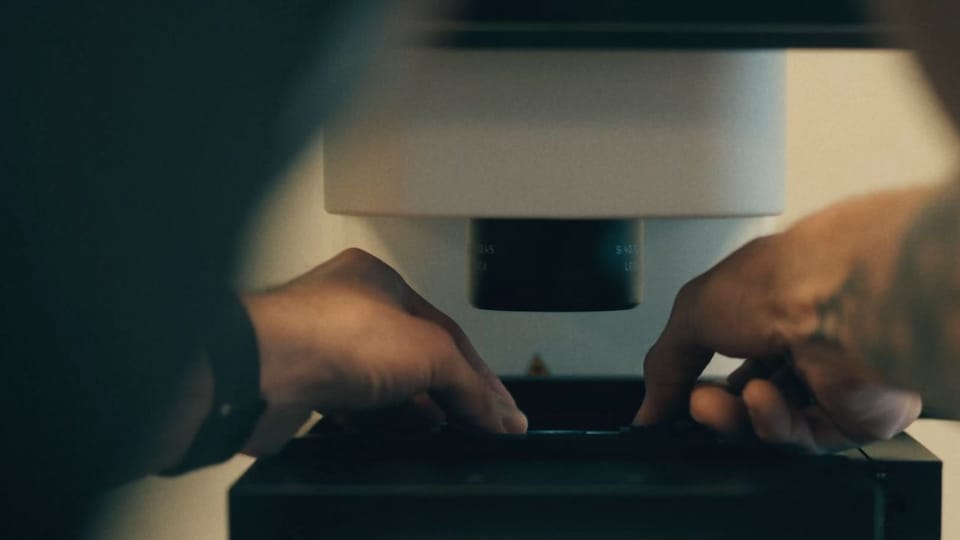
On August 27, 2026, Anthropic opened a research preview of a new specification called the Model Hardware Standard, or MHS: a shared standard that lets AI agents safely operate physical devices in scientific research labs and advanced manufacturing lines. The problem it addresses is one anyone who has worked in a modern laboratory knows intimately. Every instrument — the microscope, the robot arm, the centrifuge, the spectrometer — speaks its own language, and wiring it into an automated experiment stack consumes weeks, sometimes months, of specialized engineering. According to the official announcement, MHS compresses that work to hours or even minutes. This guide explains what the standard is, how it works technically, what the institutions testing it have actually measured, and how a lab or university anywhere in the world can apply for access.
Why Laboratories Needed a Shared Standard in the First Place
The traditional path to automating a single scientific workflow usually pulls together equipment from four or five different manufacturers, each with its own control software, its own API, and its own documentation. The engineer assigned to the job writes a bespoke integration for each device, then repeats the whole effort whenever a single component is replaced. Anthropic's announcement states the problem bluntly: this integration work takes weeks if not months, because devices do not intercommunicate and require specialists to write custom connections.
The deeper consequence is that full automation became a luxury reserved for the largest centers, while thousands of university labs and small manufacturing lines kept running manually or on fragile partial scripts. A shared, open standard means a compliant device can be discovered and driven immediately by any experiment-control system — the same normalization that transformed printer connectivity decades ago.
Consider a practical example that shows the gap. A biology lab wants to run a three-day sequence of cooling, sampling, and measurement. The traditional route requires one script for the chiller, another for the spectrometer, a third for the pipetting robot, and an orchestration layer on top — followed by weeks of testing, because a flaw in the coordination layer breaks the entire chain. Under a shared standard, the devices describe themselves in one language, the agent reads each device's reference file and knows its limits before touching it, and orchestration becomes a routine documented task instead of a bespoke software project. The difference is not merely convenience: it unlocks continuous experiments that no human could babysit around the clock.
What the Model Hardware Standard Actually Is
The official definition calls MHS a shared specification for AI agents to safely operate physical devices. The technical design is cleverer than a unified API and rests on four layers:
- A standardized driver built on simple primitives. Every device is described through basic read and write operations — reading a temperature, setting a temperature — rather than vendor-specific command sets. From the software's point of view, the gap between two brands nearly disappears.
- Standard-format device discovery. An experiment system can scan the lab and automatically identify which compliant devices are available, without manual configuration.
- Natural-language tags describing the physical device. The driver auto-generates a reference file documenting the device's measurements, its adjustable settings, and its enforced safety limits. Tags in natural language capture physical characteristics such as a robot arm's weight. This file is what an AI agent reads to understand what it may and may not do with a device before it ever acts.
- Three control interfaces. Devices are accessible through the Model Context Protocol (MCP), a command-line interface, or code files and APIs. In practice, that means any agent harness that speaks standard protocols can connect without custom middleware.
The standard's official site lists the device types shown in its preview: a camera, a robot arm, a microscope, a centrifuge, a pipette robot, a spectrometer, and an incubator. The governing rule, quoted directly from the announcement, is that MHS works with any device that has a programmable interface.
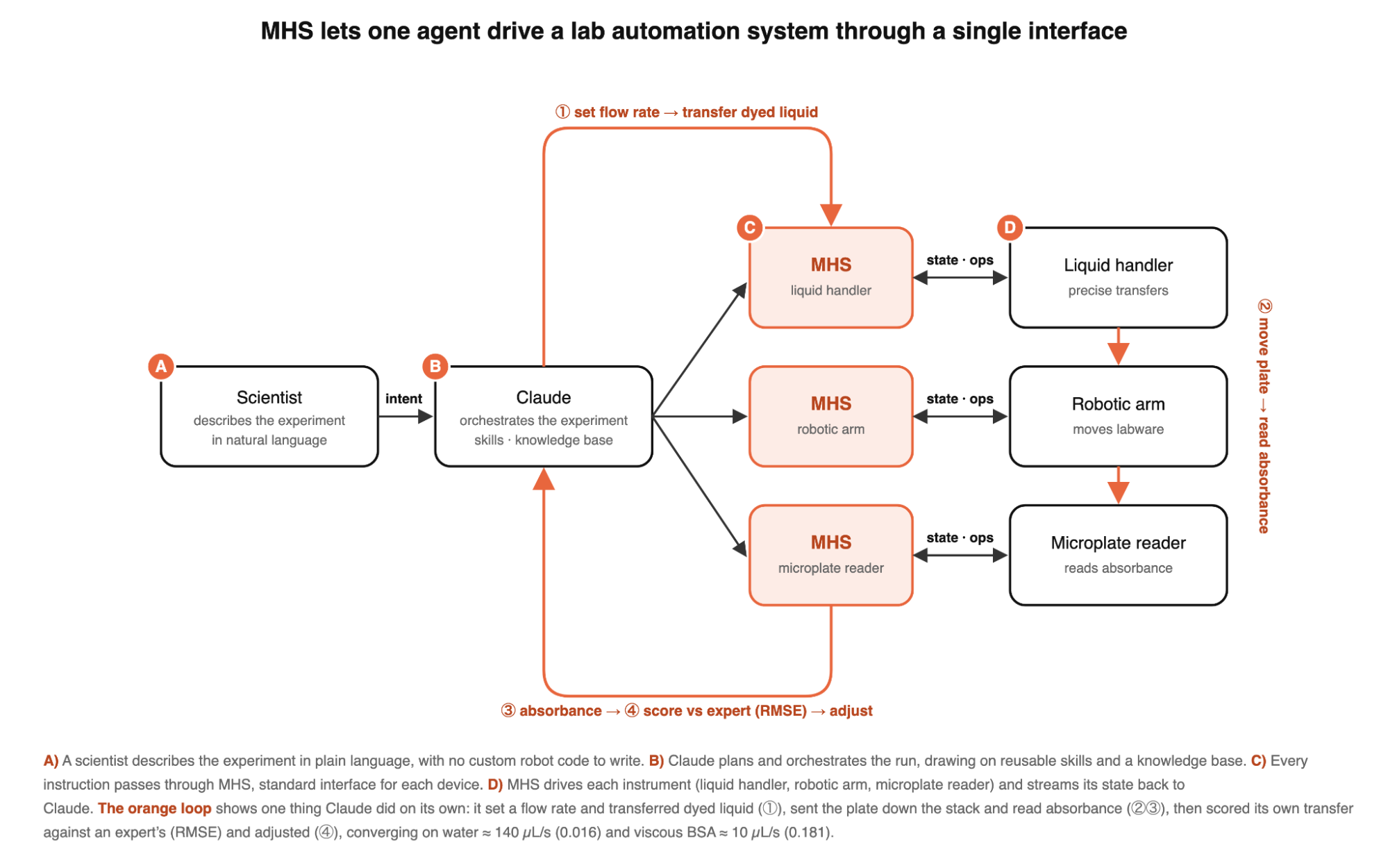
Source: Anthropic's official announcement
Safety First: How the Standard Prevents Accidents Before They Happen
The operative word in the definition is safely, and the architecture carries that commitment structurally rather than as an afterthought. Every connected device receives an auto-generated reference file enforcing three layers of information: the device's real measurements, its adjustable settings, and its enforced safety limits. The natural-language tags add a physical dimension — an agent that does not know the mass of an arm it is moving cannot reason about the risks of moving it.
This design targets one of the deepest fears about letting agents act in the physical world: that a system will interpret an instruction superficially and execute it destructively. When thermal, speed, and load boundaries live in a file the agent must read before executing, violations become exceptions engineers can program against rather than open possibilities. Above all of it sits a condition Anthropic does not soften: expert human oversight. The spatial and physical reasoning of today's models still requires it, and the research preview itself was designed partly to build safety evaluations and best practices before any wider rollout.
The Documented Numbers: What Early Testers Actually Measured
The strongest part of the announcement is that it shipped numbers from independent institutions rather than promises. Three results deserve attention because they describe operational leaps, not marginal gains:
| Institution | Experiment | Announced result |
|---|---|---|
| Carnegie Mellon University | Driver and orchestration integration for serial dilution workflows | Integration in about 8 hours instead of weeks through a vendor; experiments roughly 3x faster |
| QuEra Computing | A relock controller built by an AI agent | 99.3% success across 695 of 700 trials, completing in 0.9 to 14 seconds versus 150 seconds and 58% success for the prior script |
| Tetsuwan Scientific | 9,143 pipette dispenses | Roughly 12% better than the manufacturer's own precision specifications |
These figures come from organizations independent of Anthropic, which lends them more credibility than any internal demo. The practical message is that automation through the standard is not only faster to set up — in two of the three cases it reached execution quality beyond the manual or traditionally scripted baseline. The announcement adds an operational dimension worth noting: agents can run experiments around the clock, adjust parameters in real time, and sometimes recover from hardware errors unaided — a claim we will revisit in the limitations section, since human supervision remains a hard requirement.
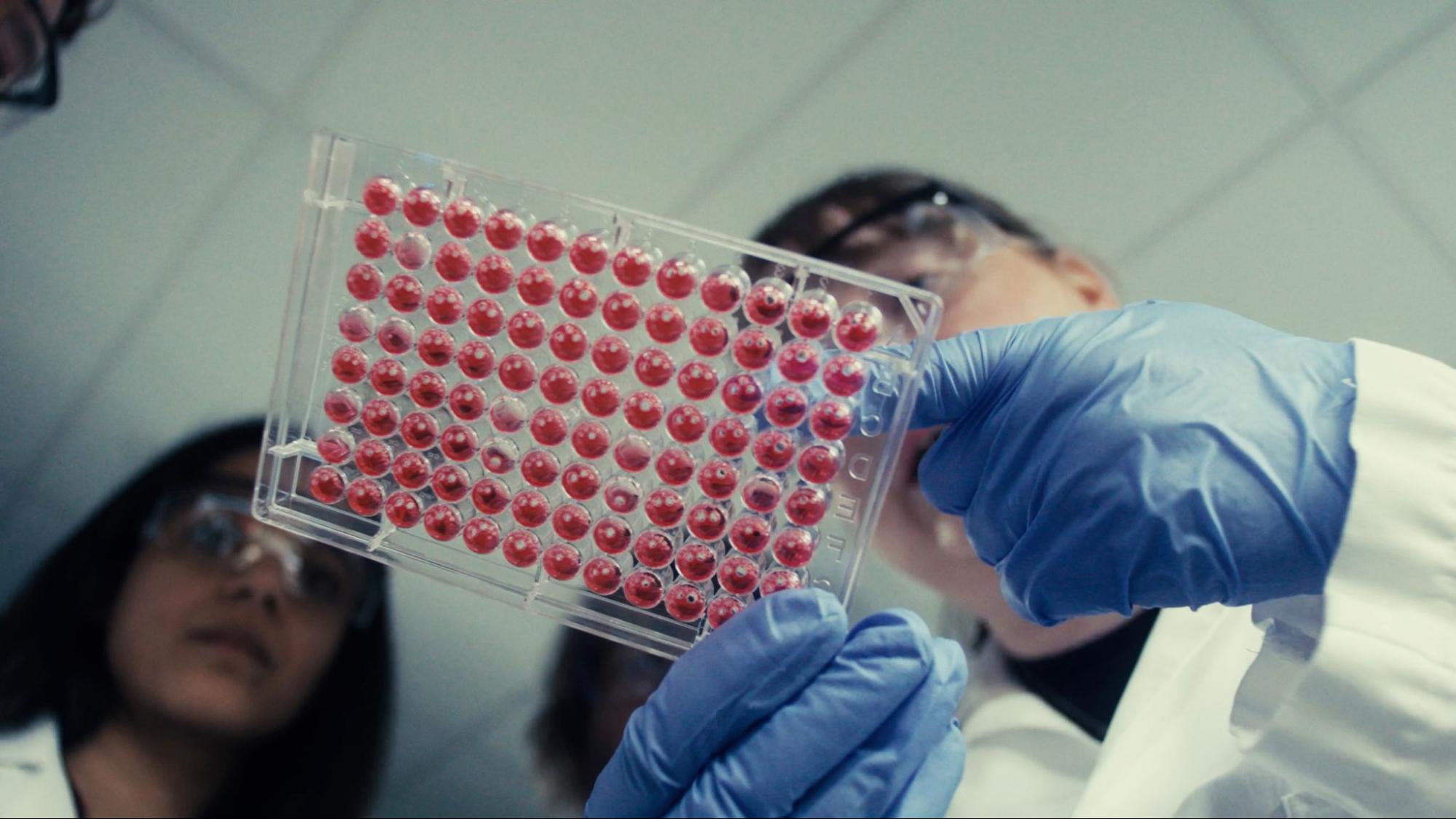
Source: Anthropic's official announcement
Who Is Actually Building on It Today
The partner list extends well beyond research groups into the major laboratory-equipment and industrial-robotics vendors, which is itself a seriousness signal:
- Launch partners with case studies: Genentech, the University of Washington through the Baker and Pinglay labs, Carnegie Mellon University, HHMI Janelia, quantum-computing company QuEra, and Tetsuwan Scientific.
- Vendors building support into their products: AWS through its Strands Robots package, Automata, Danaher, Doosan Robotics, MBF Bioscience, QIAGEN, Tecan, and Universal Robots.
- Early adopters: Hugging Face through the open-source LeRobot project, and the Raspberry Pi ecosystem.
The presence of Raspberry Pi and LeRobot matters for students and independent builders: the standard is not reserved for laboratories with seven-figure budgets but was designed to also work with cheap, open hardware accessible to university teams and makers. If you have been following the open robotics track, you will notice MHS completes a picture we have covered step by step: Google's Gemini Robotics ER 2 robot brain, NVIDIA's GR00T 1.7 release on LeRobot, and Mistral's single-camera Robostral Navigate model. The crucial difference is that those are thinking models, while MHS is the hand that touches the actual machine.
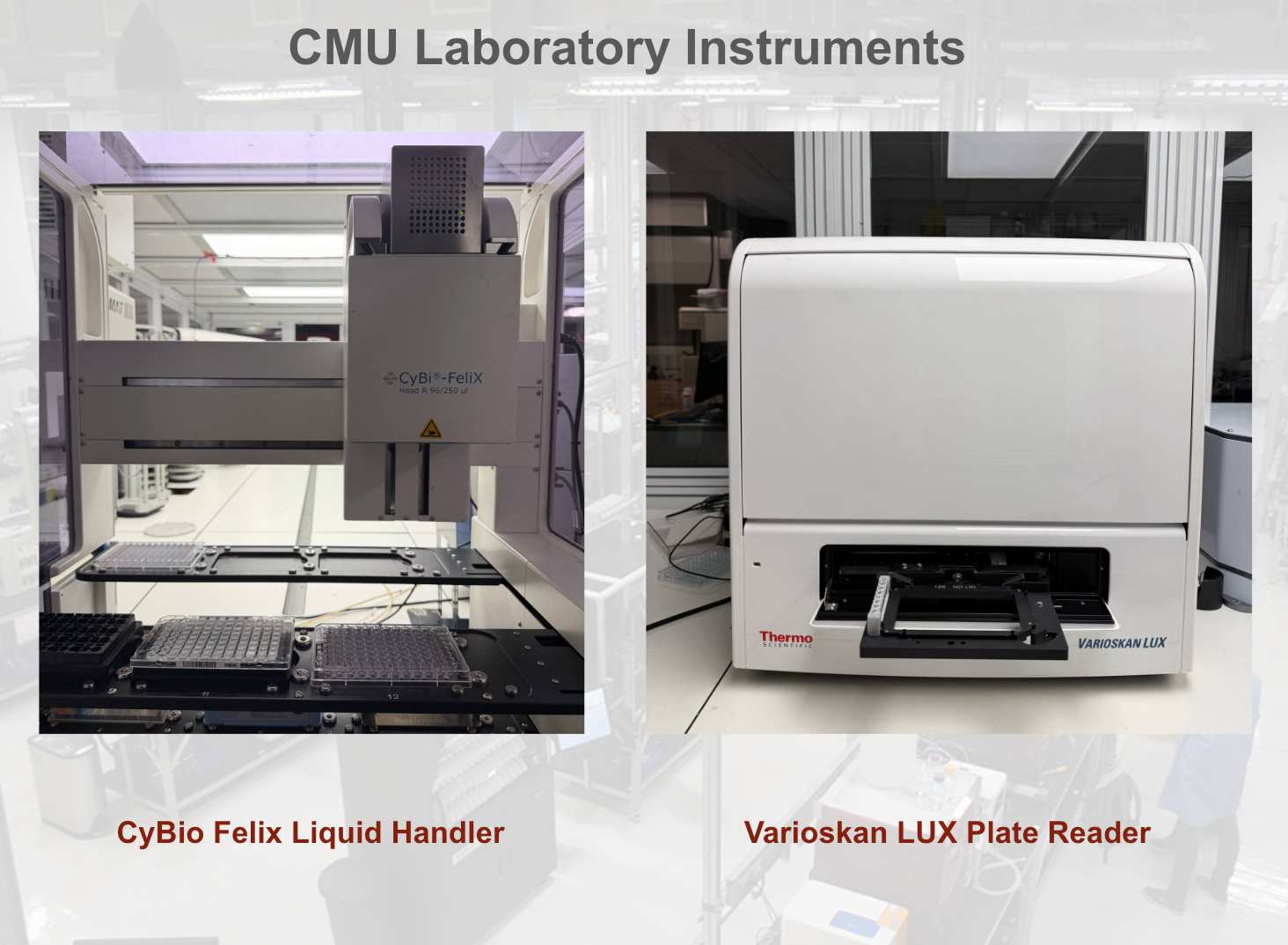
Source: Anthropic's official announcement
How to Apply for Access from Anywhere
Access today runs through an application process, not a license purchase. The steps, as laid out in the official sources:
- Visit the standard's official site at modelhardwarestandard.com.
- Read the scope of the research preview: it is aimed at stakeholders across science and industry who will test the standard, build safety evaluations, and develop best practices for agents operating physical equipment.
- Submit an application through the available form, describing your use case and hardware.
- If accepted and you operate on AWS, you can additionally use the pre-release Strands Robots package offered to preview participants.
There is no announced pricing because the effort is not commercial yet; findings and safety guidance will be published when the standard is open-sourced. For universities and research centers building automation programs — whether in Europe, Southeast Asia, Latin America, or the Gulf — applying early is a genuine opportunity to shape the specification before its final release, much as early participants influenced the open web standards that followed.
What This Means for You in Practice
If you are a researcher, an automation engineer, or a lab manager anywhere in the world, here is the reading that matters:
- For university labs: a Raspberry Pi and some open hardware are enough to build a compliant experiment station at minimal cost, turning a graduation project into experience with a real industrial standard.
- For manufacturers: production lines undergoing modernization need exactly this class of specification to cut the cost of automation and re-programming whenever equipment changes.
- For agent engineers: anyone already working with the Model Context Protocol will find the environment familiar, since MCP is one of the three control gates. Learning MCP now has doubled in value.
- For industry watchers: this is another step in a clearly strategic direction from Anthropic beyond language models, and many read it alongside the company's published position on open-weights models as part of a broader application-layer roadmap.
While this ecosystem matures, you can build practical skills with the tools available to everyone today — start with the AI tools reviewed on Truescho.
Quick Comparison: MHS Versus Traditional Integration
| Aspect | Bespoke traditional integration | With MHS |
|---|---|---|
| Time to connect a new device | Weeks to months | Hours to minutes |
| Cross-vendor differences | Every device is its own language | Unified read/write primitives |
| Safety documentation | Scattered manual files | Auto-generated reference file with enforced limits |
| Agent access | Layers of custom middleware | MCP, CLI, or direct APIs |
| Cost for a small lab | Usually prohibitive | Viable through open hardware like Raspberry Pi |
| Licensing | Closed per-vendor solutions | Research preview now, open source planned |
Limitations You Should Know Before Getting Excited
Fairness requires listing what is not finished, exactly as stated in the official sources rather than outside speculation:
- Claude's spatial and physical reasoning still requires expert human oversight; the standard automates access to the device, not the responsibility of the supervising human.
- Devices without a programmable interface are not supported at this stage, so fully legacy equipment remains out of scope.
- Access is application-gated, and the initial participant group is limited by the nature of a research preview.
- There are no localized interfaces and no pricing; what exists today serves research and industrial institutions, not individuals.
- Broader independent replication has not been published; the announced numbers all come from first-wave partners, and other organizations' results may differ.
Frequently Asked Questions
What is Anthropic's Model Hardware Standard?
It is a shared specification announced by Anthropic on August 27, 2026 that lets AI agents safely operate physical devices in laboratories and factories, through a standardized driver, automatic device discovery, and an auto-generated reference file documenting safety limits, with an open-source release planned.
How does MHS let an AI agent control lab equipment?
The agent reaches the device through one of three gates — the MCP protocol, a command-line interface, or code APIs — then performs unified read/write operations such as setting a temperature, within the safety limits documented in the device's generated reference file.
Is the Model Hardware Standard open source?
Not yet. It launched as an application-only research preview for research labs and advanced manufacturers, and the stated plan is to open-source it once the preview concludes and safety guidance is published.
How do I join the MHS research preview?
By applying at modelhardwarestandard.com with a description of your use case and hardware. The announcement does not restrict participation by geography; selection is based on the research or industrial merit of the application.
How does MCP relate to Anthropic's new standard?
MCP is a standard protocol for connecting AI agents to tools and data, and MHS adopts it as one of its three control interfaces — meaning any agent framework that speaks MCP can operate compliant devices without custom bridges.
Does the standard replace automation engineers?
No. The announcement itself states that the models' physical reasoning still needs expert oversight. MHS removes repetitive integration work but raises how many systems one engineer can oversee at once.
The landscape is shifting quickly, and we track every turn of it. To stay sharp on the AI tools you can use today without waiting for previews, start with the Truescho AI tools directory.