

The direct answer: a similarity index in the blue or green band of a Turnitin report — meaning anything up to 24 percent — is generally safe territory for a thesis or assignment, scores from 25 to 49 percent deserve a careful read rather than panic, and anything above 50 percent needs active rewriting before submission. Within that green zone, many universities and examiners in practice look for something between 10 and 20 percent for undergraduate and master's work, and often tolerate a bit more in PhD chapters dominated by literature review. But the number alone tells you very little, and this is the point Turnitin itself keeps making: there is no universally acceptable percentage, because a score is high or low depending on where the matching text sits, how it is cited, and what your specific institution has decided to allow.
That is why this guide goes past the single number. Below you will find the thresholds that universities have actually published — not the invented ranges that circulate on content farms — a practical method for reading a Turnitin report the way an examiner reads it, the five official exclusion filters that lawfully change your score, and seven fully legitimate techniques for bringing similarity down without touching the borders of plagiarism.
The Short Answer, and the Three Caveats Attached to It
If you want a working rule of thumb for the pre-submission moment, use this one: aim to sit comfortably inside the green band, keep your largest single-source match small — the University of Baghdad's published cap of 5 percent from any one source is a sensible private benchmark even where it does not formally bind you — and treat any yellow report as a prompt to open the report and read it, not as a verdict.
The three caveats matter as much as the rule. First, the vendor's own position: Turnitin's instructor and student guides state plainly that the similarity score is simply the percentage of text in a submission that matches other sources in its database, that Turnitin does not check for plagiarism but highlights matched text for human review, and that no fixed number is acceptable everywhere — each university, instructor and assignment can differ, so your institution's policy is the only binding one. Second, the composition principle from the University of Exeter's library guide, which this article returns to repeatedly because it is the single most useful idea in the field: a report of 45 percent spread across 45 different sources, roughly 1 percent each, is usually not a problem, while 12 percent drawn from one or two sources is much closer to one. Third, stage matters: what passes in a first-year essay will not pass in a doctoral thesis, and journal editors read similarity reports differently again — qualitatively, with attention to where the matches fall in your manuscript.
What Universities Actually Publish: Documented Thresholds by Stage
Most articles in this niche print ranges like "10 to 15 percent is fine" with no source at all. That is exactly backwards: the institutions that publish real numbers are findable, quotable and worth quoting, because they show how different the official positions genuinely are. Here is every documented threshold used in this article, with its source named inline.
| Stage or body | Published rule | Source |
|---|---|---|
| Master's theses and doctoral dissertations, University of Baghdad | 15 percent total similarity, with a maximum of 5 percent from any single source; trivial quotations below 1 percent excluded | University of Baghdad plagiarism-detection portal, controls approved by the Iraqi Ministry of Higher Education |
| Promotion research files, University of Baghdad | 20 percent total similarity | Same ministry-approved controls |
| Penalties for intentional plagiarism in results, applications or recommendations chapters | Cancellation of the student's enrolment, plus a weekly research ethics course; a unified Turnitin and iThenticate standard across universities | Same controls |
| All levels, University of Exeter | No fixed percentage; composition decides — 45 percent across 45 sources is usually acceptable, 12 percent from one or two sources is not | Exeter library Turnitin guide |
| All levels, MIT | No published percentage; the integrity handbook bans copying ideas, data or verbatim wording without attribution | MIT academic integrity site |
| Every user of Turnitin | No universal acceptable score; each institution sets its own | Turnitin instructor and student guides |
What the table teaches is the honest structure of the question. One national system — Iraq's, in this case — hard-codes 15 percent with a 5 percent single-source cap and serious consequences for deliberate copying. Most Western universities refuse to publish a number at all, precisely because a percentage without context punishes honest literature reviews and rewards cleverly disguised copying. For journal submissions, editors typically screen with iThenticate rather than Turnitin and judge the report qualitatively; no major publisher posts a fixed cutoff, so the professional move is to read the journal's guide for authors and, where it is silent, keep your index low and your matches diffuse. And for doctoral work specifically, the common practice — practice, not published policy — of tolerating somewhat higher totals reflects the sheer size of literature-review chapters, not a license to paste.
How to Read a Turnitin Report: the Number Is the Beginning of the Analysis
Opening the similarity report is where your score either becomes manageable or becomes a problem you can actually fix, and the reading method takes five minutes to learn.
Start with the color. Turnitin's official bands are: blue for no matching text, green for anything from one matching word up to 24 percent, yellow for 25 to 49 percent, orange for 50 to 74 percent, and red for 75 to 100 percent. The bands are triage, not judgment — they tell the marker how closely to look.
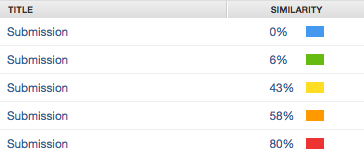
Source: Turnitin Guides
Then read the shape of the match list, not the headline figure. The report's sidebar ranks every source that matched your text. Look at the top of that list: your largest single-source match is the most informative number in the entire document, because a large concentrated match signals possible patchwriting or an uncited dependency, while many small matches from many sources usually signal an ordinary, citation-dense literature review. This is Exeter's principle in one action.
Next, examine the line-level highlighting. Each colored underline in your text links to the matched source, and the pattern of highlighting tells you what kind of similarity you have: long unbroken highlighted blocks usually mean quotation or copying; scattered short highlights often mean disciplinary phrasing, method descriptions or reference strings that no rewriting will ever remove — the standard phrasing of a blood-pressure measurement or a regression model is shared property, and examiners know it.
Finally, remember what the index includes by default. Quoted text inside quotation marks and the bibliography are both counted as matches until exclusion filters are applied, and Turnitin's own instructor guide describes a student whose 53 percent score was driven largely by extensive quotation and reference lists that exceeded the institution's allowance — a number the filters would have prevented. A high score made of cited quotes and references is a formatting conversation with your supervisor, not an academic offense.
https://www.youtube.com/watch?v=oI-TrsyJvo4
https://www.youtube.com/watch?v=6bjnVRVIdJA
The Five Official Exclusion Filters That Lawfully Change Your Number
Turnitin ships with five exclusion filters, and knowing them changes how you interpret every report you will ever receive. They are documented in the official guides for both instructors and students:
- Exclude bibliography — the system automatically detects reference lists and removes them from the index, including lists written in languages other than English by recognising start and end phrases such as "references", "bibliography" and "endnotes". For theses written outside the English-speaking world, this single filter routinely removes several percentage points.
- Exclude quoted text — passages inside quotation marks are removed from the count, which is exactly as it should be, since quoted material with attribution is legitimate scholarship.
- Exclude cited text — matched passages carrying in-text citations can be filtered separately, reflecting the principle that attributed paraphrase is not plagiarism.
- Exclude small matches — matches below a word threshold set by the instructor vanish from the index, clearing disciplinary boilerplate and standard phrases.
- Exclude small sources — entire sources whose total contribution falls below a chosen percentage can be dropped, cleaning the report of trivial database hits.
Who flips these switches varies by institution: the settings are controlled by the instructor or administrator who created the assignment, and students can sometimes apply filter views to their own report. The practical protocol is simple. Before submission, ask your supervisor or graduate office which exclusions your institution enables — many do not enable them by default — and, if you are permitted an early check, run it with quotes and bibliography excluded so you are improving the number that will actually be assessed rather than a scarier one that will not.
Seven Legitimate Ways to Lower Similarity — and Why Each One Is Allowed
Lowering a similarity score legitimately means changing how you write, not hiding what you wrote. Each technique below is standard academic practice, and each comes with the reason it is academically legitimate.
- Paraphrase genuinely, then cite anyway. Restate the idea in your own syntax and vocabulary — new sentence structure, new framing, your own emphasis — and still name the source. This is allowed because attribution with transformation is precisely what academic writing asks for; the citation keeps you honest, and the transformation proves the understanding is yours. Rephrasing flagged paragraphs is the slowest, highest-value part of the whole exercise; if the wording needs a professional polish, Qaddimli's language and style editing service refines up to 1,000 words of your text without changing the scientific content.
- Cite every borrowed idea in correct APA 7 style. Attribution is the mechanism that converts matched text into legitimate scholarship, and correct formatting makes your citations legible both to examiners and to exclusion filters. Working from concrete APA 7 citation examples removes the guesswork from author-date formatting, DOIs and page numbers.
- Quote sparingly, and only where wording itself matters. Keep direct quotation for pivotal sentences — a definition, a law, a memorable original phrasing — inside quotation marks with a page number. Selective quotation is legitimate because exact wording sometimes carries evidence; mass quotation is the problem, not quotation itself.
- Synthesize sources instead of summarizing them one by one. Take four studies and write one analytical paragraph that compares their methods, samples and disagreements. Synthesis is legitimate because the paragraph's structure and judgment exist nowhere in any source — it is your intellectual work, so it cannot match anything. Our guide to writing the previous-studies section without inflating similarity builds this skill step by step.
- Cut your quote density. Wherever a block quote merely repeats a point you could compress, replace it with a tight paraphrase plus citation. Reducing quotation volume is legitimate because it removes redundancy while preserving every source credit — the argument stays fully attributed and becomes more yours.
- Grow your own analysis. Connect each source to your own research problem, critique the methods, note the gaps, and state what your data adds. Original analysis is the one part of a thesis no database can match, and sharpening your research problem statement is what gives that analysis a spine. Legitimate because it is definitionally new.
- Self-check early, on a full draft, and fix what you find. Run the check on a draft, read every flag, repair accidental missing citations and patchwriting, then re-check the final PDF so late formatting has not shifted anything. Pre-submission self-checking is sanctioned practice at most institutions, and catching an accidental uncited match before submission is the difference between a learning moment and a misconduct case. Long projects benefit most from this habit — if you are at the start, seeing how a PhD research proposal is structured keeps your own voice in the driver's seat from page one.
Notice what is absent from this list: no trick filters, no character-swapping, no translation laundering, no "paraphrasing tools" spinning text into word salad. Those tactics fail on the axis that matters — a marker reading your work — and many now fail on a second axis too, because machine-spun prose reads exactly like what it is.
Similarity Is One Indicator; AI Detection Is Another
A modern wrinkle deserves its own clarification: the similarity index and the AI-writing indicator are separate measurements, and conflating them causes real confusion. Turnitin's Originality product reports them independently — a manuscript can score near zero on similarity and still carry an elevated AI-writing flag, or the reverse. The AI-writing detection capability officially covers Arabic-language submissions as well as English, alongside an indicator designed to balance signals of AI-generated phrasing against the student's own writing. For your purposes the practical conclusion is small but firm: a clean similarity percentage is not a certificate that a submission is clean overall, and the credible defense against both indicators is the same — be able to explain, sentence by sentence, why every paragraph says what it says. Human readers make the final call in every serious process, the same way the academics and experts on Türkiye Bursları interview panels probe whether a candidate can defend their own written work in person.
Frequently Asked Questions
What is a good Turnitin similarity score?
Most institutions treat the blue and green bands — anything up to 24 percent — as comfortable, and many informally expect 10 to 20 percent for taught-degree work. But no universal safe number exists: Exeter judges composition over totals, Baghdad caps theses at 15 percent, and Turnitin says your institution sets the standard. Read the match list, not just the headline.
Is 30 percent similarity acceptable if everything is cited properly?
Sometimes, depending on where the 30 percent sits. Spread across dozens of cited sources, it is often unremarkable for a literature-heavy chapter; concentrated in one or two sources, it invites questions even at 12 percent, as Exeter's guide notes. Under Baghdad's published thesis rule of 15 percent total, a 30 percent report would need genuine rewriting. Ask which policy binds you.
Do quotations and the bibliography count in my score?
Yes, by default they do. The similarity index includes quoted text and reference lists until the exclusion filters are applied, and Turnitin's own guides describe a student flagged at 53 percent largely because of extensive quotation and references. Enabling the quote and bibliography exclusions — ask your supervisor or graduate office — often changes the picture dramatically before you rewrite anything.
What do the colors in a Turnitin report mean?
Blue signals no matching text, green runs from one matching word to 24 percent, yellow covers 25 to 49, orange 50 to 74, and red 75 to 100 percent. These are Turnitin's official bands and they are triage signals, not verdicts. A yellow report built from cited quotations is healthier than a green report matching an unattributed ghostwritten text.
Does Turnitin detect AI writing, including in Arabic?
Similarity and AI detection are separate indicators inside Turnitin's Originality product, and the AI-writing detection officially supports Arabic submissions alongside English. A document can show low similarity and still raise an AI flag, so never treat a low similarity percentage as proof of overall integrity. The durable defense is being able to explain your own text.
Can I check my score myself before submitting?
Often, yes. Many universities allow draft submissions through the learning platform, and journals commonly pre-screen manuscripts for authors through iThenticate. Run an early check with the standard exclusions applied, repair flagged paragraphs, then re-check the final PDF — late edits and formatting shifts can move matches between pages and sections.
Before You Press Submit: the Pre-Submission Checklist
The last hour before submission is worth more than the last month of anxious guessing. Work down this list against the actual report, in this order:
- The exclusion filters for quotes and bibliography are applied, and you know your institution's settings.
- Your largest single-source match is low — under 5 percent is a sound private benchmark drawn from Baghdad's published rule.
- Every highlighted passage is either inside quotation marks with a page number, or paraphrased with an in-text citation, or disciplinary boilerplate you have consciously accepted.
- Every in-text citation appears in the reference list, and every reference list entry appears in the text.
- Direct quotations are rare and load-bearing, not decorative.
- The literature review reads as synthesis — sources talking to each other — rather than a chain of single-source summaries.
- Your own analysis, critique and problem statement occupy visible space in every chapter.
- The final check was run on the final PDF, after the last formatting pass, not before.
Want someone to handle this step for you?
Qaddimli formats your thesis to your university's guide or APA standards — headings, margins, automatic lists of contents — delivered in Word and PDF files ready to upload — see thesis formatting.