
Academic Paraphrasing: Seven Approaches With Before-and-After Examples
Academic paraphrasing means explaining a source's ideas in your own language while preserving their meaning and acknowledging their origin. It is not a contest to replace enough words. A passage can contain many new words and still misrepresent the research, conceal borrowed ideas or follow the original too closely.
The seven approaches below help you work with source material deliberately. Five develop or support paraphrasing; summarizing and quotation are distinct alternatives when they better serve your argument. None of the mechanical changes is sufficient on its own. All before-and-after passages in this workshop are original teaching examples, not quotations from published studies or reports of real findings.
Decide whether to paraphrase, summarize or quote
Start with the purpose of the source in your paragraph. Do you need a specific explanation, the broad direction of several findings, or the exact wording of a definition? The answer determines how much information to retain and which source-integration method fits.
| Method | What you retain | What changes | Attribution requirement |
|---|---|---|---|
| Paraphrase | The specific meaning and necessary detail | Your wording and sentence construction | Cite the original source. |
| Summary | The main point or selected relevant points | Length and level of detail are reduced | Cite the summarized source or sources. |
| Direct quotation | The exact language you need to discuss | Its position within your own argument | Mark the quotation and provide the required source locator. |
The University of Utah Writing Center's guidance distinguishes restating a message from condensing it. Both require documentation. A summary that drops a central qualification is inaccurate; a paraphrase that simply follows the original with substituted synonyms may be unacceptable patchwriting.
For a literature review, the aim is usually to organize evidence around a question rather than rewrite one article after another. Our literature-review guide offers a comparison framework. Read beyond the sentence you plan to use: its limitation may be explained in the next paragraph, a table note or the study's methods.
Understand the passage before changing its language
Read until you can explain the idea without looking at the original. Note the subject, main claim, evidence and qualifications. Then set the source aside and draft the contribution it makes to your argument. Reopen it to compare meaning, not merely vocabulary.
The George Mason University paraphrasing guide explains why inserting synonyms word by word can remain patchwriting. Technical terms may need to stay unchanged because an approximate alternative would describe a different concept. Originality comes from your independent explanation and argument, with proper attribution, rather than from replacing every recognizable word.
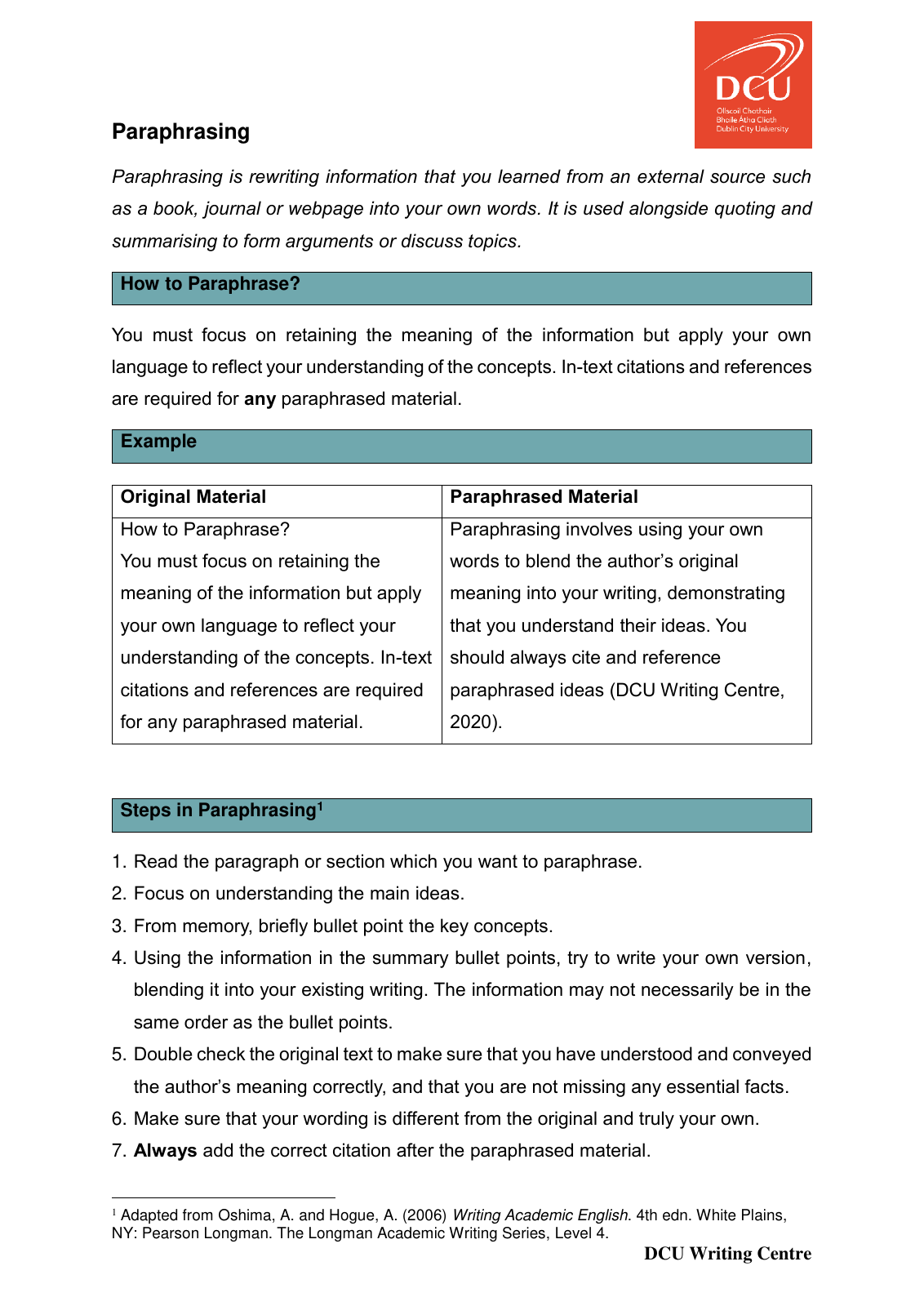
Source: page 1 of Dublin City University Writing Centre's paraphrasing guide.
DCU's guide also warns that isolated mechanical techniques do not constitute effective paraphrasing. Use the following examples as decisions to combine within a complete rewrite. The source and revision are shown side by side in sequence so you can inspect the relationship; this is not a recommendation to write every academic sentence while staring at its original.
Seven approaches to working with academic source text
1. Choose vocabulary by meaning, then rebuild the explanation
Source passage: “Students who received written feedback described the revision process as more manageable, although they still found it difficult to decide which comments deserved priority.”
Revision: “Written feedback helped students feel that revision was easier to organize, but they continued to struggle with ranking the comments they had received.”
The revision preserves the students' reported experience and the remaining difficulty. It does not claim that feedback objectively improved their grades or removed every obstacle. “Described” and “feel” concern perception; replacing them with “demonstrated” would strengthen the evidence beyond what the passage provides.
Do not produce a near-copy such as “Learners who obtained written comments called the editing procedure more controllable.” The substitutions may sound awkward while leaving the source's structure largely intact. After selecting accurate vocabulary, reconsider the whole explanation and its role in your paragraph. Keep specialist terms when changing them would introduce ambiguity.
2. Change sentence construction or word class
Source passage: “The expansion of evening opening hours enabled employed students to use the laboratory after finishing their shifts.”
Revision: “Employed students could use the laboratory after work because it remained open later in the evening.”
The noun phrase “the expansion” becomes a clause explaining what changed. The information begins with the people affected rather than the administrative action. The relationship remains the same: later hours made a particular pattern of access possible.
Check the boundaries. “All employed students used the laboratory every evening” would add frequency and universality absent from the passage. “The laboratory became more effective” would introduce a different outcome. A useful syntactic change clarifies the original relationship without supplying missing results. In an actual research paper, the rewritten account still needs the source citation even though its grammatical form is substantially different.
3. Switch voice when the actor remains clear
Source passage: “Two trained reviewers independently classified the interview responses before the research team compared their decisions.”
Revision: “The interview responses were classified independently by two trained reviewers, and the research team then compared the classifications.”
Passive voice places the responses first, which may suit a paragraph describing the treatment of data. The revision retains who classified them, how many reviewers were involved and the order of the work. Removing those details could weaken the methodological account.
Changing active to passive is not a complete paraphrasing strategy by itself. It is a grammatical choice within a fuller explanation. Sometimes the actor is essential: “Errors were identified” obscures whether participants, researchers or an automated process found them. Decide what the reader needs to understand, then use the voice that makes that relationship visible.
4. Combine or divide sentences without changing their logic
Source passage: “The workshop was available online. Some students could not attend because their internet connection was unreliable. A recording was offered after the live session.”
Revision: “Although the workshop was delivered online, unreliable internet prevented some students from attending; a recording was subsequently made available.”
The combined sentence preserves the contrast between availability and practical access. It also preserves the timing of the recording. It does not say that every excluded student watched the recording, because the source does not establish that outcome.
The reverse move can be helpful when a source sentence contains several conditions. Divide it into shorter statements, but retain the connection between them. If two clauses describe different populations or studies, do not merge them into one finding. Sentence length is an editing matter; the boundaries of the evidence are a research matter.
5. Summarize when the broad point is sufficient
Source passage: “Participants valued the library's weekend opening, the availability of quiet rooms and the option to renew books online. However, they reported difficulty finding suitable group-study space during examination periods.”
Summary: “Participants appreciated several access and study facilities, while identifying examination-period group space as a continuing limitation.”
This is a summary, not a detailed paraphrase: it groups three positive features into a broader category. That reduction is appropriate only if your argument does not require the individual facilities. If you are comparing online renewal systems, omitting the renewal detail would remove the very information you need.
Summaries still require citations. They also need a fair balance. Reducing the passage to “Participants were satisfied with the library” would hide the limitation. Reducing it to “The library lacked suitable space” would erase the positive findings and overstate the scope of the problem.
6. Reorder information around your paragraph's focus
Source passage: “The course introduced weekly peer discussion after the first assessment. Students reported that this helped them explain their reasoning, but the study did not measure changes in examination scores.”
Revision: “Because examination-score changes were not measured, the reported benefit of weekly peer discussions introduced after the first assessment concerns students' ability to explain their reasoning, rather than demonstrated improvement in test performance.”
The revision begins with the limitation because that is the point the surrounding argument needs. It retains the timing, the reported nature of the benefit and the absence of an examination-score measure. The emphasis changes without reversing the finding.
Reordering can be especially useful when comparing evidence across studies. Keep the source's logic intact, however. A qualification should not become an afterthought if it changes what the finding means. Signal clearly which source supports each part when a paragraph brings together multiple publications.
7. Quote the wording when that wording is the evidence
Source passage: “Access is not meaningful unless a person can use the resource when the task requires it.”
Integrated quotation: “The workshop statement defines access through timing and use: ‘Access is not meaningful unless a person can use the resource when the task requires it.’ This definition distinguishes nominal availability from practical usability.”
The quotation retains the original language because the paragraph examines that definition. It is an alternative to paraphrasing, not a transformation that makes copied words your own. The demonstration sentence is original workshop material; in a real assignment, identify the actual author and add the locator required by the referencing style.
Use quotations selectively. Surround them with your own explanation of why they matter, and preserve their context. Cutting a qualification from the middle can distort the source even when the remaining words are reproduced exactly. Consult the assignment's referencing rules rather than assuming quotation marks alone complete attribution.
Audit meaning before polishing style
A fluent revision can be scientifically inaccurate. Compare the source and draft using a short evidence checklist: population, sample, timeframe, quantities, units, direction of the relationship, uncertainty, actor and conditions. Mark anything you have added and ask whether it comes from your own analysis or from the cited evidence.
| Source wording | Problematic revision | What went wrong |
|---|---|---|
| “May improve comprehension” | “Guarantees better comprehension” | Possibility became certainty. |
| “Associated with attendance” | “Caused higher attendance” | Association became causation. |
| “Some first-year participants” | “University students” | A limited population became a broad one. |
| “No clear difference was detected” | “The methods are identical” | Lack of detected difference became proof of equivalence. |
| “After six weeks” | “Over the long term” | The observation period was expanded. |
| “Participants reported” | “The study established” | Self-report became stronger evidence. |
For a short self-check, consider this invented statement: “Students who used the optional practice page reported greater confidence, but no achievement test was administered.” A draft saying “The practice page improved achievement” is unsupported. A sound revision retains both the reported confidence outcome and the absence of an achievement measure. No amount of vocabulary variation repairs that missing distinction.
When the ideas are already sound but the language needs attention, Truescho's language review and editing service covers grammar, style and flow in an existing document of up to 1,000 words. It preserves your content and voice; it does not create research findings, certify citations or promise a particular similarity score.
Keep a source ledger and make attribution visible
Separate exact copied notes from your own interpretations as soon as you read. A source ledger can contain the bibliographic record, page or section, exact quotation clearly marked, your explanation of its meaning and its intended use. This prevents a polished copied sentence from later being mistaken for your own draft.
| Ledger field | What to record | Why it matters |
|---|---|---|
| Source identity | Accurate author, title and publication details | Enables a traceable reference. |
| Location | Page, section, paragraph or another appropriate locator | Helps you verify context later. |
| Exact wording | A clearly marked quotation | Preserves the boundary between copying and drafting. |
| Your interpretation | Meaning written from understanding | Reveals uncertainties that need checking. |
| Intended role | Definition, finding, counterargument or limitation | Prevents irrelevant source accumulation. |
| Draft attribution | The source signal and citation needed in the paragraph | Connects the claim to its origin. |
Use a source signal where needed so readers know whose argument they are reading. One citation at the end of a long paragraph may not make the ownership of every sentence clear, especially when several authors and your own interpretation appear together. The University of Waterloo's paraphrasing guidance provides a useful source-integration workflow.
Follow the actual style required by your department. Our APA 7 examples and Harvard referencing guide help organize the mechanics. A correct reference-list entry does not replace an in-text citation, and a citation does not automatically excuse copying distinctive language without quotation marks.
Understand similarity reports and the limits of rewriting tools
Turnitin explains that its similarity score measures matching text, not a final determination of plagiarism. Proper quotations and reference material can match. Conversely, an uncited borrowed idea may use different words and produce little matching text. There is no universal percentage that proves academic integrity.
An AI-writing report addresses a different question and should not be treated as the same result. Turnitin's guidance on reviewing an AI-writing report presents it as information to interpret with other evidence and human judgement. Do not choose wording to evade a detector or assume that a reassuring result validates the research.
| Option | Verified feature scope at the review date | What you must still check |
|---|---|---|
| Manual drafting with source notes | No product-imposed rewriting word limit | Meaning, independence of expression and attribution. |
| QuillBot free Paraphraser | Official help states 100 words at a time and Standard/Fluency modes | Whether the revision preserves claims and fits the permitted workflow. |
| LanguageTool rephrasing | Official pages describe three sentences per day for basic use and six supported rephrasing languages | Language support, context and the accuracy of each suggestion. |
Sources: QuillBot's current free/Premium comparison and LanguageTool's rephrasing explanation. These are feature descriptions, not our performance tests. Product limits can change. LanguageTool's listed rephrasing languages are English, French, German, Dutch, Spanish and Portuguese; general grammar-language coverage should not be confused with this particular feature.
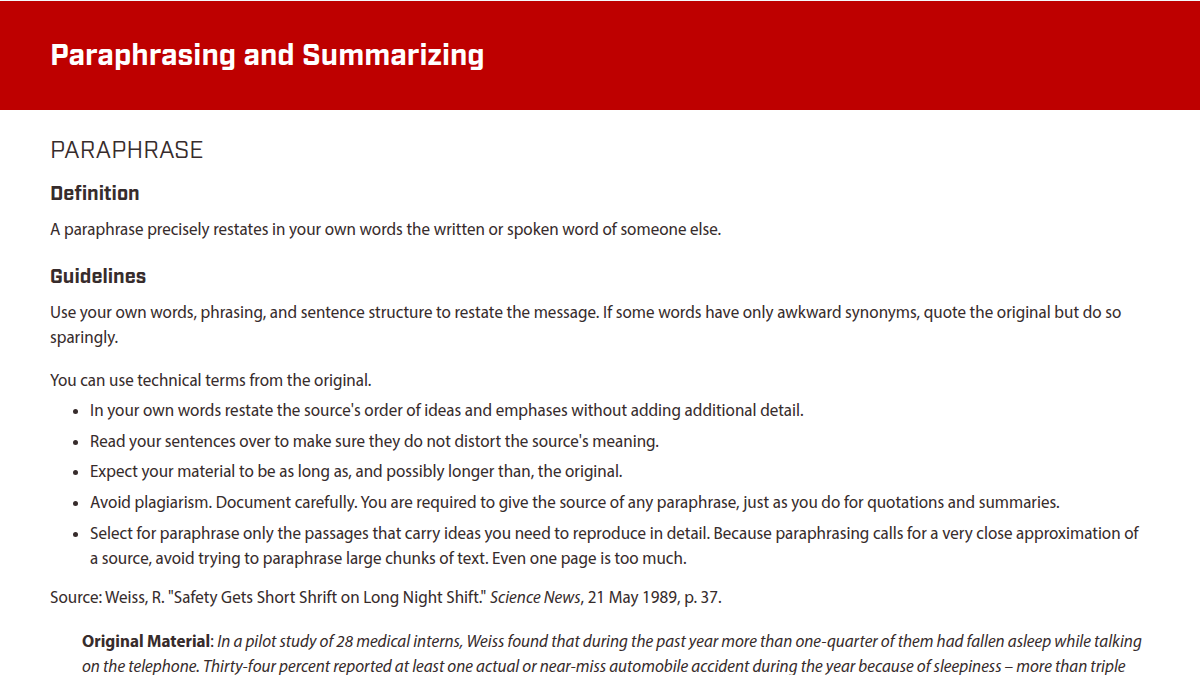
Source: screenshot of the University of Utah Writing Center's guidance.
Before uploading unpublished material, check institutional permission and the tool's relevant data-handling terms. Follow any disclosure requirements for assisted writing. Translation is also source use: changing the language of a borrowed idea does not remove the need to acknowledge it. Our academic translation guide explains the additional meaning-review questions involved.
Frequently asked questions
Do I need a citation if every word is different?
Yes, when the idea, finding or information comes from a source that requires attribution. Paraphrasing changes expression, not ownership. Readers should be able to identify where the evidence originated. Your own analysis should also be distinguishable from the material you are reporting.
Is replacing synonyms enough to avoid plagiarism?
No. Word-by-word replacement can remain patchwriting and may preserve too much of the source's structure. Understand the passage, set it aside, explain the relevant idea independently and compare the result with the original. Retain accurate technical terms rather than forcing unsuitable alternatives.
Can I keep the same technical terminology?
Often you should, because specialist terms can have precise meanings that ordinary synonyms do not share. Their presence does not excuse copying an entire explanation. Preserve necessary terminology while constructing your own account of the source and supplying the appropriate citation.
Is a low similarity percentage proof that my work is acceptable?
No. Similarity measures textual matches under a particular system and configuration. It does not establish the ownership of every idea, accuracy of every claim or compliance with an assignment. Review individual matches and source use in context instead of treating a percentage as a verdict.
When is a quotation better than a paraphrase?
Quote when the exact language is important to your analysis, such as a definition or a phrase you are interpreting. Mark the quotation, identify the source and supply the required locator. Explain its role in your own argument rather than allowing a quotation to stand without analysis.
Can I use an AI tool to improve a paraphrase?
Only within the rules that apply to your project and material. Check permission, confidentiality and disclosure requirements, then verify the resulting meaning and attribution yourself. A tool can produce fluent changes while altering uncertainty, causality or scope. It cannot transfer responsibility for the submitted work.
Does translating a source into English remove the citation requirement?
No. A translated borrowed idea still has an origin, and a translated quotation may need specific treatment under your referencing style. Identify the source and make the translation status clear where required. Review the meaning in both languages rather than assuming fluent English proves accuracy.
Submit a traceable, independently written argument
Keep the source notes, draft and final references connected. Before submission, inspect each borrowed claim for accurate meaning, independent expression and visible attribution. If an existing short document needs clearer grammar or flow after those research checks, request language editing and specify its purpose, length and required style. The final academic decisions and responsibility remain yours.