
100 US Dollars to Syrian Pounds: Conversion Tables in New and Old Currency for 2026
Last updated: Thursday, September 3, 2026 — every figure below comes from today's rate boards, quoted in both new Syrian pounds (the official unit since the January 2026 redenomination) and old Syrian pounds, so you can use whichever system your family, bank, or spreadsheet still relies on.
A hundred dollars is the most common remittance unit in the Syrian diaspora: it is the monthly top-up a sister in Germany sends home, the Eid gift from an uncle in Dubai, the emergency amount friends transfer when a medical bill lands. And almost everyone who searches "100 dollars to Syrian pounds" runs into the same wall of conflicting numbers: new pounds vs old pounds, buy rate vs sell rate, Damascus vs other cities, official bulletin vs market board. This guide collapses all of it into ready-to-use tables — from 10 to 5,000 dollars — with today's verified rates, and explains the three decisions (direction, timing, location) that determine how many pounds a hundred dollars actually puts in your hands.
100 dollars to Syrian pounds today: the direct answer
According to the Damascus parallel-market board of Thursday, September 3, 2026:
- Buy rate (what you receive when selling 100 dollars to an exchanger): 131.00 new pounds per dollar — so 100 dollars = 13,100 new pounds.
- Sell rate (what you pay when buying 100 dollars): 131.50 new pounds per dollar — 100 dollars = 13,150 new pounds to buy.
- In old pounds: add two zeros — 100 dollars = 1,310,000 old pounds when selling, 1,315,000 when buying.
- The official rate on the Central Bank of Syria's bulletin the same day: 122.00 new pounds per dollar, i.e. 12,200 new pounds per 100 dollars — but that rate applies to state channels and valuations, not to individuals at money changers. The full two-track explanation lives in Official vs Black-Market Exchange Rate in Syria: Which One You Actually Pay.
In one sentence: if you walk into a Damascus money changer today with a hundred-dollar bill, you walk out with about 13,100 new pounds; in Hasakah, between 13,170 and 13,220 — and every one of those differences is unpacked below.
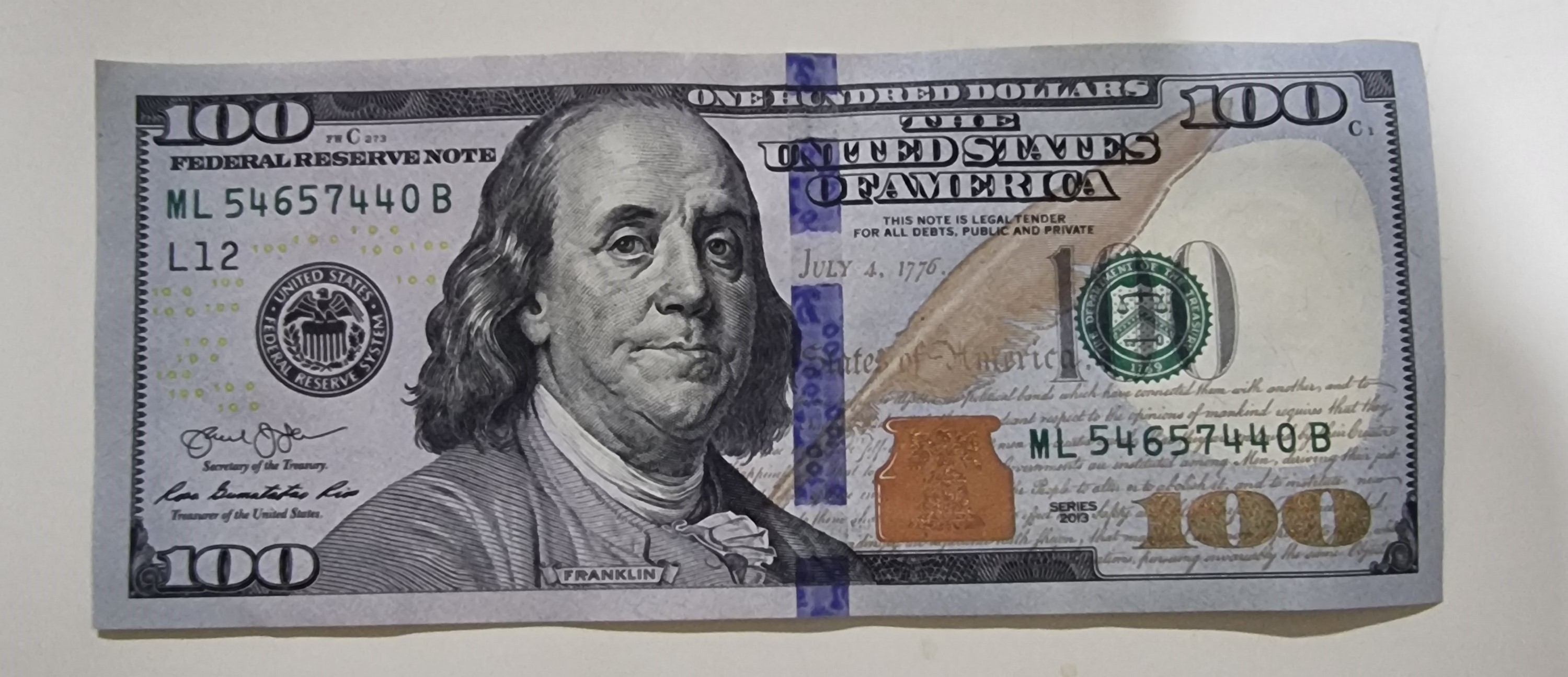
Photo: front of the US one-hundred-dollar note — Source: Wikimedia Commons
The full conversion table: 10 to 5,000 dollars, new and old pounds
All rows use today's Damascus rates (buy 131.00 / sell 131.50), with the official rate for comparison:
| Amount (USD) | You receive (buy) — new SYP | Same in old SYP | You pay (sell) — new SYP | At official 122.00 — new SYP |
|---|---|---|---|---|
| 10 | 1,310 | 131,000 | 1,315 | 1,220 |
| 50 | 6,550 | 655,000 | 6,575 | 6,100 |
| 100 | 13,100 | 1,310,000 | 13,150 | 12,200 |
| 200 | 26,200 | 2,620,000 | 26,300 | 24,400 |
| 500 | 65,500 | 6,550,000 | 65,750 | 61,000 |
| 1,000 | 131,000 | 13,100,000 | 131,500 | 122,000 |
| 5,000 | 655,000 | 65,500,000 | 657,500 | 610,000 |
Three facts fall out of this table:
- The buy/sell spread is half a pound per dollar (about 0.4%), but it compounds with size: 25 new pounds on 5,000 dollars — real money, worth a two-minute comparison between exchangers.
- The distance from the official rate is a fixed percentage: 900 new pounds per 100 dollars, roughly 7.4%. Nobody is skimming that from you; the official rate is simply not available on your channel.
- New-to-old conversion is mechanical: add two zeros to go old, remove them to go new. There is no multiplier, no devaluation haircut — it is a redenomination of the same value, fully explained in Old vs New Syrian Pound: The Two-Zero Redenomination Explained.
For the reverse question — how many dollars your pound savings are worth — the complete reverse tables from one thousand to one million pounds are in How Much Is a Million Syrian Pounds in Dollars? Every Amount Converted, and the live calculator sits in USD to Syrian Pound Converter at Today's Rate.
Buy or sell: the half pound that decides your number
The most common mistake when searching this question is grabbing a single number without a direction. The rule is universal on every Syrian rate board:
- You are selling dollars (you received a transfer, you hold savings, you want pounds): your price is the buy rate, because the exchanger is buying from you — 13,100 new pounds per hundred today.
- You are buying dollars (preparing travel, paying a hard-currency invoice): your price is the sell rate — 13,150 new pounds per hundred today.
- Never use the midpoint for a real transaction. The midpoint is a monitoring convenience; no one pays it and no one receives it. The table above lists both sides precisely to avoid this trap.
For repeat recipients, timing is the quiet variable. Someone receiving 100 dollars monthly and converting on different days rides the market's weekly wiggle: if the parallel rate moves from 131.00 to 133.00 between two remittances, the same hundred dollars yields 13,300 instead of 13,100 — a "bonus" of 200 new pounds created entirely by conversion timing, not by the sender's generosity. This is why experienced recipient households watch the board for a few days and treat the convert-now-or-wait decision as part of monthly budgeting, and why the cost of the transfer channel itself deserves separate attention — covered in full in Sending Money to Syria in 2026: Legal Channels and Real Costs.
How much is 100 dollars in Damascus, Hasakah, and other cities?
Cities are not copies of one number. Today's boards document two:
| City | Buy | Sell | 100 dollars receives (new SYP) |
|---|---|---|---|
| Damascus (general board) | 131.00 | 131.50 | 13,100 |
| Hasakah | 131.70 | 132.20 | 13,170 |
The documented city gap today is 0.70 pounds per dollar in each direction — about half a percent — which is the typical scale of city variation in calm markets. Major monitoring boards do not currently publish a separate Aleppo panel; practically, exchangers in Aleppo work within the national margin around the Damascus general board. The working rule for any city without its own published panel: treat the Damascus board as your negotiation anchor, accept a spread of up to about one pound around it, and question anything wider unless the market is genuinely turbulent.
Three rules for using city differences:
- A small location gain cannot rescue bad timing. The half-percent you might gain by shopping cities is smaller than a normal weekly move; timing beats geography.
- Local competition is your friend. In bigger cities, comparing two neighboring exchangers takes two minutes and recovers part of the spread — mandatory practice for large amounts.
- The counting unit is identical everywhere. A new pound is a new pound in Damascus, Aleppo, and Hasakah; beware anyone quoting "old" figures for visual inflation and settling in new ones — which is exactly why this guide carries both columns in every table.
New and old pounds: a sixty-second conversion drill
Since January 2026, Syrians have lived in two number systems at once: the new pound on boards, salaries, and official statements, and the old pound alive in memory, in older relatives' speech, and in years of mental price anchors. Conversion between them needs no math beyond one rule: one new pound equals one hundred old pounds — add two zeros, or remove them. The skill is in applying it without hesitation:
- A board quoting 131.50 means new pounds; in old terms it is 13,150 per dollar.
- A relative quoting a price "two hundred thousand" is almost certainly speaking old pounds — that is 2,000 new pounds.
- A salary of "one and a half million" (old) is 15,000 new pounds; a transfer of "hundred thousand" (old) is 1,000 new.
Zero-errors are the number one arithmetic mistake in daily conversion, and their cost scales with the amount: two misplaced zeros turn 13,100 into 1,310,000 or vice versa — a hundredfold distortion of the entire transaction. The reliable safeguard is a mental anchor: in the current range, one hundred dollars is always "about thirteen thousand" new pounds. Any figure arriving a hundred times larger or smaller than your anchor is a zero-error, not a spectacular opportunity.
The journey of a hundred-dollar remittance
To understand why the number in your hand rarely matches the number on the board, follow a typical remittance from Berlin to Damascus. The sender pays euros at a transfer company, covering a fixed fee or a small percentage. The instruction travels to the company's payout partner in Syria. At payout, the partner converts to pounds at the channel's rate — usually pegged near the parallel market with a small margin for the agent. The recipient receives roughly the hundred dollars' value at the day's market rate, minus channel costs. Three variables, not one: the market rate on conversion day, the channel's fees, and the EUR/USD cross rate at the moment of sending.
Two hard-won tips from diaspora communities: compare your payout against the board of the conversion day, not the sending day (a two-day gap in a moving market can equal the entire channel fee), and keep the receipt stating the applied rate — it is your reference for disputes and your benchmark for choosing next month's channel. For recurring small transfers, batching helps: one channel fee on a doubled amount beats two fees on two halves — provided the family's needs can wait for the batch.
What a hundred dollars buys: converting the number into a household budget
Exchange rates only matter when translated into life. At today's prices, a 13,100-new-pound remittance covers, in a typical Syrian city, a meaningful slice of a household budget: most of a winter heating-gas cylinder refill, several months of home internet and mobile data, two weeks of school transportation for two children, or a small medical emergency buffer. This is why "what's the rate today?" is the most consequential economic question in many Syrian households — far more than any inflation statistic: the exchange rate is the direct converter between a relative's effort abroad and a family's standard of living at home.
For savers, the behavioral takeaway is gradualism: converting needs as they arise, rather than converting a lump sum on a single day, spreads currency risk across time. The mirror-image problem — turning pounds into dollars when needed — has its own practical playbook of channels and fees in Money in Syria 2026: The Practical Guide to Cash, Cards, and ATMs.
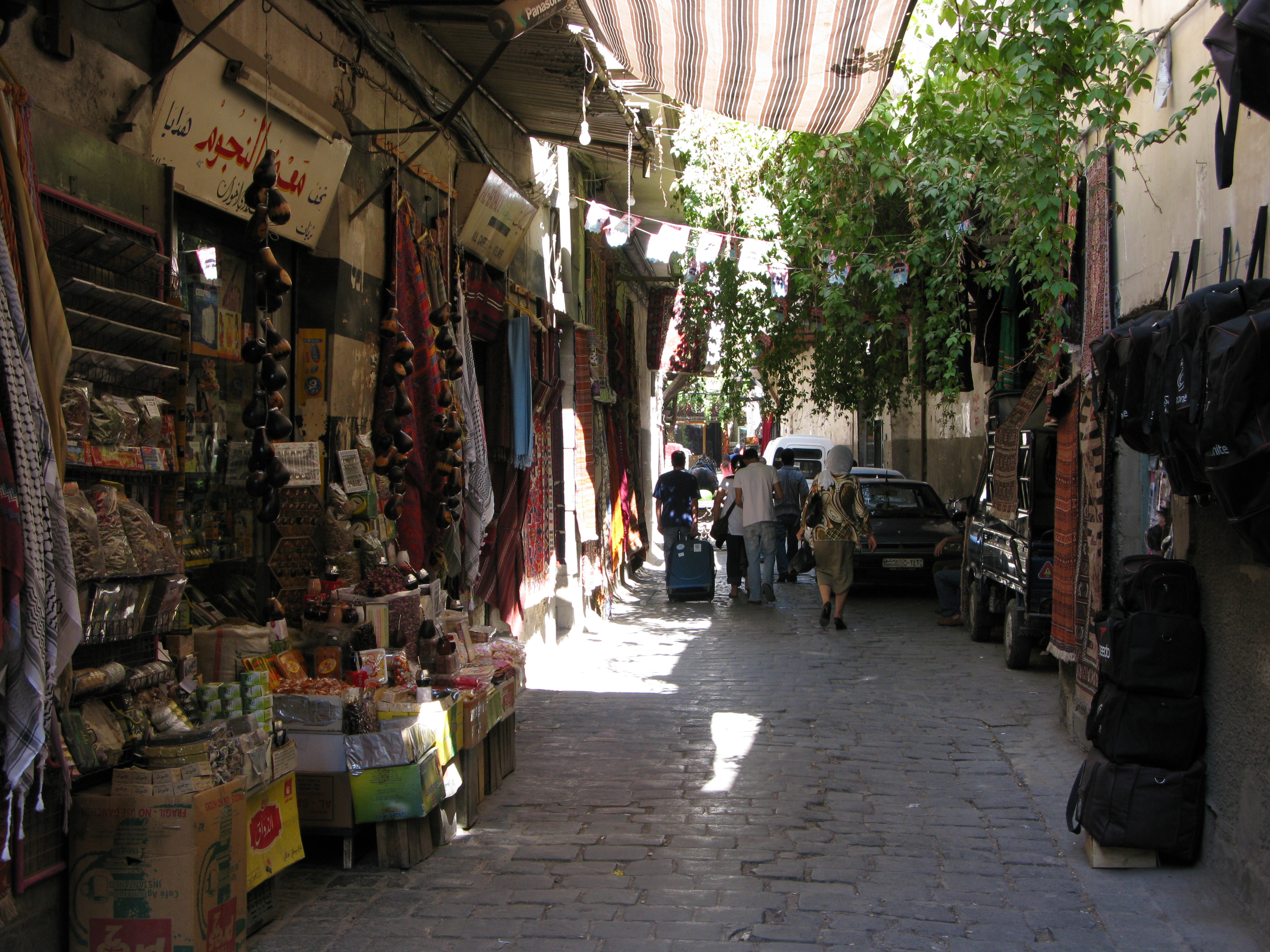
Photo: a public Damascus market — Source: Wikimedia Commons
Reading the trend before you convert: four windows
"Today's rate" is only half a question; "where is it heading?" completes it. Today's board carries four windows, and each serves a different decision:
- Daily change (~0.15% down today) is noise; it should never delay an existing need, since waiting costs more than the move is worth.
- Weekly change (~0.6% down) suits timing small remittances: a clearly rising week argues for converting immediately after payout; a falling week allows a day or two of patience if needs permit.
- Monthly change (~0.15% up) is the budget window: anyone converting one large amount for a month's expenses should price it at the month's average plus a one-percent safety buffer.
- Yearly change (~19% up for the dollar) is the savings window: it is the standing reminder that long-term goals should not sleep entirely in a high-inflation currency, and that splitting between currencies by horizon is prudence, not speculation.
One line summarizes it: look before you convert, but never wait without a deadline — pick the window that matches your need, decide inside it, and ignore the noise outside it.
Practical checklist before exchanging any amount
- Fix your direction first: seller or buyer? Your number depends on it.
- Always ask for both sides of the quote, even if you need only one; the spread reveals the exchanger's margin quality.
- Sanity-check a small basket of amounts, not just one: knowing 10/50/100/500 together instantly exposes any zero-error or rounding trick.
- Pin the timestamp of any board you cite: morning and evening quotes differ; compare like with like.
- Compute the after-spread net on large sums: on 5,000 dollars, a quarter-pound difference between two exchangers is 1,250 new pounds — five comparison minutes well spent.
- Settle on one or two dated, timestamped sources rather than harvesting numbers from old posts; a dead number is more dangerous than a wrong one because it looks credible.
Frequently asked questions
How much is 100 US dollars in Syrian pounds today?
Per the Damascus parallel-market board of September 3, 2026: 13,100 new pounds when selling (buy rate 131.00) and 13,150 new pounds when buying (sell rate 131.50). In old pounds: 1,310,000 when selling.
How much is 100 dollars in old Syrian pounds?
The old pound is one-hundredth of the new one, so add two zeros: 13,100 new pounds = 1,310,000 old pounds for a hundred dollars at today's rates.
Is the rate in Aleppo different from Damascus?
Today's major boards publish a general (Damascus) panel and a Hasakah panel about 0.70 pounds higher per dollar. No separate Aleppo panel is published daily; exchangers there generally work within a small margin of the general board. Practical rule: use the Damascus quote as your anchor and negotiate within about a pound of it.
Why do I receive 13,100 instead of 12,200 for my 100 dollars?
12,200 is the product of the Central Bank's official rate (122.00), which applies to state channels and valuations. Individuals transact in the parallel market at 131.00 buy; the roughly 7.4% difference is the gap between the two tracks, not anyone's commission.
How much are 50 and 500 dollars in new pounds today?
At today's Damascus buy rate: 50 dollars = 6,550 new pounds; 500 dollars = 65,500 new pounds. At the sell rate: 6,575 and 65,750. The full table above covers 10 through 5,000 dollars.
Does the answer change during the same day?
Yes — the parallel market typically moves within a narrow intraday band with supply and demand, while the central bank bulletin is published once daily. This guide's figures are pinned to today's evening boards; verify with a live tool before any large transaction.
Conclusion
A hundred dollars equals 13,100 new pounds when selling and 13,150 when buying in Damascus today (1,310,000 old pounds), between 13,170 and 13,220 in Hasakah, and 12,200 at the official rate — which individuals cannot access. The golden rule is three words in order: direction, timing, location. And because the number moves daily, one live tool keeps you from hunting boards: the SYPNow live rates page shows the rate in real time with an any-amount converter, and the SYPNow app removes even the browser. Disclosure: it is our own product, stated with full transparency.
Sources
- https://cb.gov.sy — Official Exchange Rate Bulletin, Central Bank of Syria, September 3, 2026
- https://sypnow.com/en/rates — Live parallel-market and reference rates in new Syrian pounds
- Damascus parallel-market boards as tracked by rate-monitoring platforms (sp-today), general and Hasakah panels, September 3, 2026 evening update — source named without linking
- /en/blog/syria-central-bank-dollar-rate-vs-parallel-2026 — Truescho file: the central bank rate vs the market, explained