
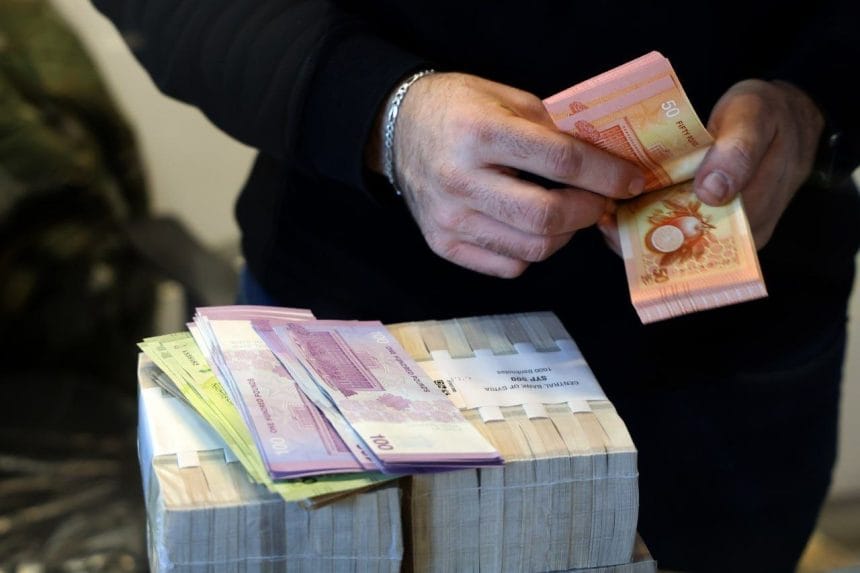
How Much Is 1 Million Syrian Pounds in USD? 2026 Conversion Table for Every Common Amount
One million new Syrian pounds is worth roughly $7,600 — precisely $7,593 to $7,622 at the Damascus market rate of 131.20–131.70 new SYP per dollar, observed September 2, 2026, at the time of writing. And if the million you are thinking of is in old Syrian pounds (the pre-2026 notes), divide by one hundred: one million old SYP is 10,000 new SYP, which is worth about $76.
Those two sentences are the entire answer; everything else in this article exists because the question hides a trap. Since January 1, 2026, Syria has two pounds in circulation — old and new, at a 100:1 ratio — and foreign websites, older news articles, and even some banks still quote figures in the wrong scale, making amounts look exactly 100 times bigger or smaller than they are. Below you get the full conversion table for every common amount (in dollars, euros, pounds sterling, Turkish lira, Saudi riyals, and UAE dirhams), the plain-language explanation of the old-vs-new confusion, and a three-step method to convert any amount yourself in seconds.
The conversion table: every common amount
Computed from Damascus market mid-rates observed September 2, 2026: 131.45 new SYP per USD (market spread 131.20–131.70), with EUR at 151.80, GBP at 176.65, TRY at 2.715, SAR at 34.90, and AED at 35.62 new SYP per unit. Actual payouts vary by about ±0.2 percent depending on the buy/sell side of the deal, and more once a provider adds fees.
| Amount (new SYP) | Same amount in old SYP | USD | EUR | GBP | TRY | SAR | AED |
|---|---|---|---|---|---|---|---|
| 1,000 new | 100,000 old | $7.61 | €6.59 | £5.66 | ₺368 | 28.7 | 28.1 |
| 10,000 new | 1,000,000 old | $76.08 | €65.9 | £56.6 | ₺3,683 | 287 | 281 |
| 100,000 new | 10,000,000 old | $761 | €659 | £566 | ₺36,800 | 2,865 | 2,810 |
| 500,000 new | 50,000,000 old | $3,804 | €3,294 | £2,830 | ₺184,200 | 14,330 | 14,040 |
| 1,000,000 new | 100,000,000 old | $7,607 | €6,590 | £5,661 | ₺368,300 | 28,650 | 28,080 |
| 10,000,000 new | 1,000,000,000 old | $76,074 | €65,880 | £56,610 | ₺3.68 million | 286,500 | 280,800 |
Read the table with three habits. First, always confirm the scale before repeating any figure: the bolded row answers the literal question "one million new pounds ≈ $7,607," while the row above it shows that "one million" in old pounds (10,000 new) is worth just $76.08. Second, treat every number as a snapshot — these were mid-market figures on a specific day, and the pound moves daily. Third, remember that the rate you personally get includes a spread and possibly fees; the mid is a benchmark, not an offer.
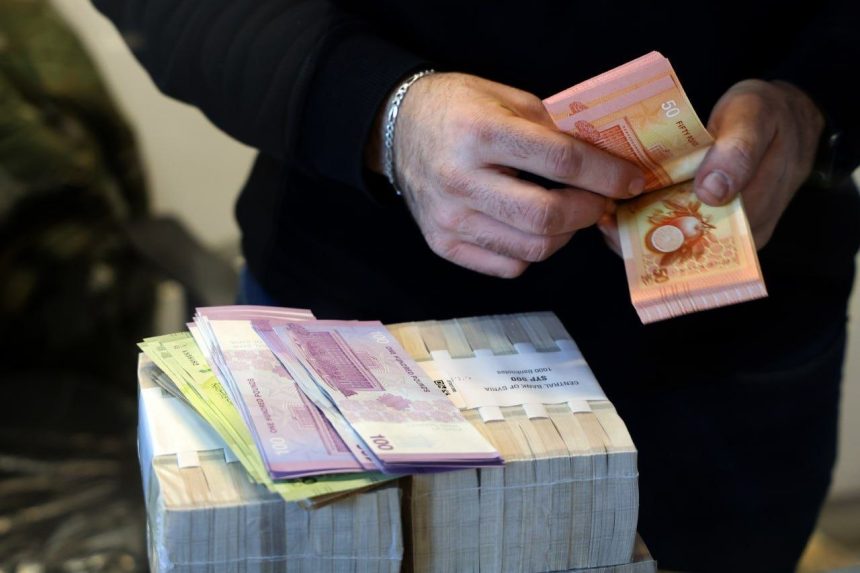
Source: SANA — Central Bank says 56% of old currency replaced
The old pound vs the new pound: why so many websites are 100× wrong
On January 1, 2026, Syria redenominated its currency: 100 old SYP became 1 new SYP. Salaries, prices, and savings converted at that single ratio, and new banknotes (25, 50, 100, 200, and 500 new SYP) entered circulation on January 3, 2026, replacing a money supply whose largest note had become nearly worthless. The exchange of old notes — initially scheduled to finish by March 31, 2026, extended to June 30 — was roughly 95 percent complete by the end of July 2026, per figures cited from the Central Bank.
The redenomination is why the internet is currently full of answers to this question that are wrong by a factor of one hundred. A site that has not updated since 2025 still quotes rates near "13,000 SYP per dollar" — correct in old pounds, but misleading today, because the same market now trades at "131.50" in new pounds. Multiply an old-scale price by nothing and you overstate it 100×; convert it as if it were new-scale and you understate it 100×. The failure mode is symmetric and everywhere: rental listings, salary discussions, charity appeals, even machine-translated news.
The defense is one question, asked explicitly every time money is discussed: "new pound or old pound?" In the 131 range, a number is almost certainly new pounds; near 13,100, the same market expressed in old pounds. When the speaker does not know either, the magnitude of the purchase tells you: nobody pays 13 million anything for a phone, and nobody buys an apartment for 5,000 of any local unit in 2026 Syria — if a figure sounds absurd in one scale, try the other before concluding anything about prices.
The two banknote families make the distinction visible. The new series — nature-themed designs in 25, 50, 100, 200, and 500 new SYP, with smaller and larger denominations following later in 2026 — circulates alongside the vanishing tail of the old series, whose highest notes (the 500 and 1,000 old SYP) were each worth just 5 and 10 new pounds after conversion. Our old vs new Syrian pound explainer covers the full conversion rule and both banknote families, and the eighty-year history of the pound's value explains how the currency reached the point where deleting two zeros became necessary.
How this table was computed (and why yours will differ slightly)
Every figure above is a division, not an opinion: amount in new SYP ÷ the day's mid-rate. The reference rates were captured on September 2, 2026, from the Damascus market — buy 131.20, sell 131.70 new SYP per dollar, hence mid 131.45. The cross-currency columns use the same observation: euros at 151.80, sterling at 176.65, lira at 2.715, riyals at 34.90, and dirhams at 35.62 new SYP per unit, which is why, for example, one million new SYP lands at €6,590 rather than a dollar figure converted at some other day's rate.
Your actual result will differ for legitimate reasons: dealers quote a buy/sell spread rather than a mid (about ±0.2 percent at the time of writing), transfer services and exchange offices add their own margins, and the market itself moves day to day — the new pound has drifted from 111.00 at its January launch to the low 130s by September, losing roughly 15–16 percent of its dollar value over 2026 so far. None of that changes the method: get the day's mid, convert, and compare any offer against it. For a deeper treatment of why the market rate is the one remittances and daily pricing actually use — versus the official central-bank rate — read the official vs market rate guide.
Do the conversion yourself in three steps
You do not need this article open to answer "how much is X Syrian pounds in dollars" tomorrow. You need one reference number and this loop:
- Get today's mid, in new pounds. Any live tracker that labels the scale works — for example the Damascus market rates our team publishes at SYPNow, which shows buy, sell, and mid in both new and old pounds, with the full-day history.
- Divide your amount by that mid. At 131.45 new SYP per dollar: 500,000 ÷ 131.45 ≈ $3,804. Working in old pounds? Divide by the old-scale equivalent of the same rate (13,145) or, identically, convert old to new first by removing two zeros.
- Label and date-stamp your result. "About $3,800, at 131.45 new SYP per dollar, September 2." An undated conversion is how the 100× errors and stale-rate errors survive.
For anything you check often, the calculator our team built into SYPNow does all three steps at once — it converts any amount between new pounds, old pounds, and a dozen foreign currencies using live market rates. Full disclosure: SYPNow is our own project, the same team behind this site, and we built the old↔new toggle precisely because mixed-scale figures were the single most common error we saw. The app is on the App Store and Google Play, and the web version is here.
From dollars to pounds: the reverse table
Half the people asking this question are converting in the other direction — pricing a gift, a freelance payment, or support for relatives back home. Here is the same market, reversed, at the same September 2, 2026 observation (mid 131.45 new SYP per dollar; the market's buy/sell spread was 131.20–131.70):
| Amount | In new SYP | In old SYP (same value) |
|---|---|---|
| $10 | ~1,315 | ~131,500 |
| $50 | ~6,570 | ~657,000 |
| $100 | ~13,145 | ~1,314,500 |
| $500 | ~65,725 | ~6,572,500 |
| $1,000 | ~131,450 | ~13,145,000 |
| $7,607 | ~1,000,000 | ~100,000,000 |
Two things jump out of the reverse table. First, $100 is once again "a million pounds" — in old pounds, which is why older relatives may still say "a million" when they mean a hundred dollars' worth; their arithmetic is old-scale, and it is not wrong, just dated. Second, the round-trip check: the last row is the dollar equivalent of the bolded row of the first table ($7,607 ≈ one million new SYP). If your own conversion does not round-trip within about half a percent, you have mixed a scale or a stale rate somewhere — redo it with today's mid.
A note on which direction to trust: when a dealer or service converts dollars into pounds for you, they will use their sell side (the more expensive pound for you), and when they buy your dollars they use their buy side. That asymmetry — roughly ±0.2 percent around the mid at the time of writing — is the ordinary cost of using money changers; it becomes abnormal only when it widens past a couple of percent, at which point you are no longer paying a spread but a bad price.
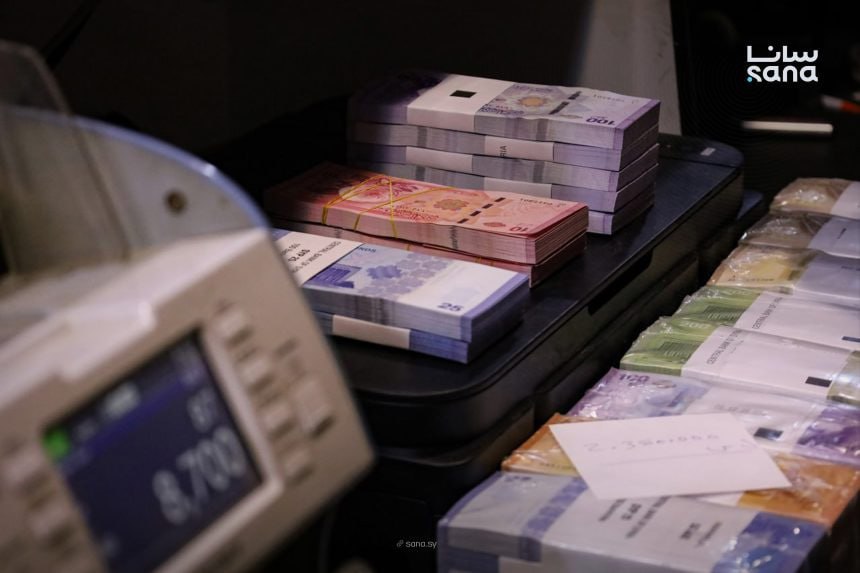
Source: SANA — Currency exchange deadline extended to June 30, 2026
Why the answer moves: what has driven the rate in 2026
A conversion table is a photograph; the exchange rate is a film. In 2026 the film has run at walking pace — no 2020-style cliffs — but it has run consistently in one direction. The new pound launched at 111.00 per dollar in the first week of January 2026, traded through the 120s during spring as the old-note replacement operation ran, and reached 131.20–131.70 by early September.
The drivers are the same ones that move any recovering currency: import demand for reconstruction sucking dollars out of the market, a banking system still rebuilding the correspondent relationships cut by two decades of sanctions (the last major sanctions step — rescission of the State Sponsor of Terrorism designation — came only in late August 2026), and household habits formed by fourteen years of collapse, which favor holding dollars over pounds. None of this is a forecast in either direction; it is simply why a table like this one carries a date and why any answer to "how much is a million pounds" that does not carry a date is not an answer.
For perspective on what "moving" has meant historically: in May–June 2020, the old pound went from about 1,600 to 3,000 per dollar in a matter of weeks, meaning a dollar-denominated sum like $76 flipped from about 1.2 million old pounds to about 2.3 million old pounds within two months. Against that history, the new pound's 2026 journey — 111 at launch to the low 130s by September, a decline measured in single-digit percent per month — is a comparatively calm market. Calm is relative: for anyone holding savings in pounds, even a steady two-to-three percent monthly drift compounds painfully, which is precisely why Syrians price big-ticket items in dollars and settle in pounds.
There is also a structural reason 2026 feels different from every previous year in this story: for the first time in the war era, the currency itself was rebuilt. The old-note replacement — 35 percent by late February, 56 percent by early May, over 63 percent by June 1, and roughly 95 percent by the end of July, per Central Bank figures reported by the state news agency — removed the physical chaos of a money supply denominated in thousands. The arithmetic of daily life is simpler now, and the remaining question — what the rebuilt pound is actually worth — is answered daily by the market table above, not by any institution's decree.
Sources
- Live Damascus market rates (buy/sell/mid, new and old SYP) observed September 2, 2026, via SYPNow — the reference for every figure in the table.
- Wikipedia — Syrian pound: redenomination timeline, launch-week rate (111.00 new SYP, January 5, 2026), and replacement percentages (35% → 56% → 63% → ~95%).
- SANA — Central Bank: 56% of old currency replaced (May 4, 2026)
- SANA — Currency exchange deadline extended to June 30, 2026 (May 1, 2026)
- Our team's old vs new Syrian pound guide and USD to SYP converter guide for the surrounding mechanics.
Frequently asked questions
Is 1 million Syrian pounds a lot of money in 2026?
It depends entirely on the scale and the context. One million new SYP (≈ $7,607 at the time of writing) is a substantial sum by Syrian standards; one million old SYP is just 10,000 new pounds (≈ $76) — pocket money. This ambiguity is exactly why you should never accept or repeat an unlabeled figure.
Why do some websites say a million pounds is worth only about $76?
Because they are correctly converting one million old pounds, or incorrectly applying the old scale to a new-pound amount. Since January 1, 2026, 100 old SYP = 1 new SYP, so 1,000,000 old = 10,000 new ≈ $76, while 1,000,000 new ≈ $7,607. If a figure looks 100 times off from these, the scale — not the math — is the problem.
Which currency pairs can I convert Syrian pounds to?
The market actively quotes the pound against the US dollar, euro, British pound, Turkish lira, Saudi riyal, and UAE dirham (all in the table above), plus a set of regional currencies including the Jordanian dinar, Lebanese pound, Egyptian pound, Kuwaiti dinar, Qatari riyal, Swiss franc, Chinese yuan, Japanese yen, and Russian ruble. Rates outside the big six are quoted less tightly, so compare offers carefully.
Why does my bank's rate differ from the market rate I see online?
Banks price through their own liquidity and may reference official-channel rates, while the online figure is the open market's buy/sell spread. A difference of a few percent is normal; anything larger deserves a second quote. The official vs market rate guide explains the two-rate system in full.
How often does this table change?
The method never changes; the mid moves daily. This table was computed from the September 2, 2026 Damascus market (131.45 new SYP per dollar mid). For today's number, check a live tracker — for example the dollar page on SYPNow, which shows the current buy, sell, mid, and daily change in both scales.
The short version, one more time: a million new pounds is about $7,600; a million old pounds is about $76; and the number is only true for the day you checked it. Keep a live reference in your pocket — our team's app SYPNow shows the Damascus market in both scales with a converter for any amount, free on the App Store and Google Play, with the web version here.